
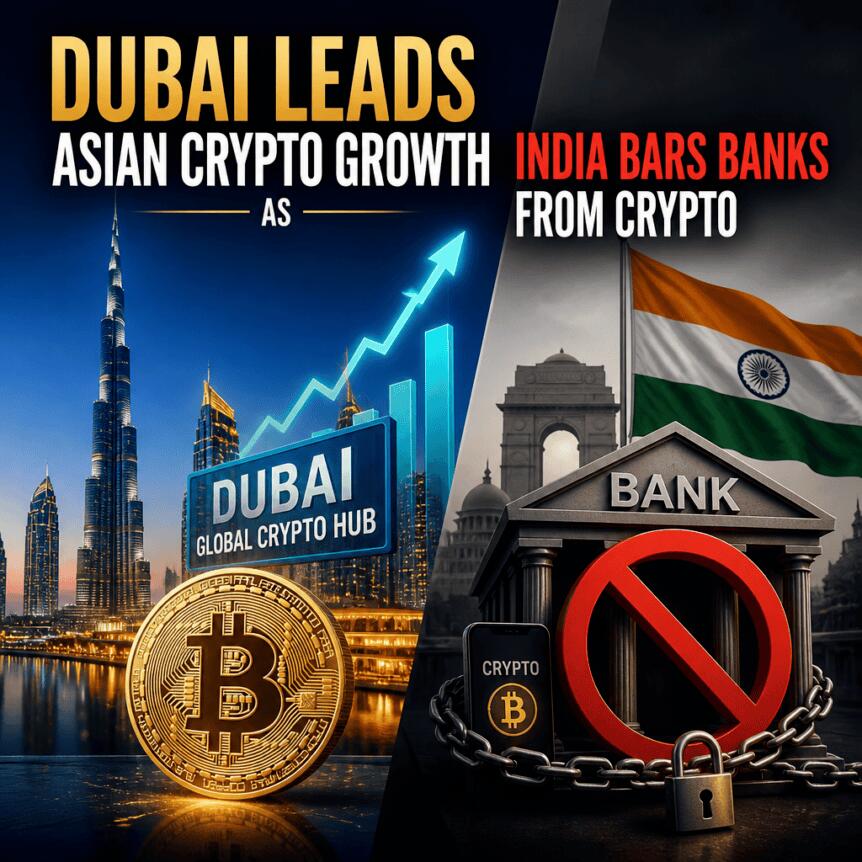
Regulators across Asia and beyond delivered a mixed but telling set of signals this week on how crypto and tokenization may fit into mainstream finance—ranging from calls to quarantine banks from private digital assets to new licensing regimes for stablecoins and virtual-asset services.
Meanwhile, developments in Russia’s central bank digital currency roadmap, US sanctions tied to ISIS-K crypto activity, and corporate Bitcoin treasury moves reinforced a reality traders and institutions can’t ignore: compliance, custody, and token infrastructure are becoming as strategically important as market liquidity.
Key takeaways
- India’s central bank urged lawmakers to keep banks insulated from crypto and private stablecoins, while carving out space for regulated tokenization.
- Russia’s central bank governor said the digital ruble is on track for a Sept. 1 rollout, with initial acceptance limited to financial and credit institutions.
- SBI Crypto will shut down its Bitcoin mining pool after a five-year run, ending share acceptance on July 31.
- The US Treasury’s OFAC sanctioned 134 ISIS-K crypto wallet addresses; Tether froze 131 Tron balances tied to the designations.
- Taiwan’s legislature passed a crypto and stablecoin regulatory framework that requires VASPs to be approved and sets reserve/audit rules for stablecoin issuers.
India: isolate banks from private crypto while enabling regulated tokenization
According to a report by The Economic Times, India’s central bank position—presented to the Parliamentary Standing Committee on Finance—leans toward containment rather than blanket normalization.
The Economic Times reported that RBI Deputy Governor Rohit Jain and Executive Director P. Vasudevan presented the central bank’s stance on Thursday. In a background note submitted to the panel, the RBI reportedly framed prohibition as a policy option that remains on the table.
Per the report, the RBI recommended preventing crypto use in payments and settlements, while restricting banking-sector exposure. The central bank reportedly cautioned that “traditional” regulation applied to crypto could effectively legitimize speculative assets and encourage a false sense of safety among users.
At the same time, the RBI reportedly urged policymakers to distinguish between crypto and tokenized instruments that are already regulated—such as tokenized government securities and corporate bonds—so that restrictions would not unintentionally throttle legitimate tokenization efforts.
Russia: digital ruble rollout reiterated for Sept. 1
Russia’s central bank governor Elvira Nabiullina said the country remains prepared to launch its central bank digital currency within a short timeline. Earlier coverage by Cointelegraph reported that Nabiullina confirmed the rollout plan based on the schedule outlined last year.
According to a Thursday report from Russian state media outlet RIA Novosti, Nabiullina said “everyone is ready” for a Sept. 1 digital ruble launch. The digital ruble is intended to complement Russia’s fiat currency, the ruble, and initially will be accepted by financial and credit institutions.
Russia’s CBDC has also drawn external pressure. The EU has previously announced restrictions tied to sanctions over Russia’s war in Ukraine, including actions aimed at limiting the role of the digital ruble; those measures were highlighted in an April EU press release referenced by the Council of the European Union.
Japan: SBI Crypto ends Bitcoin mining pool operations
SBI Crypto, the cryptocurrency-focused division of Japanese financial group SBI, announced it will end its Bitcoin mining pool operations after five years. Earlier coverage from Cointelegraph noted the shutdown, and the company later confirmed the operational cutoff.
SimpleMining data, cited by Cointelegraph, shows SBI Crypto ranked 12th globally among Bitcoin mining pools at the time of reporting, with about 21.46 EH/s of hashrate and roughly 2.24% of total network share.
According to an announcement on SBI Crypto’s announcements page, the mining pool will stop operating on July 31, and the company will stop accepting mining shares at the same time. SBI Crypto said miners should continue directing hashrate to the pool until the cutoff so that final payouts can be calculated correctly, requesting ongoing support “until the final day of operation.”
US enforcement: OFAC sanctions ISIS-K wallets; Tether freezes Tron-linked balances
The US Treasury’s Office of Foreign Assets Control (OFAC) sanctioned 134 cryptocurrency wallet addresses identified as belonging to ISIS-Khorasan (ISIS-K), according to Cointelegraph.
OFAC added the listed addresses to its Specially Designated Nationals (SDN) list on Wednesday, tightening compliance pressure on exchanges, service providers, and on-chain intermediaries that handle transfers to or from sanctioned entities.
Cointelegraph reported that Tether froze balances associated with 131 Tron addresses, while the remaining three sanctioned addresses were on the Monero network, based on analysis described in a Chainalysis report: “ISIS designation crypto addresses (July 2026)”.
The latest action follows earlier OFAC sanctions against individuals and entities that the agency said facilitated ISIS fundraising and movement of funds. On June 22, OFAC sanctioned three individuals and six entities, including MSB Bitcoin Xchange and Spider, as described in a US Treasury press release: “OFAC sanctions …”.
Treasury and token infrastructure: Metaplanet’s Bitcoin accumulation and tokenized-bonds ambitions
Bitcoin treasury strategies continued to shape headlines as Japanese investment company Metaplanet reported further accumulation. Earlier reporting by Cointelegraph said Metaplanet acquired 2,823 Bitcoin in the second quarter at a purchase price below its average acquisition cost, pushing holdings above 43,000 BTC.
Per Metaplanet’s disclosure referenced by Cointelegraph, the latest purchase was made at an average price of about 12.71 million yen (quoted as $78,850 at the time of reporting), reducing its average acquisition cost to about $95,117 per BTC from $96,258. Metaplanet now holds 43,000 Bitcoin acquired for about $4.1 billion, and it also reported revenue of about $10.95 million from its Bitcoin income-generation strategy, which includes selling cash-secured options and other Bitcoin-related yield approaches. The company’s announcement is where these figures were taken from.
Elsewhere, the policy and infrastructure discussion around tokenization widened beyond crypto asset trading. Speaking at a panel discussion referenced by Cointelegraph, Bank of Korea governor Hyun Song Shin argued for tokenized government bonds as a way to simplify issuance and post-trade management. Shin said tokenized bonds could make it easier to verify collateral, credit the asset provider’s account, and reverse transactions when appropriate.
Cointelegraph also reported that Shin outlined plans to place tokenized government bonds, wholesale central bank digital currencies, and tokenized commercial bank deposits onto a unified ledger as an extension of “Project Hangang,” a Bank of Korea-led pilot testing a blockchain-based wholesale CBDC system. A Cointelegraph link in the source text pointed to additional context on token securities, but the core claims here are Shin’s remarks and the existence of the Hangang initiative.
Dubai and Taiwan: licensing momentum and stablecoin rules tighten
Dubai continued to expand its licensing regime for virtual-asset service providers (VASPs). Cointelegraph reported that the Virtual Assets Regulatory Authority (VARA) granted its 50th VASP license to tokenized assets platform Tribe Tokenisation FZE, with the approval announced on Thursday.
While the milestone highlights growth in the number of licenses, Cointelegraph cautioned that license totals don’t necessarily indicate how many firms are operational or their level of activity. Even so, VARA’s licensed-VASP count, as reported by Cointelegraph, exceeds Hong Kong’s and Singapore’s totals cited in the same coverage (Hong Kong: 13; Singapore: 37).
Taiwan took a different step: lawmakers moved from licensing talk to legal structure. Cointelegraph reported that the Legislative Yuan passed a law establishing a regulatory framework for crypto, including licensing requirements for VASPs and rules for stablecoin issuers.
According to the Financial Supervisory Commission (FSC), cited by Cointelegraph, the law requires VASPs to obtain approval from the regulator to operate. It also states that stablecoins issued in Taiwan must be approved by both the central bank and the FSC, and issuers must maintain sufficient reserves with a trustee and undergo regular audits. Cointelegraph framed the measure as Taiwan’s first comprehensive crypto and stablecoin regulation, placing it alongside regional jurisdictions that have already adopted formal regimes.
Next to watch
As banking regulators debate how to separate traditional financial rails from crypto exposure, and as jurisdictions tighten VASP and stablecoin compliance, market participants should watch for how tokenization policy gets carved out—especially whether “regulated tokenization” expands faster than private crypto activity, and how enforcement actions influence stablecoin and custody behavior.
https://www.cryptobreaking.com/dubai-leads-asian-crypto-growth/?utm_source=blogger%20&utm_medium=social_auto&utm_campaign=Dubai%20Leads%20Asian%20Crypto%20Growth%20as%20India%20Bars%20Banks%20from%20Crypto%20
Comments
Post a Comment