
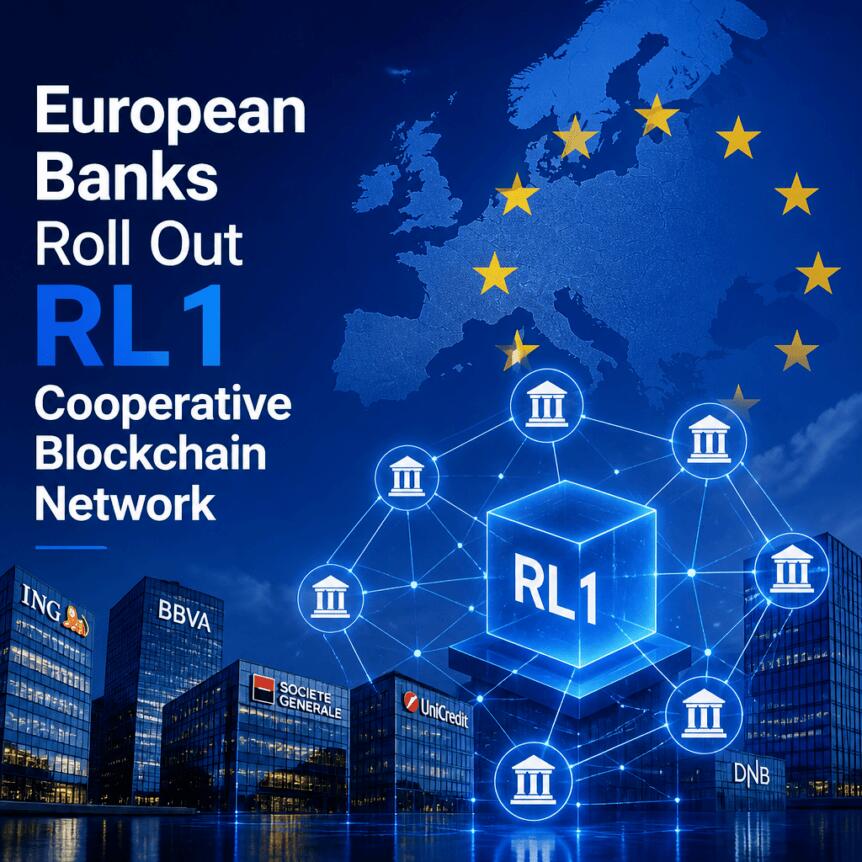
Ten European financial institutions have formed a jointly owned blockchain cooperative called Regulated Layer One (RL1), aiming to provide shared infrastructure for tokenized assets and regulated market workflows. The initiative positions RL1 as a “permissioned” network built for institutional use rather than public, open participation.
RL1 announced that it has been established as a European Cooperative Society in Luxembourg and has started operations with founding members including ABN AMRO, Cecabank, Chartered Investment, Crédit Mutuel Alliance Fédérale, DekaBank, DZ BANK, LBBW, Natixis CIB, SC Ventures, and Seturion. The group says governance is structured so that each member holds equal decision-making rights over the network’s development and direction.
Key takeaways
- RL1 is launching as a European Cooperative Society in Luxembourg, bringing 10 founding financial institutions into a shared, permissioned blockchain network.
- The network is governed on an equal voting basis among members, with plans to expand participation to additional institutions.
- RL1 is built on infrastructure previously developed by German fintech Secure Worldwide Interbank Asset Transfer (SWIAT).
- SWIAT reported processing more than 50 transactions worth over €700 million during three years of production use.
- The cooperative targets regulated institutional use cases such as tokenized bonds, collateral, and settlement for digital money.
From SWIAT infrastructure to a member-owned cooperative
RL1’s launch centers on a shift in ownership from the previously developed SWIAT platform to the cooperative structure. According to RL1, SWIAT has transferred ownership of the network to the cooperative, effectively moving the project from a vendor-led or sponsor-led stage into a jointly controlled model.
That transition matters because institutional blockchain projects often struggle not only with technology, but also with long-term governance, shared standards, and accountability. By placing decision-making in a cooperative framework, RL1 is attempting to reduce the “single-rail” problem—where multiple institutions build or operate separate ledger systems that may not interoperate cleanly.
For its part, RL1 says the permissioned design is intended to fit regulated environments and institutional processes, rather than trying to replicate the accessibility and openness typical of public blockchain networks.
Reported production usage and the scope of institutional applications
RL1 says its underlying platform has already been used in production for three years. SWIAT reported that the system processed more than 50 transactions with a total value exceeding €700 million (about $808 million). While the report does not specify the exact nature of every transaction type, RL1 frames the technology around institutional patterns such as tokenized bonds, collateral, digital money, and blockchain-based settlement.
RL1 also argues that using a shared network could help address fragmentation across financial markets—especially where banks and other institutions deploy distinct distributed ledger systems. In practical terms, fewer separate ledgers can reduce duplicated development, simplify integration efforts, and potentially speed up cross-institution settlement experiments.
Still, investors and builders will likely want to watch whether RL1’s cooperative model translates into measurable interoperability advantages—such as smoother settlement across participating institutions—rather than remaining primarily a governance and pilot-coordination framework.
Governance, leadership, and expansion plans
Leadership for RL1 will be led by former SWIAT managing director Henning Vollbehr, with KfW and L-Bank continuing to provide support for the initiative. RL1 did not detail the precise structure of ongoing involvement from these backers, but their continued support signals that the project retains institutional and policy-level sponsorship beyond the initial founding members.
On expansion, RL1 said it is already in discussions with additional institutions, including NatWest, about joining the network. The cooperative’s equal decision-making rights among members may become a central factor in future growth: as more institutions join, governance will need to scale without diluting consensus or slowing development.
The network’s success will likely depend on attracting participants with complementary use cases—such as custody, issuance, market settlement, and collateral management—while ensuring that shared standards hold up as the number of stakeholders increases.
Why RL1’s cooperative model could matter for tokenized markets
Tokenization in traditional finance has progressed in bursts, often driven by pilots and consortia, but scaling remains difficult when participants operate on disconnected infrastructures. RL1’s emphasis on reducing fragmentation directly targets one of the sector’s recurring friction points.
At the same time, it’s important to recognize that RL1 is permissioned, meaning access and participation are restricted relative to public networks. That tradeoff can be beneficial for compliance and integration in regulated markets, but it also raises questions about interoperability with other ledgers and token ecosystems—particularly if tokenized assets are expected to move across platforms over time.
For market participants, the key watch item is whether RL1 evolves from “shared infrastructure” into a platform with demonstrable deployment outcomes—such as repeatable settlement flows, standardized token mechanics, and smoother inter-institution operations—rather than limited transaction counts typical of early-stage pilots.
As RL1 begins operations in Luxembourg, the next signals to monitor will be how quickly additional institutions join, what concrete tokenization and settlement workflows are prioritized, and whether the cooperative’s shared governance model leads to faster, more scalable execution compared with earlier, siloed distributed ledger efforts.
https://www.cryptobreaking.com/european-banks-roll-out-rl1-2/?utm_source=blogger%20&utm_medium=social_auto&utm_campaign=European%20Banks%20Roll%20Out%20RL1%20Cooperative%20Blockchain%20Network%20
Comments
Post a Comment