
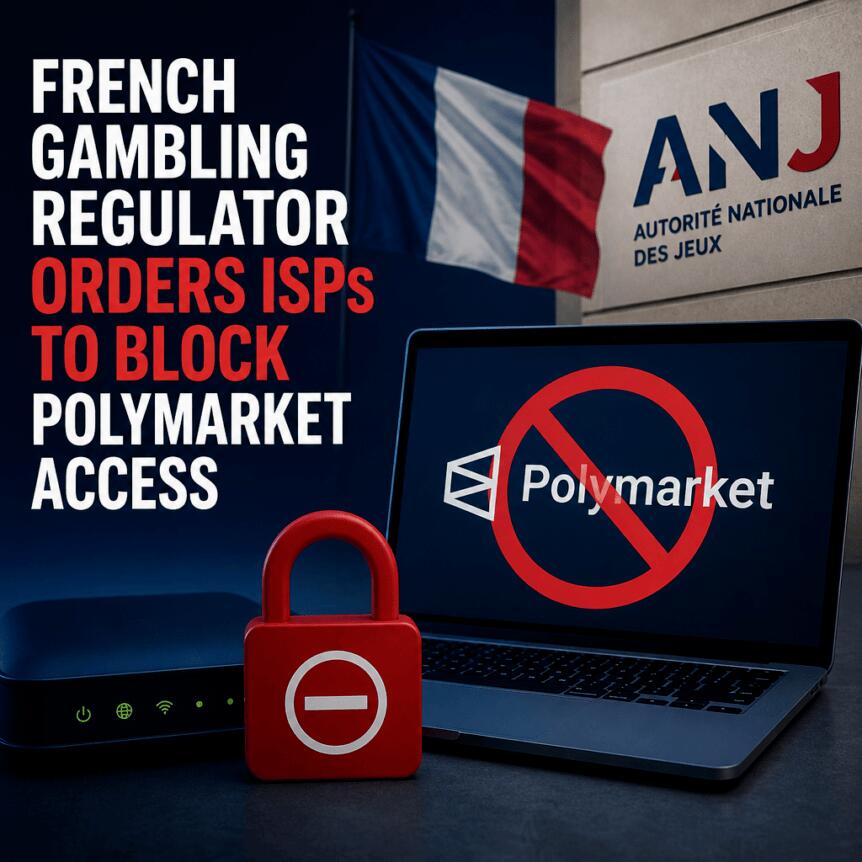
France’s national gambling regulator has ordered internet service providers to block access to Polymarket, arguing that the platform operates like illegal gambling in the country. The Autorité nationale des jeux (ANJ) said Polymarket’s services are not authorized in France and warned that promoting unapproved gambling sites can trigger criminal penalties.
The move underscores how prediction and “event contract” platforms continue to run into regulatory friction across Europe and beyond—particularly over whether these products should be treated as gambling, unlicensed financial instruments, or something else entirely.
Key takeaways
- The ANJ directed French ISPs to block Polymarket, saying its prediction contracts amount to illegal gambling under French law.
- The regulator cited “addictive” mechanics and the absence of protective safeguards common in regulated gambling markets.
- ANJ also pointed to concerns that certain outcomes could be manipulated, including references to hacked weather sensors.
- France joins a growing list of jurisdictions that have restricted Polymarket access.
France orders ISP-level blocks
In a Friday press release, France’s Autorité nationale des jeux (ANJ) said it considers online prediction platforms to be illegal gambling when they are not authorized through the regulated framework. Based on that determination, the regulator ordered internet service providers to block access to Polymarket.
The ANJ stated that Polymarket’s operations are not authorized in France. It also highlighted that advertising gambling services without authorization is a criminal offense, with fines that may reach 100,000 euros (about $114,000), according to the regulator.
For investors, traders, and users, the practical impact is straightforward: even if markets can still be accessed through other means, ISP-level blocking raises friction, reduces discoverability, and increases the likelihood that marketing and distribution channels are disrupted inside the country.
Regulatory concerns: missing safeguards and possible manipulation
Beyond the authorization question, ANJ argued that Polymarket’s user experience resembles regulated gambling offerings, but without the protective mechanisms found in the legal market. The regulator described the platform as having features that can be “addictive,” while emphasizing that France’s authorized gambling environment includes safeguards that are not present on Polymarket.
ANJ further said some event contracts raised manipulation risks. In particular, the regulator referenced cases suggesting bets may have been “rigged,” including weather-related markets where weather sensors allegedly could have been hacked.
“Some of the bets offered on this platform appeared to be rigged: for example, bets on the weather revealed that weather sensors may have been hacked.”
The regulator linked the concerns to findings tied to an investigation by the cybercrime unit of the Paris Public Prosecutor’s Office, which reportedly began in May 2026. ANJ also said investigators identified a lack of identity verification measures, such as Know Your Customer (KYC) checks.
That combination—gamification-style incentives plus weak identity controls plus questions about how external data is validated—has become a recurring theme in regulators’ critique of online prediction products. If identity and data integrity remain unresolved, platforms face higher odds of being treated as gambling rather than as a form of regulated markets activity.
France follows a broader crackdown pattern
France is not alone. According to the article being rewritten, multiple countries have already moved to block or restrict access to Polymarket, including Singapore, Poland, Portugal, Hungary, Ukraine, Brazil, and Indonesia.
At the time of writing, Polymarket indicated it had implemented geoblocking in 36 regions, pointing to the reality that regulatory compliance often arrives as region-by-region access controls. Still, an ISP block order like the one announced by France changes the enforcement posture: instead of relying only on platform-side geofencing, the regulator targets the local internet access layer.
France’s action also fits with its earlier warning signals. The ANJ previously shared plans to block Polymarket in November 2024, citing failures to comply with French gambling rules. The new ISP order therefore represents a formal escalation from planning to execution.
Global pressure from US regulators
Regulatory scrutiny around prediction market platforms is not limited to Europe. In the United States, multiple legal challenges have centered on whether these platforms operate as unlicensed sports betting, and whether states can regulate them without conflicting with federal authority over certain event contracts.
According to earlier coverage referenced in the source material, on June 17 Kentucky sued five prediction market platforms—including Kalshi and Polymarket—arguing they were operating unlicensed sports betting. The same reporting states that at least 17 other states joined similar actions.
The source also notes that the Commodity Futures Trading Commission (CFTC) sued eight states, arguing they interfered with the agency’s exclusive authority over federally regulated event contracts. Taken together, these US developments show a fragmented regulatory landscape where platforms can face lawsuits on both sides of the jurisdiction question: whether they should be classified as gambling/sports betting under state frameworks, or as instruments governed by federal commodities and derivatives rules.
For readers trying to gauge what comes next, the key variable is classification—how regulators decide whether prediction contracts are gambling products requiring licensing, or market instruments subject to a different compliance regime. France’s ANJ decision makes one side of that argument explicit.
As France moves to block Polymarket at the ISP level, market participants should watch for how Polymarket responds in practice—whether it can modify compliance to address authorization, identity verification, and data integrity concerns—and whether other European regulators follow France’s lead with similar enforcement steps.
https://www.cryptobreaking.com/french-gambling-regulator-orders-isps/?utm_source=blogger%20&utm_medium=social_auto&utm_campaign=French%20Gambling%20Regulator%20Orders%20ISPs%20to%20Block%20Polymarket%20Access%20
Comments
Post a Comment