
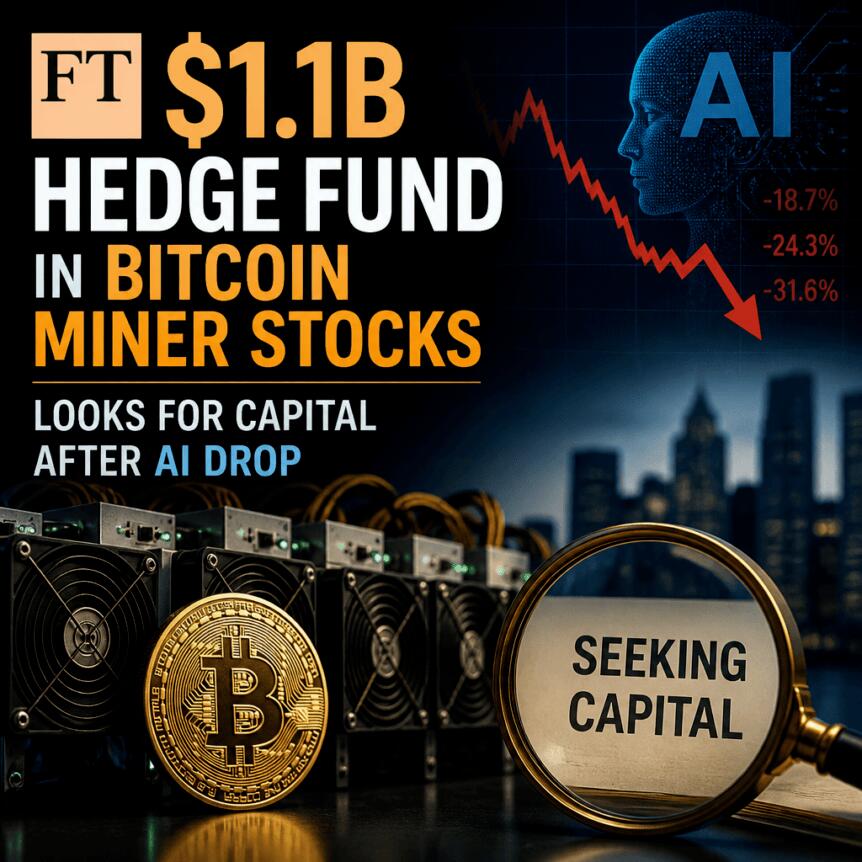
Hedge fund Situational Awareness, founded in 2024 by former OpenAI researcher Leopold Aschenbrenner, is reportedly seeking new funding after taking substantial losses during a recent sell-off in artificial intelligence stocks. The Financial Times said the firm has approached investors and lenders for additional capital, and in some cases has offered investors the chance to buy assets from its portfolio.
The fund—tied to a strategy centered on the infrastructure underpinning AI—was reported by the Wall Street Journal to manage roughly $20 billion in assets under management as of June 8. However, the FT reported that the scale of losses and the amount of capital being sought were not disclosed in the discussions it reviewed, which included a July 24 investor letter.
Key takeaways
- Situational Awareness is reportedly raising fresh capital after losses tied to the July sell-off in AI-related equities.
- According to the Financial Times, borrowing amplified the impact of the downturn on the fund’s leveraged positions.
- The fund’s reported AI-infrastructure focus includes trades connected to data centers and power, with past disclosures referencing stakes in Bitcoin mining firms.
- In addition to seeking funding, the firm has reportedly offered some investors the option to purchase portfolio assets.
Why the AI sell-off became a funding story
The immediate catalyst for Situational Awareness’s capital push appears to be the market turbulence that hit AI stock momentum in July. The FT linked the losses to the broader “AI stock collapse” during that rout and emphasized that the fund’s risk profile was made more severe by increased borrowing.
While the FT did not provide a dollar figure for losses or the size of the capital requirement, it reported that Aschenbrenner’s fund had gained 439% after fees through June, as described in the July 24 investor letter. The same letter suggests that strong earlier performance did not prevent a rapid drawdown once AI equities sold off—particularly because leverage can magnify both gains and losses.
That leverage detail matters to investors because it helps explain how a thematic equity thesis—AI infrastructure—can still unravel quickly when valuation compression and liquidity pressures hit the complex simultaneously. The situation also reflects a recurring pattern in crowded “platform” trades: when the market reprices the expected earnings power of AI beneficiaries, funds exposed to those segments may require external capital to stabilize their balance sheets.
What Situational Awareness is betting on
Situational Awareness’s strategy has been described as focused on the physical backbone of AI: the power generation, data centers, and related infrastructure that enable compute-heavy systems. In earlier reporting, Cointelegraph noted that the fund made a notable bet around that infrastructure theme, including investments connected to Bitcoin miners pivoting into AI computing.
Cointelegraph previously pointed to a March filing with the U.S. Securities and Exchange Commission that showed approximately $1.11 billion in positions across seven Bitcoin miner stocks. The stocks cited in that disclosure included IREN, Core Scientific, Riot Platforms, and CleanSpark, among others.
That matters in the current context because it ties the fund’s AI infrastructure thesis to a sector that has its own cycle of operational risk, capital intensity, and market sensitivity. Even if the longer-term narrative is about compute supply, short-term market swings can still create liquidity and valuation pressures for holders of infrastructure-linked equities.
Investors were also offered a chance to buy assets
The Financial Times reported that the fund’s efforts have not been limited to classic fundraising. It said Situational Awareness has offered some investors the option to buy portfolio assets—an approach that can be used when a manager wants to reduce exposure or improve liquidity without immediately selling positions into a weak market.
According to the FT, the account relied on people briefed on the discussions. The report also cited the fund’s July 24 investor letter while noting that the specific amounts involved were not disclosed publicly.
For investors, asset-purchase offers can create a different decision set than a capital raise. Instead of simply assessing whether to contribute more cash, counterparties may need to evaluate the underlying securities at a point in time when market prices may reflect fear or forced selling. That dynamic can produce opportunities for investors willing to underwrite longer-term fundamentals, but it also introduces questions about what happens next if market conditions remain unsettled.
Aschenbrenner’s AGI expectations and the timing
Beyond the immediate funding pressure, the broader storyline includes how closely the fund’s emergence aligned with Aschenbrenner’s public discussion of artificial general intelligence. Cointelegraph previously reported that he authored a series of essays on artificial general intelligence in mid-2024, around the time he launched Situational Awareness, discussing how he believed AGI machines could outpace college graduates by the end of the decade.
Those views help frame why the fund may have been positioned for a sustained build-out of AI-related infrastructure rather than a short-term trade. Yet the funding request underscores an important asymmetry: even a conviction-driven infrastructure thesis can still be pressured by market mechanics—especially when leverage is used to scale returns.
As of publication, Cointelegraph said it contacted Situational Awareness for comment and had not received a response.
What to watch next
Investors watching this situation should focus on two things: whether Situational Awareness secures the capital it seeks without further destabilizing its leveraged positions, and how any asset-buyback offers to investors are priced relative to the market’s ongoing repricing of AI-exposed equities. The next reports—particularly any updates that clarify the scale of losses, borrowing, and proposed restructuring—will determine whether this becomes a one-off liquidity event or a longer process of portfolio adjustment.
https://www.cryptobreaking.com/ft-1-1b-hedge-fund/?utm_source=blogger%20&utm_medium=social_auto&utm_campaign=FT:%20$1.1B%20Hedge%20Fund%20in%20Bitcoin%20Miner%20Stocks%20Looks%20for%20Capital%20After%20AI%20Drop%20
Comments
Post a Comment