
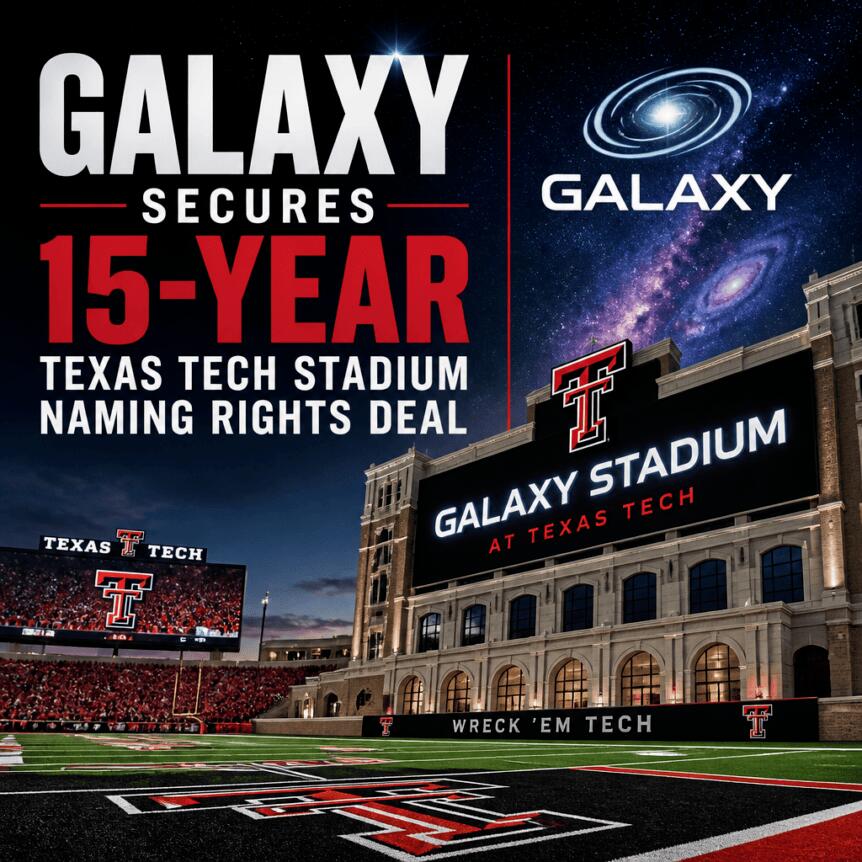
Galaxy Digital has secured a 15-year naming rights agreement with Texas Tech University, with the school announcing that its football stadium will be renamed Galaxy Stadium starting in the 2026 season. The partnership is also designed to extend beyond branding, positioning Galaxy as an official partner for data center services and digital assets within Texas Tech Athletics.
According to the announcement, the venue will debut under its new name on Sept. 5, when Texas Tech opens its season against Abilene Christian. Financial terms were not disclosed.
Key takeaways
- Texas Tech Stadium will be renamed Galaxy Stadium for the 2026 season, starting Sept. 5.
- Galaxy will serve as the university’s official data center and digital assets partner for athletics.
- The agreement aims to cover AI initiatives, student-athlete name, image and likeness opportunities, and workforce development.
- The deal reinforces Galaxy’s presence in West Texas, where it operates the Helios data center campus.
- The announcement lands as Texas continues expanding its crypto footprint through both infrastructure investment and pro-crypto policy.
What Galaxy’s Texas Tech deal actually covers
Galaxy Digital’s agreement with Texas Tech includes a combination of commercial branding and operational collaboration. Beyond the naming rights, the company will be the official provider for data center services and digital assets related to Texas Tech Athletics.
The partners said they plan to work together on student-athlete name, image and likeness (NIL) opportunities, alongside artificial intelligence initiatives and workforce development programs. While details of the programs were not expanded in the announcement, the scope signals a broader strategy: using university athletics as a platform for workforce and technology-oriented partnerships tied to digital infrastructure.
For Galaxy, it also creates a high-visibility link between its infrastructure footprint and a major institutional brand, while for Texas Tech it offers a clear pathway to connect compute and digital-asset expertise to campus programs that can support both athletic and career development goals.
Helios in West Texas: the infrastructure underpinning the partnership
The Texas Tech announcement also ties back to Galaxy’s existing operations in the region. The company operates the Helios data center campus in nearby Dickens County, approximately 60 miles east of Lubbock.
Galaxy stated that Helios has 1.6 gigawatts of approved capacity for artificial intelligence and high-performance computing (HPC). That capacity is a key reason deals like this matter to crypto and AI-focused investors: it shows how digital asset infrastructure providers are increasingly positioned at the intersection of compute-heavy applications—often driven by AI—and blockchain-adjacent digital services.
At the same time, it remains to be seen how much of Helios’ capacity will be directed toward specific Texas Tech initiatives, or whether the partnership will focus primarily on student and athletics-facing programs rather than direct compute allocation. Readers should watch for follow-on details as the 2026 season approaches.
Texas continues building a pro-crypto ecosystem
Galaxy’s university deal comes as Texas continues to strengthen its role in the crypto industry—combining large-scale mining and digital infrastructure investment with political momentum and pro-crypto state policy.
Texas is already home to several of the industry’s notable Bitcoin mining and infrastructure operators, including Riot Platforms, Cipher Mining, Core Scientific, CleanSpark, IREN and Hut 8.
Recent months have also featured major infrastructure moves and corporate activity. In February, Bitcoin mining hardware maker Canaan acquired a 49% stake in three operating Texas mining facilities from Cipher Mining for nearly $40 million. Earlier this month, MARA Holdings announced plans to acquire a 2-gigawatt powered Texas site aimed at building a digital infrastructure campus supporting both HPC and Bitcoin mining.
Policy tailwinds: spending, legislation, and reserve custody
Beyond infrastructure, Texas has also drawn attention for crypto-related political activity. In May, industry-affiliated political action committees spent more than $10 million supporting candidates in Texas congressional primary runoffs, with all six backed candidates winning, according to coverage cited in the announcement.
The state has also backed the industry through public policy. Last year, Gov. Greg Abbott signed legislation creating the Texas Strategic Bitcoin Reserve, a move tied to Texas Senate Bill 21. In May, state officials began transitioning the reserve’s holdings from a spot Bitcoin ETF to directly custodied bitcoin.
Taken together, the pattern suggests Texas is reinforcing crypto with both hardware and compute build-outs and policy frameworks that are intended to make digital assets easier to integrate into state-level plans. Galaxy’s partnership with a major public university fits the broader theme: moving from energy and compute deployment into education, workforce development, and institution-facing adoption.
As the 2026 season approaches, the most important question for stakeholders is how quickly this kind of university partnership translates into measurable outcomes—whether through concrete NIL-related programs, AI or workforce initiatives with defined participation, or operational use cases tied to Galaxy’s Helios capacity. With Texas continuing to attract capital and policy support, the next signal to watch will be what practical projects emerge from the agreement once it begins naming the stadium.
https://www.cryptobreaking.com/galaxy-secures-15-year-texas/?utm_source=blogger%20&utm_medium=social_auto&utm_campaign=Galaxy%20Secures%2015-Year%20Texas%20Tech%20Stadium%20Naming%20Rights%20Deal%20
Comments
Post a Comment