
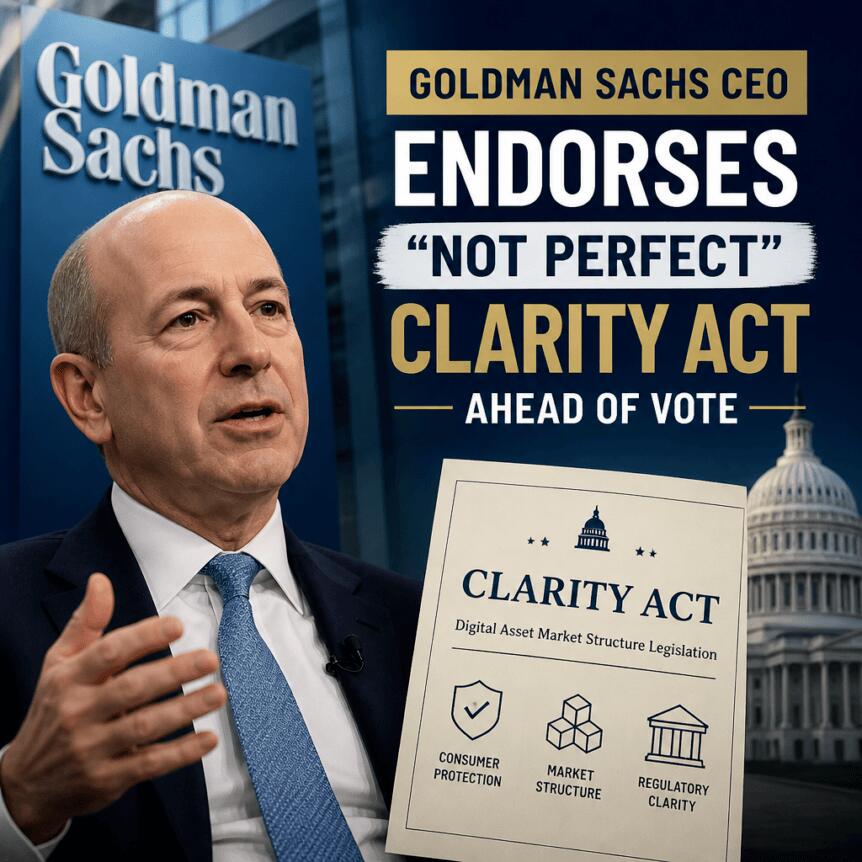
Goldman Sachs CEO David Solomon has voiced support for a US Senate bill intended to reshape crypto market structure, arguing that the proposed Digital Asset Market Clarity (CLARITY) Act is “not perfect” but could help create a more consistent framework for participants.
According to a Thursday report by Politico, Solomon framed the legislation as necessary to establish a “level playing field” that could improve market stability as digital asset markets continue to develop.
Key takeaways
- David Solomon says the CLARITY Act is “not perfect,” but supports it for creating a more “level playing field” to bolster stability.
- Many industry leaders oppose the bill’s approach, including concerns that it would allow certain crypto firms to pay yield related to stablecoins outside existing financial-institution rules.
- Republicans released the CLARITY Act text ahead of a potential Senate vote, but Senate leaders had not scheduled timing as of Thursday.
- Democrats and critics highlighted ethics provisions, with objections centered on enforcement and accountability mechanisms.
- The bill likely requires additional Democratic votes to reach the Senate’s 60-vote threshold.
Solomon’s “level playing field” argument
In comments reported by Politico, Solomon emphasized that legislation is rarely flawless, but maintained that CLARITY’s central purpose is to normalize how digital asset markets operate—at least relative to how traditional finance is regulated.
His view stands in contrast to broader skepticism within parts of traditional banking circles, where executives have questioned whether CLARITY expands regulatory permission in ways that could weaken investor and depositor protections.
Politico’s report also notes that Solomon’s endorsement is relatively uncommon among leaders at major financial institutions considering the bill.
Banking concerns over stablecoin yield permissions
A key point of contention involves whether crypto firms would be allowed to offer interest or yield on stablecoins under rules that critics say do not map cleanly to the protections expected of regulated financial institutions.
Earlier coverage highlighted that many peers oppose the bill on these grounds, arguing that the proposal’s stablecoin yield approach does not provide the guardrails banks would be expected to meet. Cointelegraph previously reported on these concerns.
The contrast in views is also reflected in remarks from JPMorgan Chase chief Jamie Dimon. As reported in an interview conducted in May, Dimon said CLARITY would let crypto companies pay interest on stablecoins “without the protection that they should have,” arguing that banks would not accept a similar arrangement. The interview was shared on YouTube.
Democrats focus on ethics provisions and enforcement
Even as the CLARITY Act moves toward a possible Senate vote, Democratic lawmakers have signaled resistance—not only on technical market-structure issues, but also on ethics language attached to the bill.
As described in reporting from Cointelegraph and subsequent commentary, Democrats are concerned that the ethics provisions do not go far enough and that enforcement would be left to the US Department of Justice rather than state authorities. If Republicans are unable to secure enough support beyond their ranks, the bill could stall at the 60-vote threshold required to advance in the Senate.
Senator Elizabeth Warren, a leading Democratic critic, said in a statement released alongside the Wednesday publication of the bill text that she believes the legislation is designed to protect President Donald Trump’s crypto profits and that it fails to adequately safeguard investors, the financial system, and national security. The statement was posted by the Senate Banking Committee’s minority.
Cointelegraph earlier also reported on Democrats’ objections to the ethics language during the markup process, underscoring how these provisions have become a central political obstacle for CLARITY. Earlier coverage details the core Democratic concerns.
What happens next in the Senate
Republicans released the full CLARITY Act text on Wednesday, setting the stage for potential Senate action. However, as of Thursday, Senate leaders had not scheduled a vote, according to the Politico report.
With multiple factions still divided—particularly over stablecoin yield permissions and ethics/enforcement mechanics—the immediate question for investors and market operators is whether amendments can narrow the gap between competing priorities or whether the bill will face a larger momentum reversal.
Readers should watch for whether Senate leaders set a vote date soon and, more importantly, whether any compromise emerges that could attract enough Democratic support to meet the 60-vote threshold—since the bill’s advancement appears tightly linked to both ethics politics and the future regulatory treatment of stablecoin-related yield.
https://www.cryptobreaking.com/goldman-sachs-ceo-endorses-not/?utm_source=blogger%20&utm_medium=social_auto&utm_campaign=Goldman%20Sachs%20CEO%20Endorses%20“Not%20Perfect”%20CLARITY%20Act%20Ahead%20of%20Vote%20
Comments
Post a Comment