
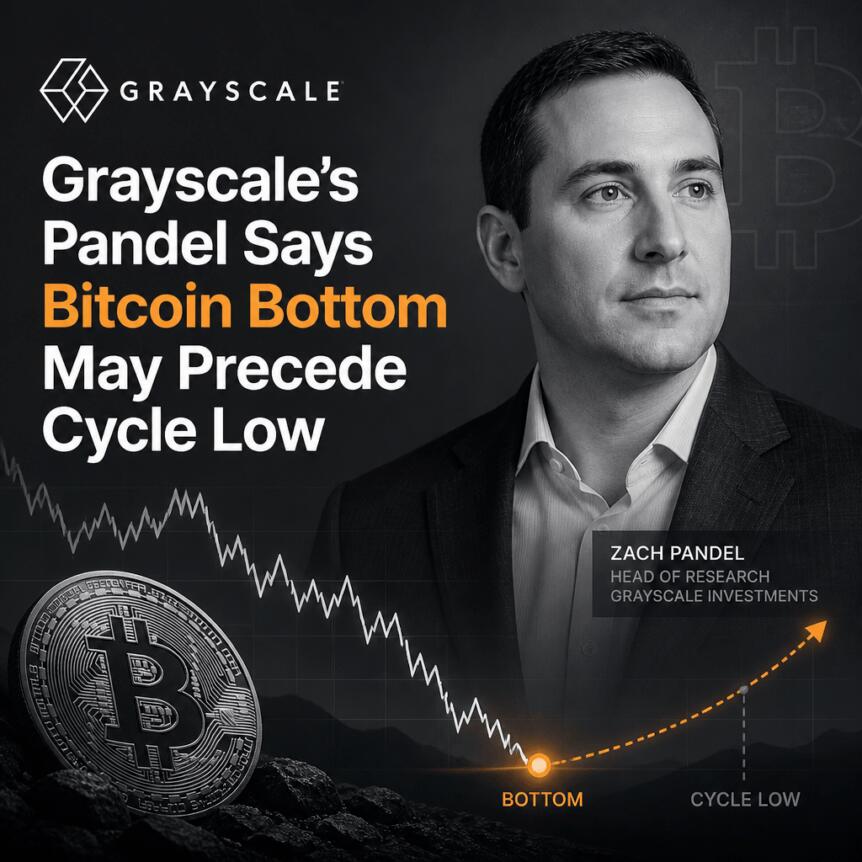
Grayscale is challenging a key assumption many traders use to frame Bitcoin’s price cycle: the idea that bottoms reliably line up with the traditional four-year, halving-driven rhythm. In a Wednesday research note, the firm’s head of research, Zach Pandl, suggested that Bitcoin may have already found a floor—potentially pointing to a cycle low as early as September or October—if upcoming macro conditions remain supportive.
Pandl’s argument centers on Bitcoin’s increasing sensitivity to broader economic variables. Rather than treating the halving cycle as the dominant force, Grayscale says macro factors—especially Federal Reserve policy—may be doing the heavy lifting for price direction right now.
Key takeaways
- Grayscale says Bitcoin’s cycle low could arrive earlier than the historical four-year pattern, with September or October cited as a potential window.
- Zach Pandl argues Bitcoin is increasingly “macro-driven,” implying that rate expectations may determine when price bottoms.
- CME FedWatch data at the time of Grayscale’s note showed markets pricing about a 66% chance the Fed holds rates on July 29, down from 88% a week earlier.
- Despite the macro thesis, Grayscale warns regulation could still cap recovery momentum, particularly if the CLARITY Act fails to pass this year.
- Other analysts still expect a later bottom, including a view that a trough may not appear until October–December 2026.
Why Grayscale thinks the cycle floor may be sooner
Grayscale’s framing departs from the more rigid “four-year cycle” approach. In the firm’s report, Pandl wrote that if the Federal Reserve “forgoes rate hikes” and economic growth remains resilient, Bitcoin “may already have bottomed.” That would imply the cycle low could come earlier than some models anticipate, potentially in September or October.
This matters for investors because it changes how risk is likely to be assessed around typical cycle milestones. If macro conditions are now the primary driver, historical calendar-based expectations may be less reliable—making forward-looking indicators (like real rates and central bank guidance) more important than fixed cycle timing.
The Fed’s meeting and shifting rate odds
A central element of Grayscale’s view is that the Fed remains the most actionable near-term variable for Bitcoin. Pandl said macro factors place Bitcoin in the “driver’s seat,” adding that Bitcoin could “bottom when these macro factors turn around.”
The next scheduled rate decision cited in Grayscale’s discussion is due on July 29. According to CME Group’s FedWatch tool referenced by Grayscale, market participants were pricing in a 66% chance the Fed will hold interest rates unchanged—down from 88% a week earlier. The change highlights how quickly expectations for policy path can evolve, and why Grayscale sees macro shifts as central to the timing of a market bottom.
Grayscale also connected prior Bitcoin bear markets to periods of slowing economic growth alongside rising real interest rates. In that framework, the direction of real rates—more than nominal liquidity narratives—has historically aligned with whether downside pressure persisted or eased.
Regulatory uncertainty remains a drag on upside
Even if macro conditions improve, Grayscale cautioned that policy risk could still limit how far Bitcoin can recover. In a June 26 Grayscale report titled “Two scenarios for the Bitcoin bear market,” Pandl argued that regulatory uncertainty may force continued “deleverage” among certain crypto treasury-related entities.
Specifically, Grayscale suggested that if the CLARITY Act does not pass this year, Strategy and other treasury companies may continue to reduce leverage, a process that could lead Bitcoin to “fall moderately further.”
This point is important because it introduces a potential mismatch: macro might be stabilizing, but balance-sheet pressure within parts of the crypto market could still weigh on prices. For market participants, the takeaway is that “macro-driven” doesn’t automatically mean “macro-only”—regulatory outcomes can influence liquidity and forced selling dynamics even when economic data looks better.
Competing views on how late the bottom could be
Grayscale’s earlier-bottom thesis is not universally shared. Earlier this year, crypto analysts pointed to market structure and long-term investor behavior as signals that a bottom could be approaching sooner rather than later. For example, K33 had argued that Bitcoin’s supply held at a loss could signal cycle timing, noting that historically Bitcoin has tended to bottom weeks after more than half of supply moved underwater. Separately, Swan Bitcoin CEO Cory Klippsten told Cointelegraph in a June interview that record long-term holdings—reaching an all-time high of 14.7 million Bitcoin—could indicate an imminent bottom.
Still, other analysts have suggested that the trough may not arrive until later. Lebit Mining Pool founder Jiang Zhuoer predicted that Bitcoin’s bottom could fall between October and December 2026—roughly six months after Strategy’s Multiple to Net Asset Value (mNAV) indicated its cycle low.
That contrast underscores a broader uncertainty for traders and portfolio managers: different approaches—cycle timing, macro signals, supply-at-loss statistics, or balance-sheet metrics—can point to different windows. The question for readers is not only whether Bitcoin bottoms, but whether the market is responding to the same underlying regime shift that each model assumes.
What to watch next
With the Fed decision on July 29 in focus and regulatory developments still capable of influencing deleveraging pressure, investors should track both macro indicators (especially real-rate expectations) and any signs that the CLARITY Act timeline or related market balance-sheet activity is changing. Grayscale’s thesis hinges on “macro turning around,” but whether that translates into a durable cycle low may depend on policy risk and crypto-specific liquidity conditions as much as on economics.
https://www.cryptobreaking.com/grayscales-pandel-says-bitcoin-bottom/?utm_source=blogger%20&utm_medium=social_auto&utm_campaign=Grayscale’s%20Pandel%20Says%20Bitcoin%20Bottom%20May%20Precede%20Cycle%20Low%20
Comments
Post a Comment