
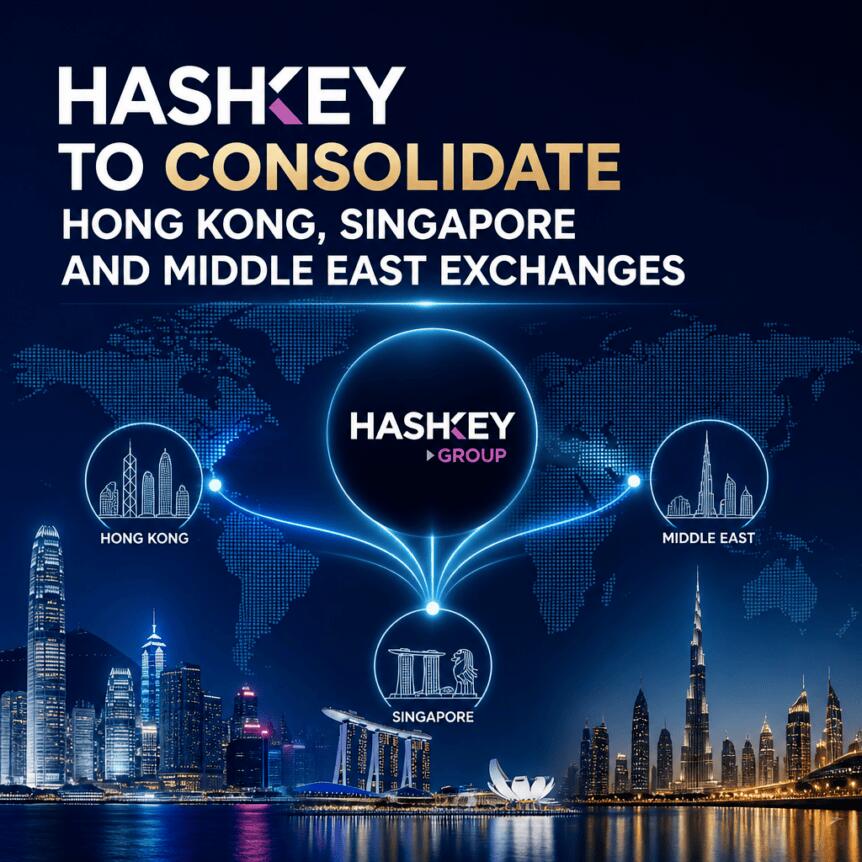
HashKey Holdings says it has consolidated its crypto exchange operations into a single platform and application, aiming to give customers one seamless entry point while keeping regulatory compliance tailored to local jurisdictions.
In a Monday announcement, the Hong Kong-based digital asset services firm said it has merged its HashKey Exchange and HashKey Global businesses. The change brings core hubs—including Hong Kong, Singapore, the Middle East (Dubai), and Bermuda—under one platform experience.
Key takeaways
- HashKey is unifying separate exchange branches into one platform and one app for multiple regions.
- The company says it will use a “unified entry, localized compliance” model rather than region-by-region front ends.
- Customers across Hong Kong, Global, Singapore, and Dubai/Bermuda should download the same application.
- Compliance and controls are described as being managed based on each user’s legislative domain.
- The approach aligns with broader industry moves toward shared user interfaces over fragmented legal structures.
One app, multiple legal environments
HashKey’s stated goal is to reduce friction for users who would otherwise need to navigate different exchange offerings depending on where they operate. The company said the rollout follows a “unified entry, localized compliance” principle: the platform experience is meant to be consistent for end users, while compliance is handled according to the applicable regulatory framework for each jurisdiction.
Practically, HashKey says users in Hong Kong, Global, Singapore, or the Middle East can download the same application. From there, the platform would manage compliance across each user’s specific legislative domain—supporting the firm’s claim that the single front end can still remain aligned with local rules.
HashKey framed the move as a shift away from the early-era virtual asset industry pattern, when licensed exchanges often maintained siloed regional models to simplify compliance at the time.
How HashKey’s model compares with other exchanges
HashKey’s consolidation mirrors a trend visible in other major platforms: presenting a single consumer interface while distributing legal responsibilities across multiple entities behind the scenes.
For example, the company pointed to market precedents such as OKX, which markets its website and mobile apps as one platform. However, OKX’s terms historically allocate customers to different providers based on residence. In that setup, the outward experience is unified, but the legal backend remains fragmented across regions.
Similarly, HashKey referenced Kraken’s approach in Europe. Kraken previously consolidated its Dutch broker BCM into its platform following an acquisition in September 2024, and later began serving the European Economic Area through its Irish MiCA entity as part of a unified regulatory framework described in its own updates.
While HashKey’s announcement focused on front-end unification and localized compliance management, the comparisons underline a recurring industry reality: even when users see one platform, regulatory coverage often still depends on separate entity structures by region.
Why the consolidation matters for users and operators
For traders and other market participants, a single platform experience can reduce confusion—especially for users who operate across multiple regions or relocate. It can also streamline onboarding workflows by limiting differences in user interfaces, login flows, and product access that often vary between regional exchange branches.
From an operator standpoint, unifying applications can simplify support, infrastructure choices, and product delivery. Rather than maintaining parallel front ends and workflows for each jurisdiction, the firm can focus on one user experience and then apply compliance controls based on user location or jurisdictional classification.
Still, HashKey’s announcement also highlights a key tension in exchange consolidation: customer-facing simplicity does not necessarily mean one set of rules. The “localized compliance” framing suggests that while the application is shared, users may be governed by different legal and compliance arrangements depending on where they fall within HashKey’s described jurisdictional domains.
What to watch next after HashKey’s rollout
As HashKey moves to the unified platform, users should pay close attention to how access, account requirements, and compliance checks behave in each jurisdiction—particularly whether the transition changes onboarding steps or documentation expectations for customers in Hong Kong, Singapore, or the Middle East.
For the broader market, the move signals that exchange operators are continuing to modernize the customer layer of their businesses, even while regulatory requirements remain inherently local. The next phase to monitor will be how smoothly the migration completes across all described regions and whether HashKey expands the approach to additional products or services tied to licensing constraints.
https://www.cryptobreaking.com/hashkey-to-consolidate-hong-kong/?utm_source=blogger%20&utm_medium=social_auto&utm_campaign=HashKey%20to%20Consolidate%20Hong%20Kong,%20Singapore%20and%20Middle%20East%20Exchanges%20
Comments
Post a Comment