
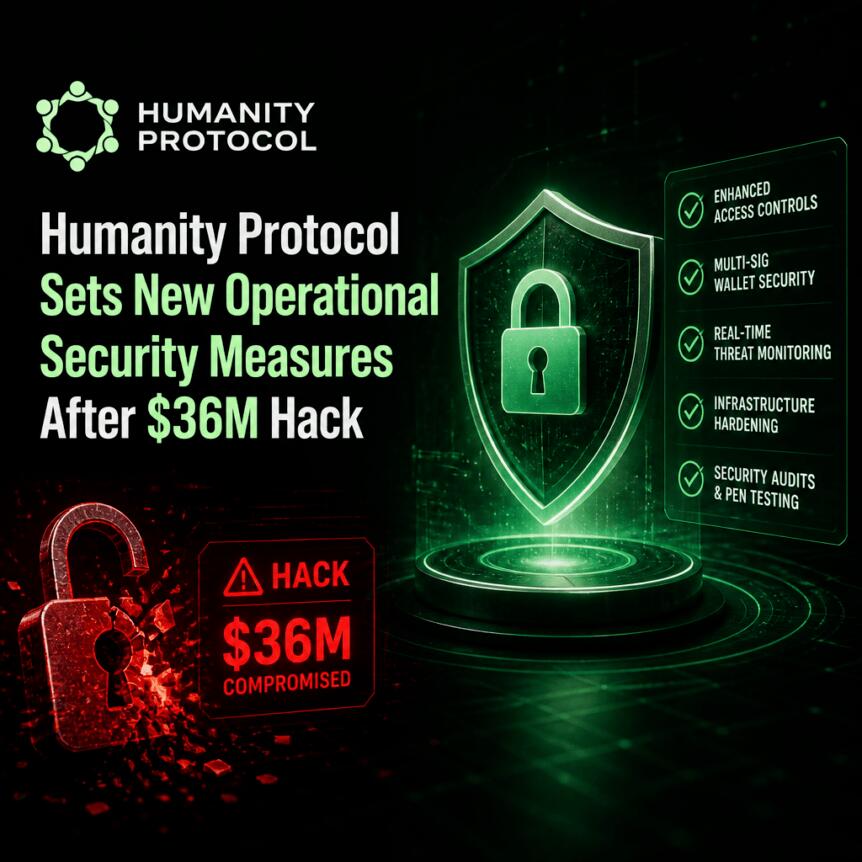
Humanity Protocol says it is tightening its operational security after an exploit that traced back to a compromised employee laptop and led to the theft of $36 million worth of Humanity (H) tokens. In remarks to Cointelegraph, founder Terence Kwok said the incident stemmed from production keys that were inadvertently copied onto the laptop during the company’s mainnet launch last year.
The breach underscores a broader shift in crypto hacking: rather than only targeting smart contract bugs, attackers increasingly focus on human and process weaknesses—phishing, endpoint compromise, and operational handling of sensitive keys. Security firm Quantstamp linked the phishing delivery to North Korea-linked threat actors and described malware installation that provided remote access to the affected machine.
Key takeaways
- Humanity Protocol attributes a June $36 million loss to compromised endpoint security rather than a smart contract flaw.
- Founder Terence Kwok says production keys—admin hot wallet keys and multisig owner keys—were unintentionally backed up to a laptop after last year’s mainnet launch.
- Quantstamp reported that the initial intrusion used a phishing email and a malicious attachment disguised as a Bithumb token schedule update.
- The incident fits a wider H1 2026 pattern highlighted by CertiK: phishing drove Q1 losses, while wallet compromises dominated Q2.
- Industry data in the period continues to associate major thefts with North Korea-linked activity, keeping geopolitical threat a central concern for operators.
Why Humanity is changing its security posture
Humanity Protocol’s founder framed the incident as a hard lesson in operational security. Kwok explained that the attackers gained the leverage needed to steal tokens from last year’s mainnet launch period, when several production keys were inadvertently backed up onto an employee laptop.
According to Kwok, those copied items included administrative hot wallet keys as well as a quorum of multisig owner keys across both chains. The company is now “rebuilding accordingly,” emphasizing that the defenses protecting smart contract logic must be matched by protections around key management processes and the systems employees use day-to-day.
For investors and users, this distinction matters because smart contract audits and formal verification can’t fully mitigate failures in how private keys are stored, accessed, and recovered. When key material leaks through endpoint compromise, even well-written code can become irrelevant to the attacker’s path to funds.
Details of the exploit: from phishing attachment to remote access
The compromise became public last month, when Cointelegraph reported that a compromised employee laptop enabled attackers to steal $36 million in Humanity (H) tokens. CoinMarketCap data puts the token’s current market capitalization at roughly $211 million, at the time of the report.
Quantstamp’s analysis pointed to phishing as the entry point. In its assessment, a malicious attachment delivered via a phishing email was disguised as a token lockup schedule update associated with South Korean exchange Bithumb. Once opened or processed, the attachment installed malware on the machine and gave the attackers remote access.
Operationally, that chain of events is a reminder of how quickly attackers can move from social engineering to direct access. Rather than waiting for a vulnerability in decentralized infrastructure, the threat model shifted to the environment where keys and operational access controls live.
Operational failures are becoming a dominant attack theme
The Humanity incident aligns with broader findings from blockchain security research during the first half of 2026. CertiK reported that cryptocurrency exploit losses were heavily driven by operational failures and social engineering schemes.
In the first quarter of 2026, CertiK said phishing drove the majority of losses, totaling $508 million. By the second quarter, wallet compromises emerged as the biggest attack vector, contributing $807 million in losses. CertiK also cautioned that year-over-year declines can be misleading: while hack losses fell 46.8% year-on-year to $1.32 billion in the first half of 2026, the reduction was influenced by a major outlier, the $1.4 billion Bybit hack in early 2025.
During Q2 2026 specifically, CertiK noted that more than 70% of losses came from the Drift Protocol and KelpDAO exploits—both widely attributed to North Korean state-sponsored hackers. Humanity’s experience fits this same general pattern of sophisticated actors leveraging weaknesses outside the smart contract code itself.
North Korea-linked activity remains a central risk
Quantstamp tied the phishing delivery used in Humanity’s case to North Korea-linked threat actors. The report also echoes a wider set of security observations about the scale of thefts linked to such activity.
The article notes that North Korea-linked threat actors were associated with at least $578 million of the $634 million stolen in crypto-related incidents in April alone. That concentration helps explain why many security teams keep focusing on threat intelligence and adversary capabilities—not only the technical vulnerabilities of protocols, but also the delivery mechanisms attackers use to reach systems and accounts.
For crypto organizations, the implication is clear: even if contract code is robust, attackers may still win by targeting the operational and human layers around deployment, custody, and key handling. Humanity’s stated response—rebuilding operational security after an exploit linked to misplaced key backups—directly reflects that reality.
Going forward, readers should watch how Humanity Protocol implements key management changes and whether it will publicly outline new operational controls—especially around backup procedures, access separation, and endpoint risk reduction—since those are now the obvious weak points. More broadly, the market will likely treat operational security measures as a comparable priority to smart contract audits whenever large thefts trace back to compromised systems.
https://www.cryptobreaking.com/humanity-protocol-sets-new-operational/?utm_source=blogger%20&utm_medium=social_auto&utm_campaign=Humanity%20Protocol%20Sets%20New%20Operational%20Security%20Measures%20After%20$36M%20Hack%20
Comments
Post a Comment