
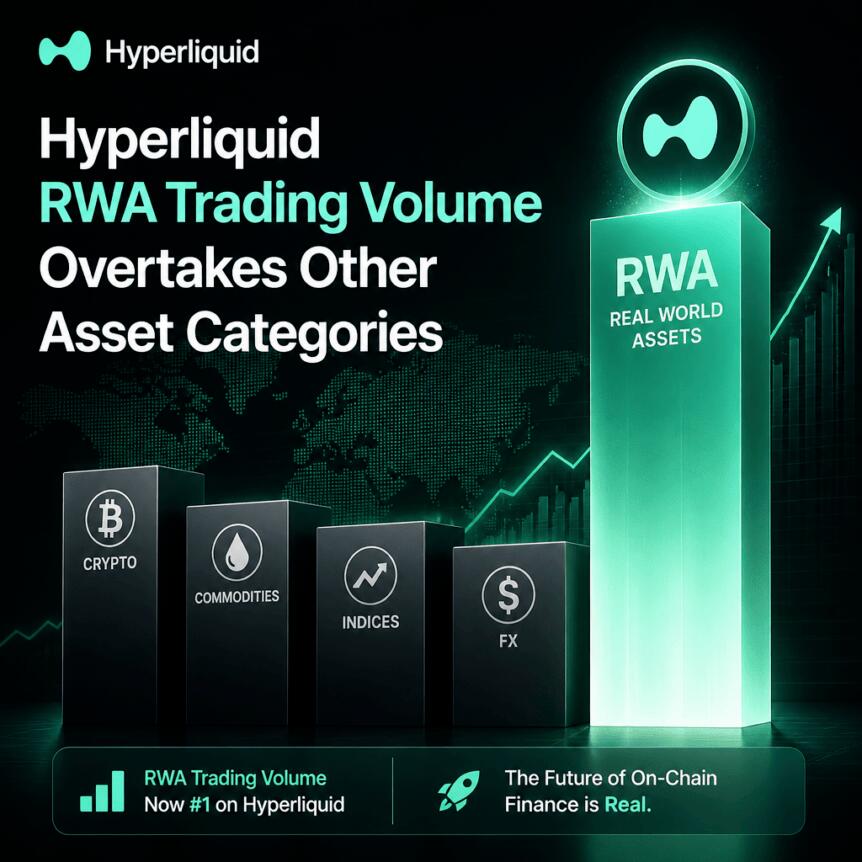
Hyperliquid’s decentralized perpetuals market has hit a notable milestone as trading in tokenized real-world assets (RWAs) started to dominate the platform’s week-over-week activity. According to Blockworks analytics, RWAs generated $25.1 billion in trading volume from July 13 to July 19—first time they have exceeded the combined volume of Hyperliquid’s other asset categories.
That $25.1 billion accounted for 52% of Hyperliquid’s total weekly trading volume of $48.2 billion, based on Blockworks data. ARK Invest research director Lorenzo Valente highlighted the scale in an X post, saying Hyperliquid’s RWA market alone was larger than the combined crypto perpetual volume of every other DEX.
Key takeaways
- RWA trading on Hyperliquid reached $25.1B in a single week (July 13–July 19), surpassing all other asset categories combined on the platform.
- RWAs represented 52% of Hyperliquid’s weekly total volume of $48.2B, per Blockworks.
- RWA adoption appears to be accelerating: RWA holder users rose 32% to 1.25 million, while tokenized RWA value increased to $36.7B (+3.5%) according to RWA.xyz.
- Revenue signals remain strong: Hyperliquid generated $7.6M in weekly revenue, placing it third among crypto apps by that metric (behind Tether and Circle).
- Executives increasingly frame perps on-chain as infrastructure: Circle CEO Jeremy Allaire called the shift a “major structural shift” toward RWA-driven trading.
RWA volume surpasses every other asset category on Hyperliquid
The shift is specific to Hyperliquid’s perpetual exchange (perps) activity, where traders transact continuously rather than relying on dated contract expirations. Blockworks’ weekly figures show that, for July 13–July 19, tokenized RWAs became the largest driver of Hyperliquid’s marketplace by volume—an inflection point for a category that has been steadily gaining attention across crypto.
Valente’s comparison—RWA volume on Hyperliquid exceeding the combined crypto perpetual volume of other DEXs—underscores how concentrated the activity is becoming around tokenized, off-chain-linked instruments on a perps venue. While DEX perps are not new, this particular weighting toward RWAs suggests that capital and liquidity are being pulled toward tokenized claims on real assets rather than limiting trading interest to native crypto commodities.
Adoption metrics point to a broader RWA pull
The volume milestone is occurring alongside growth in the underlying RWA market. RWA.xyz data cited in the report indicates that RWA holders expanded by 32% over the past month to 1.25 million users. Over the same period, the total value of tokenized RWAs rose by 3.5% to $36.7 billion.
For investors and market participants, the key question is whether Hyperliquid’s RWA outperformance reflects a one-week anomaly or a sustained change in liquidity preferences. The combination of weekly trading dominance and month-over-month growth in both holders and total RWA value makes the case for sustained demand—at least in the near term.
Revenue and relative standing among crypto applications
Volume growth often attracts scrutiny, but revenue helps clarify whether activity is translating into sustainable economic impact. DefiLlama data indicates Hyperliquid generated $7.6 million in revenue over the past week.
DefiLlama also places Hyperliquid third among crypto applications by weekly revenue, behind stablecoin issuers Tether and Circle, which generated $112 million and $45 million respectively. That ranking matters because it places an RWA-focused perps venue in direct competition for economic relevance with the dominant parts of the stablecoin ecosystem—segments that many market observers view as foundational to on-chain trading.
In practical terms, the implication is that traders are not just moving around capital for speculation: the perps market is producing measurable platform earnings at a time when RWAs are becoming a majority share of activity.
Industry executives link the trend to a “structural shift”
Beyond raw market statistics, prominent crypto and traditional finance figures are increasingly framing RWA growth on-chain as an ecosystem-level change rather than a niche experiment. Circle co-founder and CEO Jeremy Allaire said growing RWA trading on Hyperliquid marks a “major structural shift” in crypto markets. In a Friday X post, he characterized the move as departing from “speculating on endogenous digital commodities” toward trading linked to external real-world assets.
Other industry commentary supports a similar direction of travel for perpetual futures as an instrument. Earlier in July, Pantera Capital suggested that perpetual futures could become a dominant trading tool beyond crypto. The argument emphasized structural advantages of perps versus traditional derivatives, including 24/7 trading, the absence of contract expiries, simpler position management, and continuous price discovery.
Regulatory and competitive pressure is also emerging. The report references NYSE parent Intercontinental Exchange (ICE) and its chief executive Jeffrey Sprecher urging regulators to establish a “level playing field” for launching 24/7 on-chain perpetual futures contracts. The underlying tension is clear: if on-chain perps continue to attract mainstream liquidity, market participants will want consistent rules across venues that provide continuous trading and automated settlement.
At the same time, broader tokenization efforts are already integrating traditional market infrastructure concepts into blockchain settings. The report notes that in March, the NYSE partnered with tokenization platform Securitize to develop blockchain-based stock trading infrastructure aimed at 24/7 trading and settlement.
While these initiatives are not the same as Hyperliquid’s perps market, together they show a pattern: tokenized assets are moving from “possible future use” toward active trading and infrastructure design across both crypto-native and legacy finance channels.
Traders and builders should watch whether Hyperliquid’s RWA share holds beyond the July 13–July 19 window and whether revenue continues to scale as RWA holders and total tokenized value rise. The sustainability of the shift—and how regulators respond to 24/7 on-chain derivative trading—will likely determine whether this becomes a durable market structure or a temporary liquidity rotation.
https://www.cryptobreaking.com/hyperliquid-rwa-trading-volume-overtakes/?utm_source=blogger%20&utm_medium=social_auto&utm_campaign=Hyperliquid%20RWA%20Trading%20Volume%20Overtakes%20Other%20Asset%20Categories%20
Comments
Post a Comment