
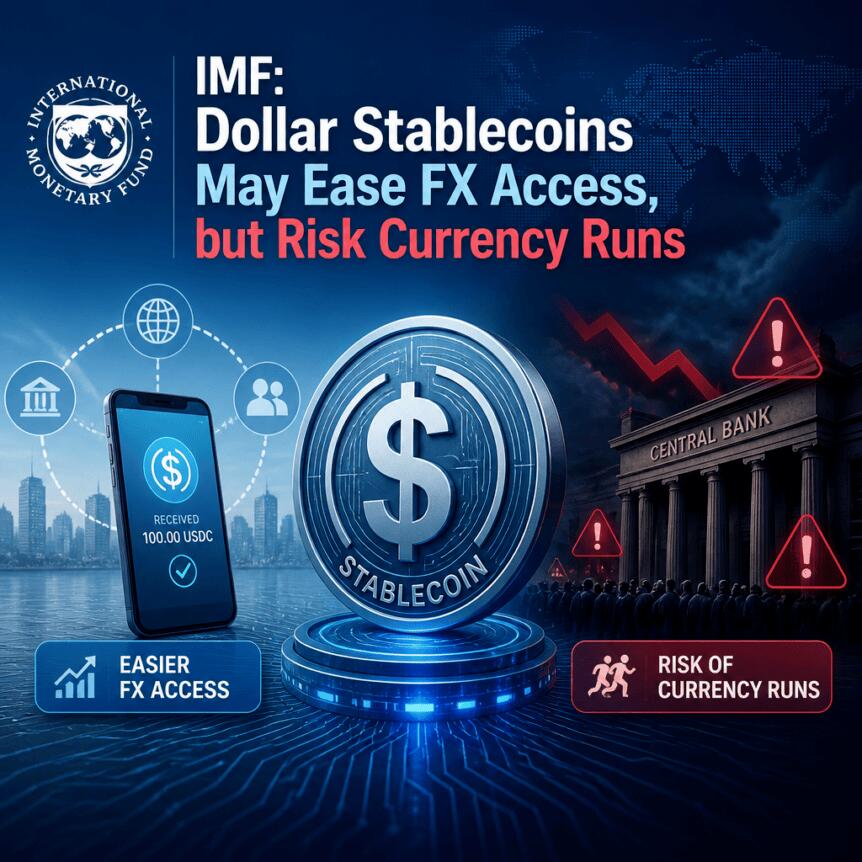
Stablecoins tied to the US dollar could widen access to foreign currency for people in countries with fixed or tightly managed exchange rates, according to a new International Monetary Fund (IMF) working paper. But the same mechanism may also make currency stress worse by accelerating “runs” out of the local currency during periods of severe pressure.
The IMF’s analysis, published as a paper by economist Brandon Joel Tan and titled “Stablecoins and Fragility in Fixed Exchange Rate Regimes,” focuses on what happens in parallel foreign-exchange (FX) markets when official dollar channels are rationed. In that setting, the paper argues that stablecoins can serve as a fast, visible signal of dollar scarcity—potentially drawing demand in normal times while also encouraging synchronized exits from the domestic currency when fear spreads.
Key takeaways
- Dollar stablecoins can improve access to foreign currency when banks or official FX systems cannot meet demand.
- The IMF model links stablecoins to higher run dynamics during crises, when many people may react at the same time to dollar pricing.
- A stablecoin price can function like a parallel “benchmark”, revealing changing dollar scarcity faster than official rates.
- Regulators may need temporary measures to curb unusually large, panic-driven transactions during acute stress.
IMF model: stablecoins as dollar access—and dollar signals
Tan’s working paper modeled how stablecoins affect parallel FX markets in fixed exchange rate regimes, particularly when official dollar access is restricted. The central trade-off is that stablecoins offer a practical route to “dollar-like claims,” even when traditional channels fall short.
In the paper’s framing, stablecoins lower friction for obtaining dollar exposure by making dollar-denominated value easier to access. At the same time, they create a continuously observable price—often tightly watched by market participants—that can reflect the intensity of dollar demand in real time.
The model suggests that this price visibility becomes especially important when the official exchange rate is far removed from the market rate. In that situation, a stablecoin’s traded value can act as an early indicator that dollar scarcity is worsening, which may then prompt more people to seek dollars or dollar substitutes at once.
Why fixed exchange rates raise the stakes during crises
The IMF analysis places particular emphasis on the vulnerability created by fixed or heavily managed regimes. When the official rate diverges sharply from the unofficial market, the gap can delay recognition of worsening scarcity through official channels. Meanwhile, stablecoin pricing—being linked to the reference dollar—can deliver a high-frequency read on demand pressures.
According to Tan’s argument, that same “signal” quality can contribute to fragility during a currency crisis. As pressure rises on the local currency, stablecoins may become the destination for those trying to preserve value, but the speed and common observability of their price can also encourage coordinated behavior.
In practical terms, the paper implies that, when fear intensifies, people may abandon the domestic currency simultaneously—turning stablecoin demand into a reinforcing loop. The result is a mechanism that can amplify currency runs rather than merely provide an alternative payment or savings tool.
Real-world parallels: stablecoins referenced where dollar access is constrained
The IMF’s theoretical claims align with observable patterns in countries where official dollar access is limited or costly. Earlier coverage from Cointelegraph highlighted instances of stablecoin usage as a reference point in everyday transactions.
For example, Cointelegraph reported that on June 9, 2025, Bolivian airport retailers priced goods using USDT as a reference while continuing to accept US dollars or bolivianos. Separately, in 2024 Cointelegraph documented that Argentines used underground “crypto caves” to exchange pesos for dollar-stablecoins at rates closer to the unofficial market—reflecting how residents sought alternatives as the peso depreciated and access to dollars was constrained by currency controls.
While these examples differ in local structure and market depth, they illustrate the broader point from the IMF paper: stablecoins can become embedded in parallel FX behavior, functioning not only as a storage asset but also as a benchmark tied closely to dollar pricing.
Regulatory warnings: the risk isn’t only conversion—it’s system-wide interaction
The IMF paper lands in a regulatory environment already focused on stablecoins’ macro-financial implications. Earlier coverage from Cointelegraph noted that the Financial Stability Board (FSB) warned on March 24 that dollar stablecoins could expose emerging markets to currency substitution, weaken monetary policy effectiveness, and potentially help circumvent capital-flow measures.
In its urging to policymakers, the FSB emphasized that lawmakers should evaluate how the stablecoin sector develops, with particular attention to liquidity and operational risks—and to how stablecoins may connect with the broader financial system.
That broader concern complements the IMF’s fragility framework. Taken together, they suggest regulators may need to look beyond stablecoin issuance and redemption mechanics and consider how stablecoin markets behave during stress—especially where fixed exchange rates and official rationing distort price discovery.
What policymakers may watch next
The IMF paper’s key policy implication is that, in acute currency pressure, regulators might consider temporary limits on unusually large or panic-driven stablecoin transactions—measures aimed at preventing synchronized exits that can intensify runs. For market participants, the next signal to watch is whether stablecoin pricing continues to act as an increasingly prominent FX benchmark in fixed-regime countries during periods of divergence between official and unofficial rates.
https://www.cryptobreaking.com/imf-dollar-stablecoins-may-ease/?utm_source=blogger%20&utm_medium=social_auto&utm_campaign=IMF:%20Dollar%20Stablecoins%20May%20Ease%20FX%20Access,%20but%20Risk%20Currency%20Runs%20
Comments
Post a Comment