
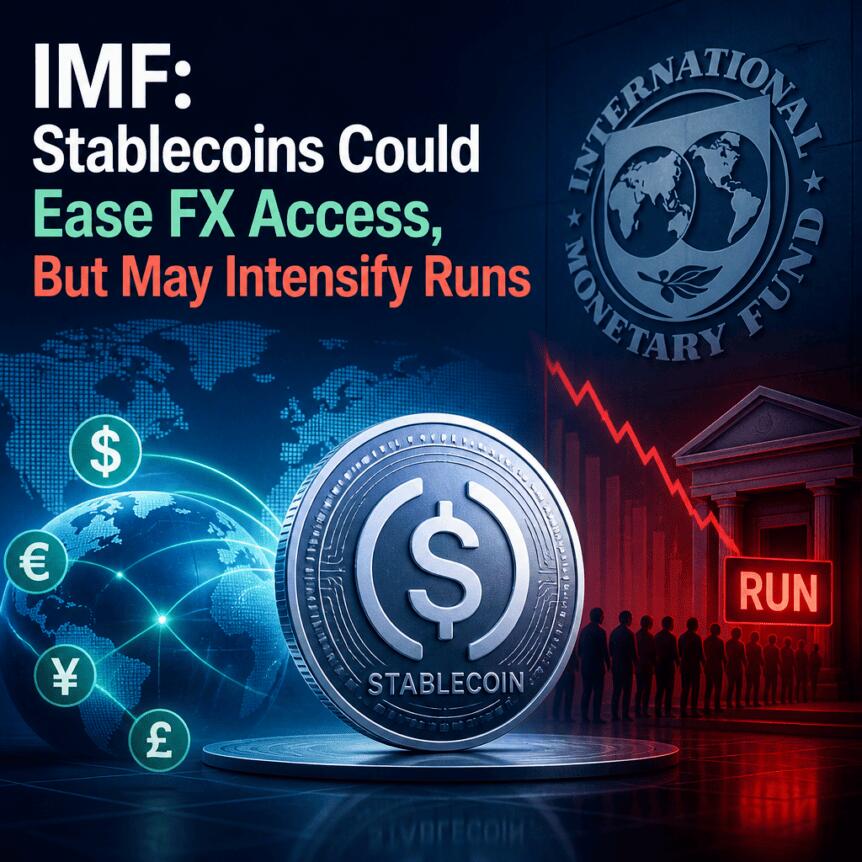
Stablecoins tied to the US dollar can make it easier for people in fixed or tightly managed exchange-rate systems to access foreign currency, but new research from the International Monetary Fund (IMF) warns the same tools may also intensify “runs” on the domestic currency during periods of acute stress.
In a working paper titled “Stablecoins and Fragility in Fixed Exchange Rate Regimes”, economist Brandon Joel Tan models how stablecoins can influence parallel foreign-exchange (FX) markets when official dollar access is rationed. The IMF analysis suggests stablecoin prices can become an unusually clear, real-time signal of dollar scarcity—helping users obtain dollars in normal times, while potentially coordinating large sell-offs of local currency when pressure builds.
Key takeaways
- Stablecoins can expand practical access to dollars when banks or official FX channels cannot meet demand, especially in economies with managed exchange rates.
- Stablecoin pricing may act like a high-frequency “benchmark” for dollar demand in parallel FX markets.
- During currency crises, that same visibility can accelerate currency substitution as many users react at once to worsening scarcity.
- The IMF’s modeling implies regulators may consider temporary transaction limits on unusually large or panic-driven stablecoin activity to reduce destabilizing feedback loops.
Why stablecoins matter in fixed-exchange regimes
The IMF paper focuses on a common policy setup: countries where exchange rates are fixed or heavily managed, and where official access to dollars is limited or rationed. In those settings, demand for foreign currency often exceeds supply through formal channels, pushing trading toward parallel markets.
Tan’s argument is that stablecoins provide “dollar-like claims” that are easier for households and businesses to obtain than traditional cross-border routes during periods when local institutions cannot deliver dollars. Importantly, stablecoins also create a widely watched price—one that can reflect changes in dollar demand more continuously than official mechanisms.
When the official exchange rate diverges sharply from the market rate, that stablecoin-linked price can signal that dollars are becoming scarce. The IMF modeling suggests this can prompt additional moves out of the domestic currency as users seek to preserve value before conditions worsen further.
Parallel FX markets and the “price signal” effect
The paper emphasizes the role of expectations and synchronization. In fixed-rate environments, people may already suspect that official dollar access will not keep up. By making dollar exposure easier and more standardized, stablecoins could reduce friction for users trying to hedge currency risk.
At the same time, the visibility of a stablecoin price may lower the coordination cost of a run. Tan’s analysis points to a scenario where, under severe currency stress, many users abandon the local currency simultaneously—turning stablecoin demand into a rapid, self-reinforcing indicator of the crisis.
This mechanism differs from a slow, gradual shift in preferences. The IMF framing is that stablecoin prices are not just another trading venue; they can become a real-time reflection of scarcity that pulls forward decisions.
Real-world patterns: stablecoin reference pricing and “crypto caves”
The IMF’s thesis aligns with reporting on how stablecoins have been used in places where official dollar access is constrained. Earlier coverage from Cointelegraph described stablecoin use as a workaround for local currency weakness and capital controls.
For example, Cointelegraph reported that on June 9, 2025, Bolivian airport retailers were seen pricing goods using USDT as a reference, while still accepting US dollars or bolivianos. That kind of reference pricing suggests stablecoins can function as a practical yardstick when formal rates are unreliable or inaccessible.
In 2024, Cointelegraph also reported that Argentines were using unofficial “crypto caves” to exchange pesos for dollar-stablecoins at rates closer to the unofficial market. The reported motivation was straightforward: with the peso losing value and access to dollars restricted, stablecoins offered a way to preserve savings outside the official system.
Regulatory concern: running beyond hedging
While stablecoins can help users access foreign currency when local institutions cannot, the IMF paper is not framed as a blanket endorsement. Instead, it treats stablecoins as a factor that could change the dynamics of FX stress—particularly in regimes where exchange rates are fixed or strongly managed.
That caution echoes warnings from the broader financial stability community. On March 24, the Financial Stability Board (FSB) said dollar stablecoins could expose emerging economies to currency substitution, weaker monetary policy, and potential circumvention of capital-flow measures. The FSB also urged lawmakers to evaluate how the sector might evolve and to understand liquidity and operational risks as stablecoins become more connected to the wider financial system.
Against that backdrop, Tan’s modeling suggests regulators may need tools designed specifically for crisis periods—such as temporary limits on unusually large or panic-driven transactions—to blunt the feedback loop that can arise when stablecoin demand accelerates in lockstep with domestic currency pressure.
What investors and builders should watch next
The IMF research highlights a critical tension: stablecoins can be a stabilizing access channel when official dollars are rationed, yet they can also become a crisis amplifier when stablecoin pricing turns into a rapid signal of scarcity. Traders, liquidity providers, and policymakers should watch how stablecoin usage behaves in FX stress—especially whether adoption is steady and hedging-oriented, or whether it shifts into synchronized withdrawals during sharp currency dislocations.
https://www.cryptobreaking.com/imf-stablecoins-could-ease-fx/?utm_source=blogger%20&utm_medium=social_auto&utm_campaign=IMF:%20Stablecoins%20Could%20Ease%20FX%20Access,%20But%20May%20Intensify%20Runs%20
Comments
Post a Comment