
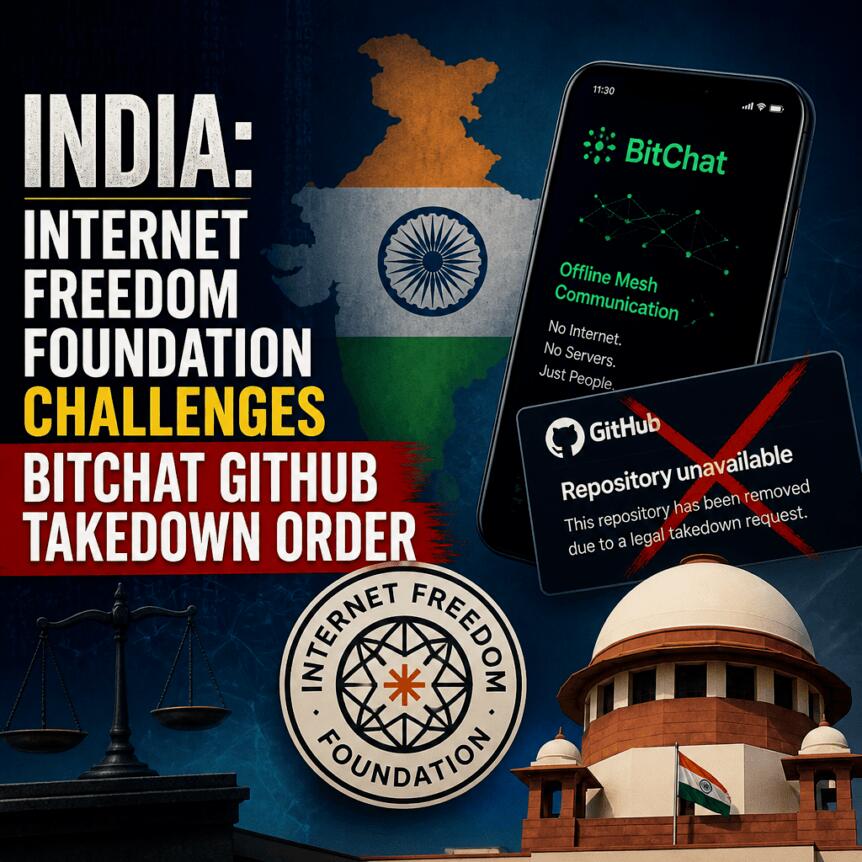
India’s Internet Freedom Foundation (IFF) has publicly challenged a government order requiring GitHub to remove access to multiple repositories connected to Jack Dorsey’s decentralized messaging app, BitChat—arguing the action bypasses safeguards built into India’s more formal website-blocking process.
The dispute escalated shortly after India’s cybercrime agency instructed GitHub to disable access to three BitChat repositories within a matter of hours, warning that the decentralized messaging system could be used to circumvent internet shutdowns, evade lawful surveillance, and support unlawful activity. IFF says the order is unconstitutional and should be withdrawn.
Key takeaways
- IFF condemns a GitHub takedown order over BitChat, saying it exceeds government authority under India’s Information Technology Act.
- The foundation argues the notice should have followed India’s formal website-blocking procedure, which includes procedural protections.
- IFF disputes the rationale for removal, noting the repositories were not accused of containing specific unlawful content.
- The underlying controversy centers on BitChat’s decentralized architecture, designed to function without internet connectivity by routing messages over Bluetooth between nearby devices.
IFF challenges the legal route used for the GitHub takedown
In a statement posted on X, IFF said the government’s order was issued under Section 79(3)(b) of India’s Information Technology Act, rather than through the established process for website blocking. According to IFF, that distinction matters because the standard approach is tied to formal procedures and safeguards.
The foundation’s core claim is that the government used an enforcement mechanism that allows rapid platform action without the protections that accompany the country’s website-blocking framework. IFF urged authorities to withdraw the notice and to publish all takedown orders made under the same provision, suggesting a broader transparency and accountability issue beyond the BitChat case.
What the cybercrime order alleged—and what IFF contests
IFF’s criticism comes a day after India’s cybercrime agency directed GitHub to disable access to three BitChat repositories within three hours. The agency’s stated concern was that BitChat—by virtue of being decentralized—could help users communicate even during internet disruptions, potentially undermining shutdowns and lawful monitoring.
IFF pushed back on that justification on two fronts. First, it argued that the order did not identify any specific unlawful material inside the repositories. Second, IFF said the reasoning effectively treated BitChat’s design choices—especially its ability to relay messages without internet access—as sufficient grounds for removal on their own.
In IFF’s view, that approach risks expanding enforcement beyond content-based restrictions and into architecture-based suppression—an issue that tends to carry significant implications for developers and open-source ecosystems.
How BitChat is designed to work without the internet
BitChat is described as a decentralized messaging app that routes encrypted messages between nearby devices using Bluetooth rather than relying on internet connectivity or centralized servers. This design is intended to keep communication possible when conventional networking is unavailable.
IFF pointed to that same feature as the subject of the government’s concern, arguing that the decentralized model—particularly its offline and proximity-based capability—was cited as justification rather than any identifiable illegal content.
This is not a purely theoretical distinction. If a messaging platform is removed primarily because it can operate during outages, the line between lawful restrictions on content and broader restrictions on tools that enable communication during shutdowns becomes a central policy question.
BitChat’s adoption surge during outages and unrest
BitChat’s visibility has grown alongside periods of unrest and connectivity failures. Cointelegraph previously reported on the app’s July 2025 launch, describing a decentralized approach that can support local messaging when normal internet routes are disrupted. Since then, BitChat has reportedly gained traction in multiple countries during moments of high disruption.
According to earlier reporting cited by the article, adoption increased during events including protests, natural disasters, and internet shutdowns across places such as Madagascar, Nepal, Uganda, Jamaica, and Iran. The pattern—more installs when connectivity is disrupted—helps explain why a case involving GitHub repositories can quickly become a flashpoint for broader debates over censorship, shutdown circumvention, and the role of open-source development during emergencies.
For investors and builders in the crypto-adjacent decentralization ecosystem, the case also underscores a recurring theme: software that is designed for resilience and offline functionality can attract regulatory attention even when it is not directly tied to specific illegal content.
Authorities have yet to clarify how they will apply Section 79(3)(b) in cases involving open-source code with offline or decentralized capabilities, and IFF’s demand to publish all takedown orders under that provision suggests further legal and procedural scrutiny ahead. Readers should watch whether GitHub complies permanently, whether the repositories are restored, and whether any court or regulatory process follows to test IFF’s constitutional arguments.
https://www.cryptobreaking.com/india-internet-freedom-foundation-challenges/?utm_source=blogger%20&utm_medium=social_auto&utm_campaign=India:%20Internet%20Freedom%20Foundation%20Challenges%20BitChat%20GitHub%20Takedown%20Order%20
Comments
Post a Comment