
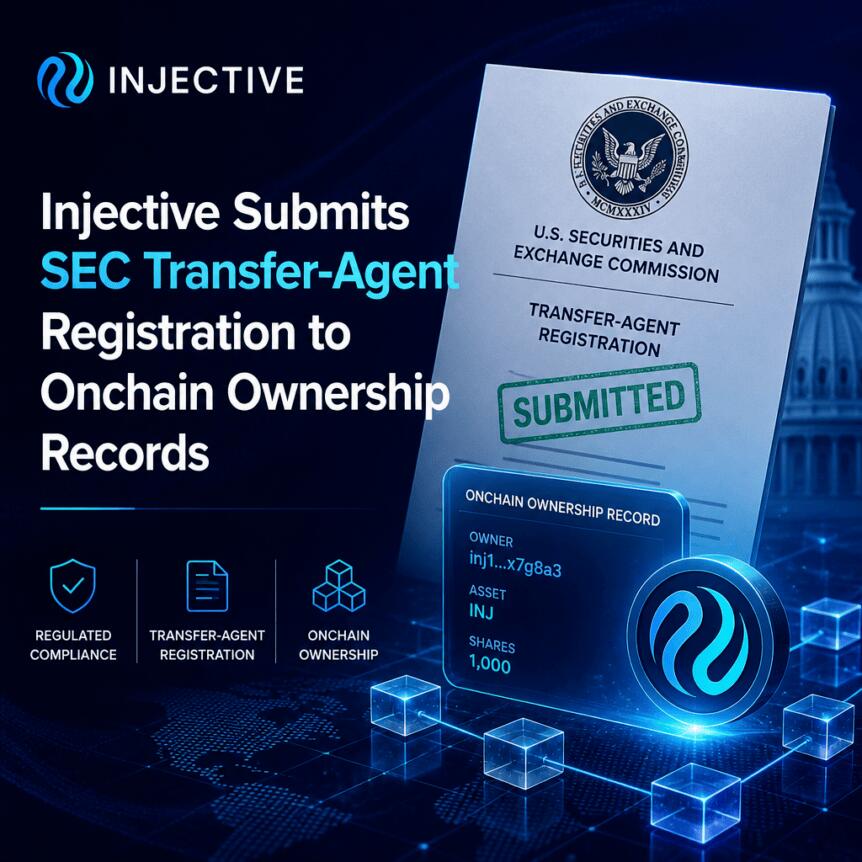
Injective says it has filed for transfer agent registration with the US Securities and Exchange Commission (SEC), aiming to bring a core securities-market record-keeping function onto blockchain infrastructure.
Transfer agents are responsible for maintaining shareholder records and tracking changes in securities ownership in the United States. Injective, a layer-1 blockchain focused on decentralized finance and tokenized real-world assets (RWAs), argues that moving this ownership-management workflow onchain could provide a more regulated way to issue and administer tokenized assets—if the SEC approves the filing.
Key takeaways
- Injective filed with the SEC to register as a transfer agent, targeting blockchain-based shareholder record management.
- Transfer agents sit at the center of legal securities ownership tracking in the US market structure.
- Injective says an onchain approach could reduce delays and reconciliation burdens between intermediaries.
- The company did not specify the legal entity behind the application, and Cointelegraph reported it could not independently verify the submission at publication time.
Why transfer agents matter for tokenized securities
In traditional capital markets, transfer agents help ensure that the right parties are recorded as legal owners of securities and that ownership changes are reflected accurately over time. For tokenized securities, the same problem persists—only the “who owns what” question becomes more complex when issuance, settlement, and record updates are expected to occur digitally.
Injective’s pitch is that blockchain infrastructure can support compliant ownership records, while leveraging faster settlement characteristics associated with its network. In a post on X, Injective said tokenized securities and RWAs require “compliant ownership records on infrastructure that settles in less than a second,” and that it intends to provide the capability at scale within the United States.
If the SEC registration is approved, Injective would move from building blockchain infrastructure for tokenized assets toward operating within the regulated systems that determine legal securities ownership.
What Injective has (and hasn’t) disclosed
Injective’s announcement did not include details that investors typically look for when assessing regulatory filings. The company did not identify the specific legal entity behind the application, and it did not provide a public SEC filing for readers to review directly.
Cointelegraph also noted it was unable to independently verify the submission at the time of publication. That uncertainty matters: regulatory outcomes, the scope of approval, and operational requirements often depend on how filings are structured and which entity is responsible for the regulated activity.
For market participants watching this space, the next signal will likely be whether the SEC confirms receipt and provides additional context, and whether Injective clarifies its role, responsibilities, and the exact mechanics of how ownership records would be maintained onchain.
Capital markets’ broader push toward onchain infrastructure
Injective’s move reflects a wider trend: major financial players are experimenting with blockchain not only for tokenized assets, but also for the “pipes” that connect issuance, trading, and post-trade processes.
Nasdaq, for instance, has pursued onchain distribution of market data. Last month, it partnered with onchain financial data network Pyth to distribute its TotalView market data to blockchain applications. Earlier in the year, Nasdaq also partnered with Kraken and tokenization firm Backed to develop infrastructure intended to link traditional equities to blockchain networks.
Intercontinental Exchange, the parent company of the New York Stock Exchange, has similarly expanded its tokenization efforts through a partnership with Securitize. That work is aimed at supporting onchain stocks and exchange-traded funds with goals that include 24/7 trading and instant settlement.
Meanwhile, DTCC—described as a primary post-trade infrastructure provider for US securities markets—is preparing a tokenized platform called the Collateral AppChain. Cointelegraph reported that the initiative is designed to automate collateral management and settlement across financial markets, using blockchain-focused infrastructure to streamline parts of the post-trade lifecycle.
What changes if transfer-agent functions become blockchain-native
If Injective’s registration advances, it could add another building block for tokenized securities: a regulated record-keeping layer that helps tie token ownership representations to legal ownership tracking. Injective claims this could reduce delays and reconciliation between intermediaries—an issue that often shows up when multiple parties, systems, and time windows are involved in updating ownership records.
Even so, the path to real-world impact depends on execution details that were not provided in the announcement: what data is recorded, how changes are validated, and how the onchain record relates to established legal and operational requirements. Readers should therefore watch for follow-up disclosures, regulatory feedback from the SEC, and evidence of how the system would integrate with existing custody and settlement workflows.
For now, Injective’s SEC transfer-agent filing signals that tokenized securities infrastructure is moving beyond experimentation into regulated operational questions—leaving the biggest unknowns centered on how the SEC frames approval and how Injective plans to operationalize compliant ownership records at scale.
https://www.cryptobreaking.com/injective-submits-sec-transfer-agent/?utm_source=blogger%20&utm_medium=social_auto&utm_campaign=Injective%20Submits%20SEC%20Transfer-Agent%20Registration%20to%20Onchain%20Ownership%20Records%20
Comments
Post a Comment