
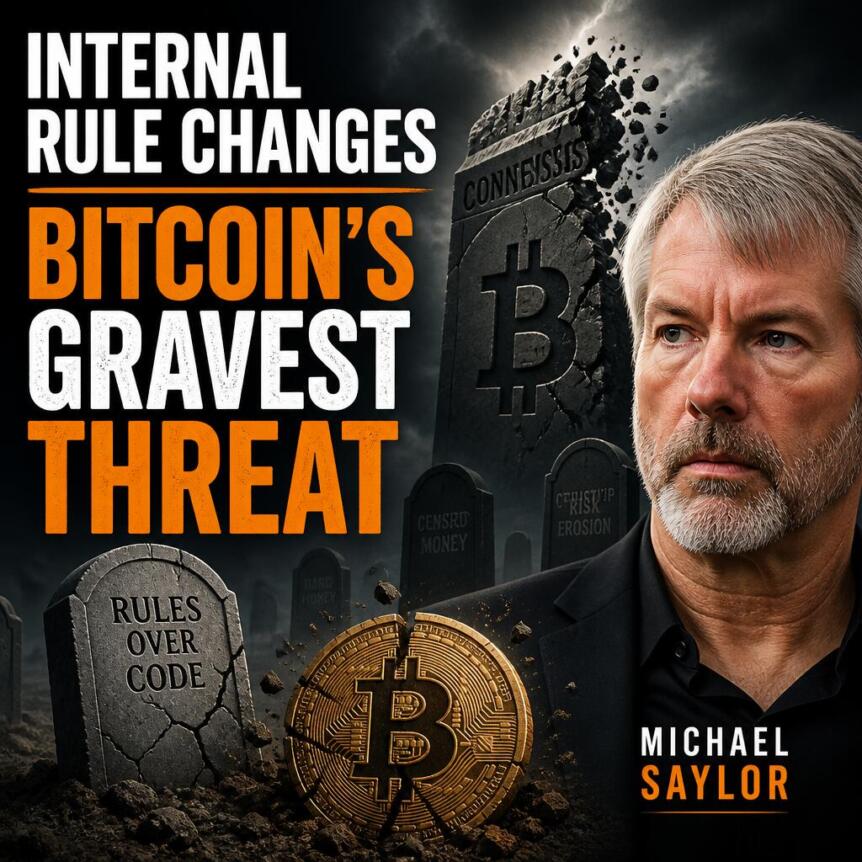
Strategy executive chairman Michael Saylor has warned that any changes to Bitcoin’s consensus rules pose a far greater threat than those posed by rival cryptocurrencies and external governments.
Saylor’s comments are likely part of his broader opposition to Bitcoin Improvement Proposal (BIP-110), a temporary soft fork that reduces arbitrary data stored on the blockchain.
Strategy Issues Bitcoin Warning
Michael Saylor issued the warning in a series of X posts, calling Bitcoin’s rules its constitution and describing how they determine ownership, scarcity, settlements, and what participants can and can’t change. Saylor stated,
“Bitcoin has won. Now it must survive victory. Its gravest threat is not an enemy at the gates, but corruption from within: factions that invent pretexts, rewrite the rules, and seize economic rights until freedom becomes permission and law becomes loot.”
According to Saylor, any changes to the protocol to benefit a single group would infringe upon the economic rights of the broader community, including miners, developers, investors, companies, custodians, and other users. He warned that if one group gained enough influence to change Bitcoin’s rules, others could use the same process for similar agendas.
Prolonged Governance Conflicts Harm Bitcoin
According to Saylor, protocol changes driven by a particular group could prolong disputes, which would drive away capital, slow development, and weaken security. Saylor has predicted Bitcoin could grow exponentially and become part of the infrastructure supporting global markets. The Strategy founder believes a poorly thought-out rule could hamper financial products and technologies in the future.
Saylor’s Opposition to BIP-110
If Saylor’s comments seem targeted, it’s because they are. Saylor has vehemently opposed BIP-110, a soft fork that reduces the arbitrary data stored on the blockchain. Supporters of the fork believe that limiting certain types of data eases storage requirements and reduces the burden on node operators. Additionally, they believe Bitcoin must focus on monetary transactions instead of tokens, inscriptions, or file storage.
While Saylor concedes that some on-chain data is redundant or could be linked to malicious activities, he argues that Bitcoin can’t use consensus rules to restrict block space to valid, fee-paying transactions. Saylor had said in an article dated July 18,
“Bitcoin does not need guardians of purity. It needs guardians of neutrality.”
Saylor’s latest comments also criticize proposals to add covenant functionality and increase block capacity, arguing that they create risks for Bitcoin’s base layer. Saylor is not the only one opposing BIP-110, with Adam Beck also publicly opposing the soft fork.
Fee Market and Network Security at Risk
Saylor believes imposing restrictions on valid transactions could weaken the fee market by reducing competition for block space, while larger blocks could reduce block space scarcity and raise bandwidth and hardware costs for node operators. He also argued that covenants could make Bitcoin’s consensus rules complicated and introduce new attack surfaces.
Saylor also warned that suppressing fee demand could substantially lower miner income, impacting the financial incentive that protects the network. He believes the base layer must be kept simple, neutral, scarce, and secure, while developers can build new functionality on a separate layer.
The Bitcoin Security Consortium
Strategy, along with Anchorage Digital, ARK Invest, BlackRock, Block, Blockstream, Coinbase, Fidelity Digital Assets, and Galaxy, has formed a consortium called the Bitcoin Security Consortium. The consortium has pledged $15 million over three years to support Bitcoin developers working on post-quantum solutions. However, the consortium will not take any position on protocol changes, nor control Bitcoin development.
Disclaimer: This article is provided for informational purposes only. It is not offered or intended to be used as legal, tax, investment, financial, or other advice.
https://www.cryptobreaking.com/internal-rule-changes-bitcoins-gravest/?utm_source=blogger%20&utm_medium=social_auto&utm_campaign=Internal%20Rule%20Changes%20Bitcoin’s%20Gravest%20Threat%20Michael%20Saylor%20
Comments
Post a Comment