
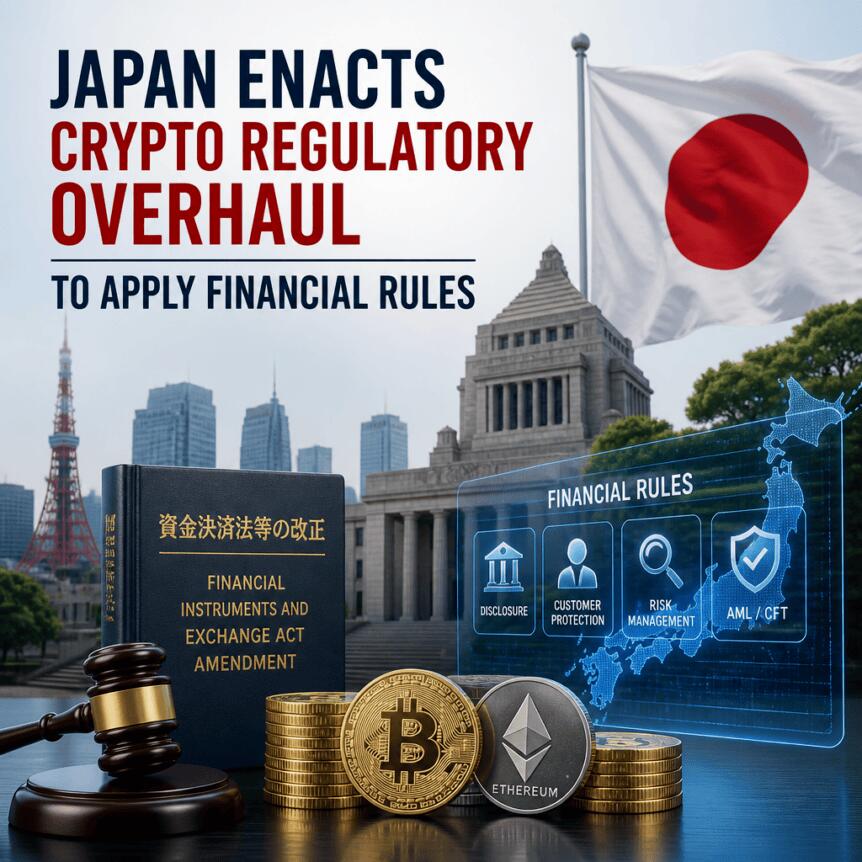
Japan has approved revisions to its cryptocurrency law, reshaping how digital assets are treated under the Financial Instruments and Exchange Act (FIEA). According to a report by Nikkei, the changes passed in parliament on Wednesday mark a major regulatory shift away from the country’s earlier approach under the Payment Services Act.
The updated framework aims to place crypto closer to traditional finance, adding market-integrity measures and strengthening oversight for businesses operating in Japan. It also introduces insider trading restrictions and tighter controls around registration and compliance.
Key takeaways
- Japan’s parliament passed revisions that treat crypto assets as financial assets under the FIEA, moving the sector away from Payment Services Act rules.
- The overhaul introduces insider trading restrictions for issuers, exchanges, and other market participants who have undisclosed material information.
- Penalties are expected to increase substantially for companies that operate without proper registration.
- Registered crypto firms may be reclassified under the law, reflecting a broader effort to align terminology and oversight with traditional financial regulation.
From payment-focused rules to a financial-assets framework
Under Japan’s previous regulatory approach, crypto assets were largely treated through the lens of the Payment Services Act (PSA), which framed digital assets primarily as payment-related instruments. The revisions now classify crypto assets as financial assets under the Financial Instruments and Exchange Act (FIEA), according to Nikkei.
That distinction matters for compliance design. When regulators bring crypto into the FIEA perimeter, firms typically need to follow expectations associated with market conduct, disclosure, and supervision—areas that are more familiar to traditional brokerage and trading environments than to payment processors.
Insider trading limits and stronger market-integrity expectations
The revised rules tighten conduct requirements across the ecosystem. As described in the Nikkei report, issuers, exchanges, and other market participants are prohibited from trading while aware of undisclosed material information.
The legal structure is intended to mirror insider trading restrictions used in traditional finance (TradFi). For exchanges and other intermediaries, this can change day-to-day controls—such as how material information is documented, who can access it, and how trading is managed around significant corporate events.
While the details of enforcement mechanisms are not laid out in the excerpt provided, the existence of an insider trading rule signals regulators’ intent to treat crypto markets as subject to the same fairness and integrity standards expected in regulated securities and derivatives markets.
Heavier penalties for operating without registration
Japan’s revisions also reportedly increase the consequences for firms that conduct business without the required registration. Nikkei reports that the maximum prison term could rise from three years to 10 years, and fines could increase from roughly 3 million yen (about $19,000) to around 10 million yen.
The report further notes that insider trading violations could lead to penalties of up to five years in prison, fines of up to 5 million yen, or both. In practical terms, these changes elevate legal risk for firms that fail to meet compliance obligations—or for employees who trade or influence trades without controls that align with the new rules.
For traders and investors, stronger penalties can also shift how firms approach internal governance, potentially affecting market behavior and the reliability of corporate and exchange disclosures over time.
Reclassification of crypto businesses and the “TradFi alignment” trend
Alongside the substantive changes, the revised framework reportedly adjusts the wording used for registered entities. The terminology may move from “cryptocurrency exchange” to “cryptocurrency trading company,” reflecting the broader role regulators now associate with the sector.
Japan’s approach fits a wider global pattern: rather than crafting entirely separate legal regimes for crypto, many jurisdictions are mapping digital asset activity onto existing financial regulation categories. That trend is visible in other policy work described in related coverage from Cointelegraph, including a report noting South Africa’s tax authority draft guidance on how existing tax rules apply to crypto assets.
In the United States, regulators have similarly continued clarifying how existing securities and commodities frameworks can apply to different kinds of digital asset activity, underscoring that the “crypto-as-finance” direction is not unique to Japan.
What Japan’s shift means for market participants
For crypto exchanges and other intermediaries, the immediate challenge is operational: aligning compliance systems with a legal regime that more closely resembles traditional market regulation. That likely includes stronger oversight processes, clearer documentation around material information, and more robust controls over who may trade and when.
For investors, the change is primarily about predictability. When conduct rules and penalties look closer to those used in established financial markets, participants may have more confidence that trading behavior is subject to comparable integrity standards. The longer-term question is how strictly and consistently the new rules will be applied as the market adapts.
Readers should watch for subsequent guidance on implementation—particularly around registration requirements, compliance expectations for exchanges and issuers, and how authorities will interpret “material information” in practice. Those details will determine how quickly Japan’s crypto market can transition into the new framework and what compliance gaps, if any, remain to be addressed.
https://www.cryptobreaking.com/japan-enacts-crypto-regulatory-overhaul/?utm_source=blogger%20&utm_medium=social_auto&utm_campaign=Japan%20Enacts%20Crypto%20Regulatory%20Overhaul%20to%20Apply%20Financial%20Rules%20
Comments
Post a Comment