
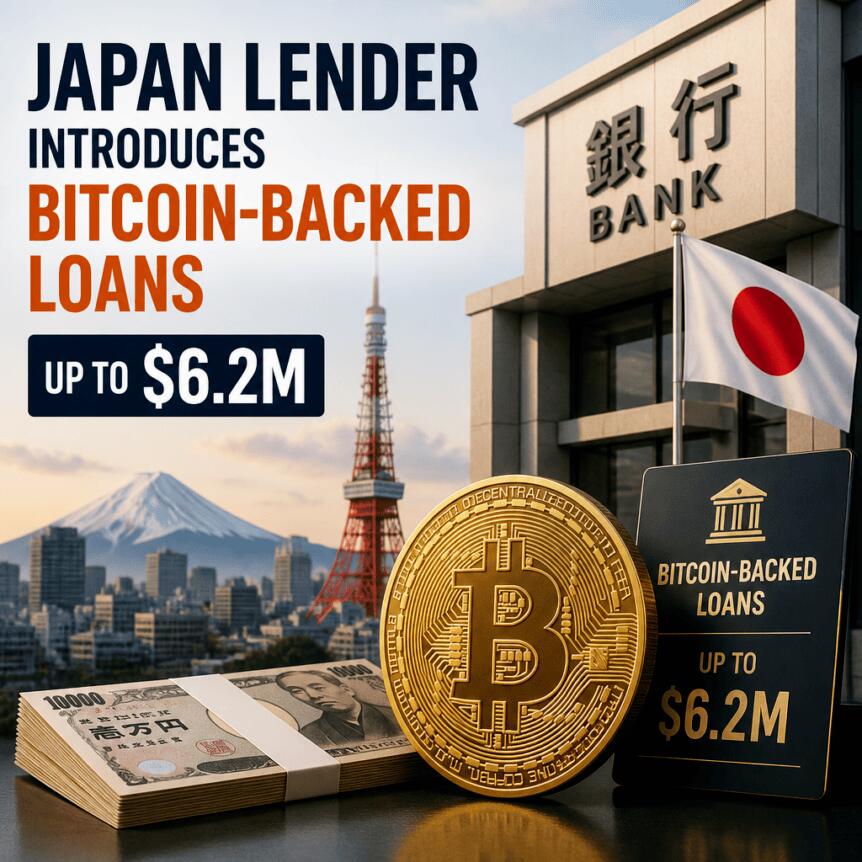
Japanese digital-asset lender CRYL has introduced a regulated Bitcoin-backed loan product that lets borrowers access fiat without selling their BTC. The new offering supports loans of up to 1 billion yen (about $6.2 million) for both individuals and businesses, using Bitcoin as collateral.
According to CRYL’s announcement on PR Times, loan sizes range from roughly $6,200 to $6.2 million at annual interest rates of 3.5% to 7%. Borrowers post a 40% to 60% collateral ratio, with the loan term set at one year. Funds can be used for a range of expenses, including tax payments, business financing, and property purchases.
Key takeaways
- CRYL’s Bitcoin-backed loans allow borrowers to raise yen liquidity without liquidating BTC, with a maximum size of 1 billion yen.
- Pricing in the new product ranges from 3.5% to 7% annually, with collateral ratios set between 40% and 60%.
- The loans run for one year and, in most cases, use a lump-sum repayment structure where principal and interest are due at maturity.
- Japan’s regulated crypto-backed lending market is still small, but the launch increases competition beyond an earlier provider.
- Other Japanese firms are exploring BTC’s role in broader credit products, though some initiatives remain in the research stage.
How CRYL’s Bitcoin-backed loan works
CRYL positions the service as a third path for Bitcoin holders in addition to simply keeping BTC or selling it. As described in the company’s release, applicants must pass a screening process before receiving financing—an important constraint for anyone expecting a frictionless borrowing experience.
While CRYL frames the product as allowing access to yen liquidity, the structure includes key protections typically associated with collateralized lending. Borrowers provide BTC collateral under a 40% to 60% ratio, and the program’s one-year tenor means repayment timing is concentrated rather than spread out monthly.
The company also indicates that most loans follow a lump-sum repayment approach, with principal and interest due after one year. For users, that matters for cash-flow planning: the benefit of borrowing without selling BTC may be offset by the need to have repayment funds ready at maturity.
Japan’s regulated crypto-backed lending: Fintertech as the benchmark
The CRYL launch arrives in a market that already had at least one established player. In 2020, Fintertech—a joint venture of Daiwa Securities Group and Credit Saison—launched a similar concept: loans where customers can borrow fiat against Bitcoin or Ether.
Fintertech’s current product listings show annual rates of 4% to 8% with a 50% collateral ratio and a minimum borrowing amount of 5 million yen (about $31,000). In comparison, CRYL advertises a higher maximum loan ceiling and a lower minimum, but with a narrower collateral scope: CRYL’s product uses Bitcoin as collateral rather than both BTC and ETH.
One clear signal that lending infrastructure in Japan is maturing is distribution. In October 2025, Daiwa Securities began introducing Fintertech’s digital asset-backed loans to customers through branches across Japan. That distribution expansion matters because it can reduce barriers for mainstream customers who prefer in-person banking channels rather than fully digital onboarding.
Fintertech is owned 80% by Daiwa Securities Group and 20% by Credit Saison, giving it an advantage in bridging traditional finance and crypto-collateral lending.
Why BTC collateral lending is gaining attention
Japan’s interest in Bitcoin-backed credit is increasingly visible beyond single products. While CRYL and Fintertech focus on collateralized loans, other companies are exploring how BTC could be used to support broader credit structures.
On Friday, Metaplanet Securities—linked with yen stablecoin issuer JPYC and tokenization infrastructure provider Progmat—announced a study into using BTC as collateral or credit enhancement for digital corporate bonds and other blockchain-based credit instruments. The companies stated that the effort remains in a research phase, with no issuance decision made.
This distinction is important. Collateralized loans like CRYL’s have a clearer implementation path, since borrowers and repayment obligations are straightforward to structure. By contrast, using BTC to enhance or secure corporate bond frameworks may require additional legal, operational, and risk-management design work—hence the “study” stage.
Still, CRYL’s launch highlights a practical direction: in Japan, Bitcoin is increasingly being treated not only as a held asset, but as a source of liquidity that can be routed into everyday financial needs—taxes, business expenses, or real-estate purchases—while retaining exposure to BTC price movements.
What borrowers should watch next
With CRYL now offering a one-year, BTC-only collateral loan with defined collateral ratios and lump-sum repayment dynamics, the immediate question for borrowers is how demand will evolve versus Fintertech’s longer-running BTC/ETH offering. Readers should watch for whether pricing tightens over time, how underwriting criteria develop, and whether competition expands beyond loans into more complex credit products that use Bitcoin as a structural credit support.
https://www.cryptobreaking.com/japan-lender-introduces-bitcoin-backed/?utm_source=blogger%20&utm_medium=social_auto&utm_campaign=Japan%20Lender%20Introduces%20Bitcoin-Backed%20Loans%20Up%20to%20$6.2M%20
Comments
Post a Comment