
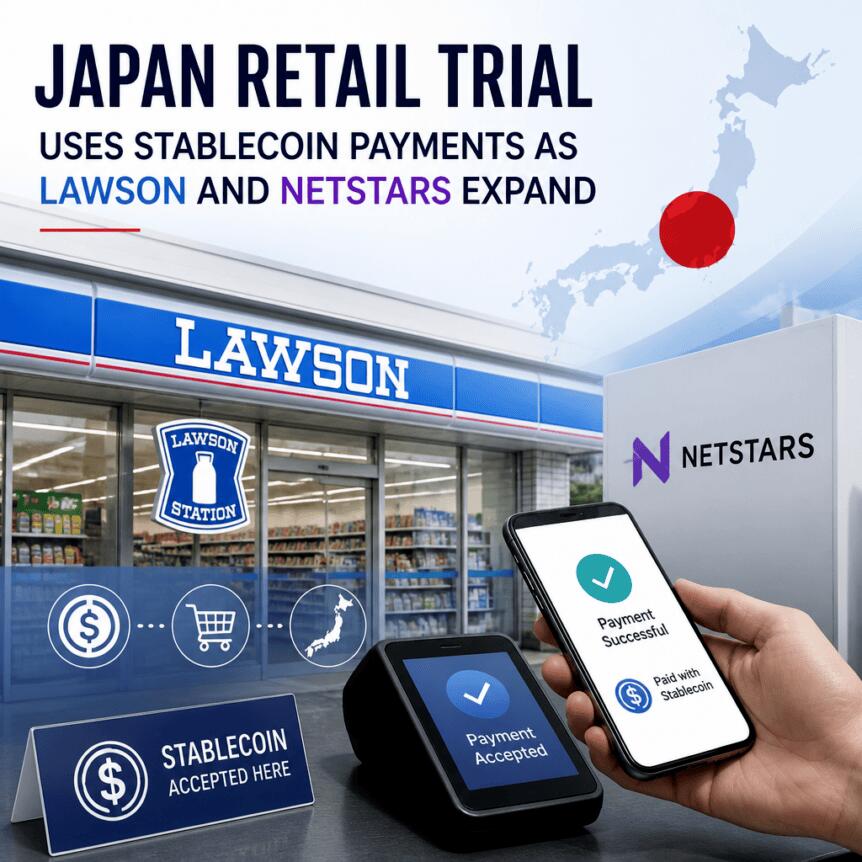
Japanese payments adoption is moving from small pilots toward more practical, merchant-ready stablecoin use. Lawson, one of Japan’s best-known convenience-store chains, will trial yen-denominated stablecoin payments inside a real store checkout flow this August, while Netstars has launched a service that lets merchants accept multiple stablecoins as payment options.
Together, the two developments highlight how Japan’s regulated stablecoin environment is increasingly focused on integration details—how payments happen at the register, how merchants settle in yen, and what wallet or infrastructure customers need.
Key takeaways
- Lawson will run an August trial of yen-denominated stablecoin payments at a Tokyo location, using HashPort’s non-custodial wallet and Lawson’s existing point-of-sale system.
- The Lawson pilot is designed to test whether stablecoins can fit smoothly into standard convenience-store checkout operations without merchants managing crypto wallets.
- Netstars launched “Stablecoin Pay” for merchants, initially supporting USDC, USDT, and JPYC via the Solana and Polygon networks.
- Netstars says its setup helps merchants price and settle in yen while customers pay with dollar-denominated stablecoins, aiming to reduce crypto and exchange-rate handling for merchants.
Lawson and HashPort test stablecoin checkout in a real store
On Monday, blockchain company HashPort said it has signed an agreement with Lawson and telecom group KDDI to conduct a trial at the Lawson Takanawa Gateway City store in Tokyo. According to HashPort’s announcement on PRTimes, participants will use HashPort’s non-custodial wallet, while the store will process payments through HashPort’s point-of-sale integration—without the store needing to open or manage crypto wallets.
The stated goal is practical: determine how stablecoin payments can be integrated into Japan’s everyday retail infrastructure, specifically within the checkout flow of a convenience store. That matters because “accepting crypto” can look very different at the register compared with an online checkout, especially when merchants want predictable operations and minimal changes to store systems.
Before expanding beyond the pilot, the companies plan to evaluate integration requirements, checkout operations, payment processing times, and whether the wallet experience is usable for customers. The emphasis on operational metrics suggests the trial is as much about systems fit as it is about payment settlement.
Netstars rolls out a merchant service for multi-stablecoin payments
In a separate move, Netstars launched a merchant-facing product called Stablecoin Pay. The company’s announcement, also published on PRTimes, opens applications for merchants that want to offer multiple stablecoins as payment options.
Stablecoin Pay initially supports three stablecoins: USDC, USDT, and JPYC (a yen-denominated stablecoin). Netstars says these can be used through the Solana and Polygon networks, with MetaMask as the supported wallet. The company set its merchant payment fee at 0.98% and said it plans to add more wallet and blockchain support over time.
Netstars also described how the service is intended to work from a merchant operations perspective. It says that merchants can use existing payment terminals in most cases and manage product pricing, sales records, and settlement in yen even when customers pay with dollar-denominated stablecoins. In its framing, that reduces the need for merchants to hold crypto or handle exchange-rate complexity.
Netstars’ timeline also matters for context. The company’s commercial launch follows earlier trials it ran using USDC payments—first at Tokyo’s Haneda Airport from January to February, and later at a trading-card store in Himeji starting in April, according to Netstars’ trial references. The new merchant service marks a step from location-based tests toward a broader offer aimed at business operators.
Japan’s stablecoin rules are shaping real-world product design
Both projects land in the context of Japan’s evolving stablecoin regulatory landscape. Japan introduced a dedicated stablecoin framework on June 1, 2023, when amendments to the Payment Services Act and related laws took effect. The framework created regulatory categories for fiat-linked stablecoins and requires intermediaries operating in certain capacities to register with Japan’s Financial Services Agency.
Subsequent regulatory milestones have helped specific stablecoin products become usable in Japan. Coverage noted that USDC received regulatory approval for distribution in March 2025. JPYC later registered as a fund transfer service provider that August—before the stablecoin launched in October, based on prior reporting.
For merchants and payment providers, the practical takeaway is that regulatory compliance increasingly informs product architecture. Netstars’ approach—settling in yen while accepting multiple stablecoins—reflects a design choice that keeps everyday commerce consistent for retailers. HashPort and Lawson’s trial similarly focuses on minimizing merchant operational burden by routing payment processing through an integrated point-of-sale flow and using a non-custodial customer wallet.
What to watch next for stablecoin payments in Japan
As these trials and merchant products progress, the key uncertainties are less about whether stablecoins can be transferred and more about whether the entire user-and-merchant workflow feels seamless. For Lawson’s pilot, readers should watch reported integration and checkout performance metrics—especially usability and processing time. For Netstars’ Stablecoin Pay, monitoring merchant onboarding, additional supported wallets and blockchains, and continued evidence of smooth yen settlement will indicate whether multi-stablecoin payments can scale beyond early pilots.
https://www.cryptobreaking.com/japan-retail-trial-uses-stablecoin/?utm_source=blogger%20&utm_medium=social_auto&utm_campaign=Japan%20Retail%20Trial%20Uses%20Stablecoin%20Payments%20as%20Lawson%20and%20Netstars%20Expand%20
Comments
Post a Comment