
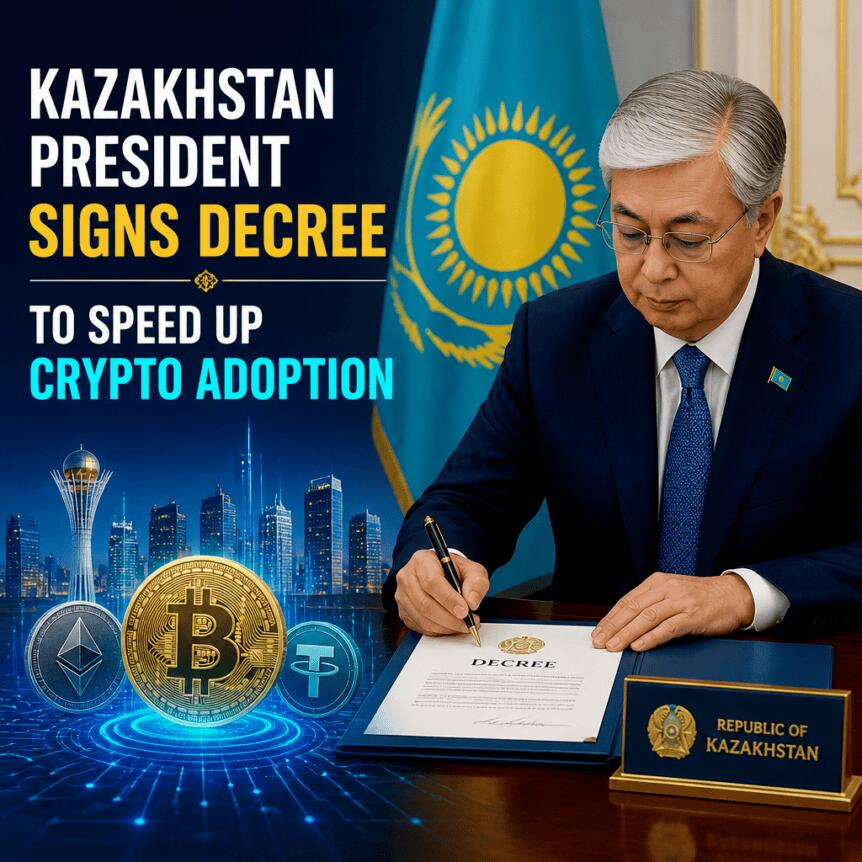
Kazakhstan is taking another step to formalize its crypto industry, signing a presidential decree designed to expand a regulated digital asset market and modernize how payments can work with stablecoins and other digital assets. The Ministry of Artificial Intelligence and Digital Development (MAIDD) said the order—developed with the central bank and the Astana International Financial Centre—was announced Wednesday.
Beyond creating a clearer framework for digital asset service providers, the decree also ties Kazakhstan’s crypto expansion to a new approach to energy supply for mining, including a mechanism to route certain gas resources into electricity generation when those fuels are not needed for state purposes.
Key takeaways
- The decree sets out rules for using stablecoins and digital assets in cross-border settlements within Kazakhstan’s regulated financial infrastructure.
- MAIDD says the government wants to encourage users holding digital assets abroad to disclose and move them to licensed domestic service providers.
- Tax incentives are planned for digital asset activity conducted through regulated infrastructure, including a proposed personal income tax exemption on related income.
- Kazakhstan’s mining strategy is paired with an energy mechanism aimed at enabling electricity generation from associated petroleum gas and natural gas when not required for state needs.
Stablecoins and digital assets in cross-border payments
A central element of the decree focuses on updating Kazakhstan’s payments infrastructure. According to the government, the plan includes creating mechanisms that allow digital assets and stablecoins to be used in cross-border settlements—effectively adding them to the country’s operational toolkit for export and import activity.
MAIDD characterized the goal as expanding the ability to conduct international transactions while keeping those activities inside a regulated environment. The framing matters because cross-border crypto rails can operate very differently from traditional settlement systems; Kazakhstan’s approach suggests an effort to bring stablecoin use closer to licensing and oversight rather than leaving it solely to informal or overseas platforms.
The decree also targets the flow of activity away from unregulated services. Users with digital assets held on foreign platforms are expected to disclose those holdings and transfer them to approved domestic digital asset service providers under Kazakhstan’s licensing framework.
Related coverage from Cointelegraph previously highlighted how stablecoins have diverged across use cases, with USDT-oriented usage patterns often discussed in payments contexts and USDC associated more with DeFi activity (as summarized in a Dune analysis report). This matters for Kazakhstan’s policy direction because the decree specifically references stablecoins as part of cross-border payments modernization.
Regulated rails and tax incentives for compliant users
Kazakhstan’s draft policy does not only aim at infrastructure. It also introduces incentives intended to encourage participation through compliant channels.
For individuals, MAIDD said the government plans tax incentives for digital asset activity conducted via regulated infrastructure. The decree includes a proposed exemption from personal income tax on income related to those activities—an explicit signal that policymakers want more activity to take place through approved services rather than remaining outside the tax perimeter.
That design is likely to be a key differentiator for traders and users deciding where to custody, transact, or obtain services. If implemented as described, the tax benefit could make licensed domestic platforms more attractive, particularly for participants who otherwise would have relied on offshore exchanges or wallets.
Energy strategy for autonomous mining operations
Alongside payments and regulation, the decree addresses a long-running constraint for mining operations: power availability and sourcing. Kazakhstan’s announcement includes a mechanism that allows associated petroleum gas and natural gas from oil and gas fields to be used for autonomous electricity generation when those resources are not needed for state purposes.
The electricity produced through this route is intended to support digital mining operations, effectively adding an energy component to the country’s broader crypto strategy. In practice, this could help mining operators reduce reliance on conventional grid supply for certain loads, depending on how the mechanism is implemented and monitored.
Kazakhstan’s mining positioning is already frequently cited in global data. The government referenced Cambridge Centre for Alternative Finance (CCAF) information from 2022, stating Kazakhstan ranked third globally by estimated Bitcoin mining hash rate.
The decree also sits on top of an earlier policy development described by the government: Kazakhstan introduced a “70/30” energy model that allows data centers and digital miners to directly access up to 70% of new power generation capacity created through infrastructure upgrades.
Taken together, the stablecoin-and-tax component and the energy component suggest a coherent push: policymakers want both the demand side (payments, custody, regulated service usage) and the supply side (power inputs for mining) to fall under a broader framework.
From tokenized instruments to trading infrastructure
MAIDD said the decree also outlines plans to develop tokenized financial instruments and a national trading infrastructure. The policy direction is consistent with the stated objective of attracting digital asset investment while ensuring transparency and protections for participants.
In remarks attributed to MAIDD Minister Zhaslan Madiyev, the ministry said the aim is to make Kazakhstan a “point of attraction for global capital and expertise” while maintaining “maximum transparency and protection for every participant in this market.”
For investors and builders, the most immediate operational question is how quickly these frameworks move from decree language into enforceable licensing and compliance requirements. While the announcement provides clear policy goals—stablecoins in cross-border settlements, incentives for regulated activity, and energy mechanisms for mining—readers should watch for the specific regulatory implementing acts that define which service providers qualify and what compliance steps users must follow to access the incentives.
As Kazakhstan builds these regulated rails, the next phase to monitor will be how domestic licensing for digital asset service providers expands, how the tax exemption proposal is finalized, and whether the energy routing mechanism for gas-to-power can be operationalized at mining scale.
https://www.cryptobreaking.com/kazakhstan-president-signs-decree-to/?utm_source=blogger%20&utm_medium=social_auto&utm_campaign=Kazakhstan%20President%20Signs%20Decree%20to%20Speed%20Up%20Crypto%20Adoption%20
Comments
Post a Comment