
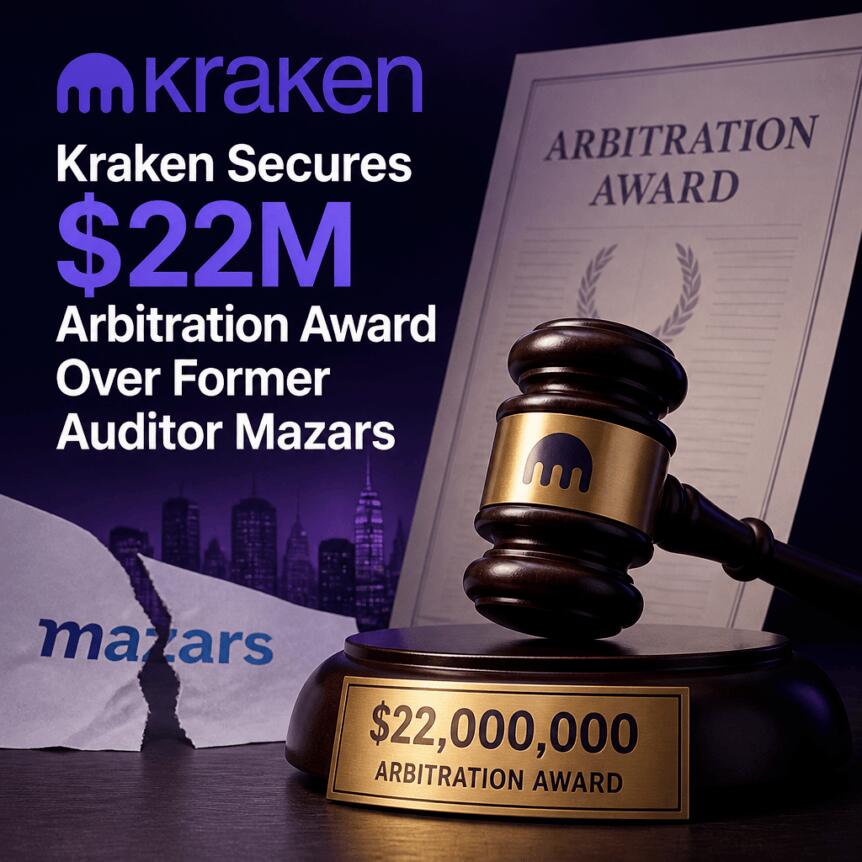
Kraken’s parent company, Payward, says it has secured a $22 million arbitration award against its former auditor, Mazars USA, and has moved to have the award entered as a judgment in Delaware’s Court of Chancery. The update comes via a letter published Tuesday by Payward co-CEO Arjun Sethi.
Payward’s filing characterizes the dispute as compensation for financial harm tied to what Sethi described as pressure campaigns aimed at lawful crypto firms—an issue that has remained central to broader debates over banking access for the digital-asset industry.
Key takeaways
- Payward says it won a $22 million arbitration award against Mazars USA and is seeking court judgment to formalize it.
- Payward claims Mazars withdrew from Kraken’s nearly completed 2022 audit despite stating it found no fraud or issues with management integrity.
- Sethi links the auditor departure to “Operation Chokepoint 2.0”—a wider alleged effort to pressure banks and service providers away from crypto.
- The letter points to 2023 U.S. regulatory developments and banking network collapses to support the broader narrative.
- Kraken executives continue to frame auditor access as vital, while U.S. regulators work on “debanking” supervision concerns.
Payward pursues judgment in Delaware after arbitration win
In Sethi’s Tuesday letter, Payward stated that it has won an arbitration award totaling $22 million against Mazars USA. Payward then asked the Delaware Court of Chancery to enter judgment on the award, according to the co-CEO’s publication.
Payward’s account emphasizes the context of the nearly completed 2022 audit. The company said Mazars withdrew from the engagement even though it had purportedly concluded there was no fraud, raised no concerns about management’s integrity, and reported no disagreements with Payward.
Sethi used the moment to underscore what he described as the practical importance of independent auditing. “An audit is not a favor. It is oxygen,” he wrote, arguing that audits are often required to maintain the trust and documentation banks and regulators expect—particularly for obtaining banking services, licenses, and other business relationships.
Why Payward says the auditor exit matters
For crypto businesses, an auditor is more than a compliance checkbox. Audited financial statements can influence how banks assess risk, how counterparties evaluate legitimacy, and how regulators gauge transparency. Payward’s narrative therefore turns a specific arbitration dispute into a broader case study about how access to traditional financial rails can hinge on third-party relationships.
Sethi further argued that Mazars’ withdrawal was connected to “Operation Chokepoint 2.0,” which he described as a campaign that pressured banks, auditors, and other institutions to cut ties with crypto companies despite their lawful status.
In support of that claim, the letter cited a range of 2023 developments. These included:
- Joint guidance from U.S. banking regulators.
- The Securities and Exchange Commission’s Staff Accounting Bulletin No. 121, which Payward noted has since been rescinded.
- The collapse of crypto-focused banking networks including Silvergate SEN and Signature’s Signet.
While Payward’s letter uses these events to bolster its framing, the key factual point for readers is Payward’s assertion that the auditor’s departure occurred even after Mazars found no fraud and did not flag integrity or reporting concerns. The implication is that the exit was not driven by a conventional audit-based failure—at least as Payward describes it—making the arbitration outcome and the court step to enter judgment particularly significant to the company.
Kraken executives connect the case to broader “debanking” concerns
Payward’s leadership also addressed the arbitration win publicly. Kraken co-CEO Dave Ripley posted on X that the story is “worth surfacing” despite being “PTSD-inducing,” arguing that only “a fraction of the stories from that era have ever been told.”
Ripley described the $22 million award as compensation for financial harm he linked to what he called a coordinated campaign against the crypto industry. Payward’s executives thus position the arbitration award not just as a private dispute resolution, but as an example of how crypto firms can face structural obstacles from the traditional institutions they rely on.
At the same time, regulators in the U.S. have continued to confront complaints about “debanking”—the risk that banks terminate or restrict accounts for reputational reasons rather than concrete misconduct. According to earlier coverage, in February the Federal Reserve sought public feedback on a proposal to formally remove “reputation risk” from bank supervision. The move was described as following a 2025 directive to stop pressuring banks to close customer accounts over reputational concerns, and critics argued the change could help bring an end to Operation Chokepoint 2.0.
For crypto stakeholders, the practical question is whether regulatory supervision adjustments translate into measurable improvements in banking access—especially for firms that need auditors, custodians, and intermediaries to operate at scale.
What else the company has been signaling: IPO plans and timing uncertainty
Beyond the arbitration, Payward and Kraken have continued to discuss broader corporate milestones. Kraken, founded in 2011, has been widely expected to pursue an initial public offering.
In November 2025, Kraken said it had confidentially submitted a draft Form S-1 registration statement to the U.S. Securities and Exchange Commission. However, reporting in May suggested the timeline for a public debut may extend to 2027, citing weaker crypto market conditions and the exchange’s ongoing cost-cutting efforts.
While the auditor dispute is a separate development, it fits into the same investor-relevant theme: how traditional finance gatekeepers—auditors, banks, and regulators—can shape the cost of doing business and the path to market participation. If Payward’s framing is accurate, arbitration outcomes may serve not only as recovery for past harm but also as leverage in future negotiations with institutional counterparties.
As Payward seeks Delaware court confirmation, readers should watch whether the judgment process proceeds smoothly and whether the dispute’s narrative—no fraud found, yet audit withdrawal occurred—finds echoes in other similar cases. In parallel, attention will likely remain on how U.S. banking regulators handle “reputation risk” and whether that guidance meaningfully reduces the operational friction crypto companies report when trying to retain or replace auditors and banking relationships.
https://www.cryptobreaking.com/kraken-secures-22m-arbitration-award/?utm_source=blogger%20&utm_medium=social_auto&utm_campaign=Kraken%20Secures%20$22M%20Arbitration%20Award%20Over%20Former%20Auditor%20Mazars%20
Comments
Post a Comment