
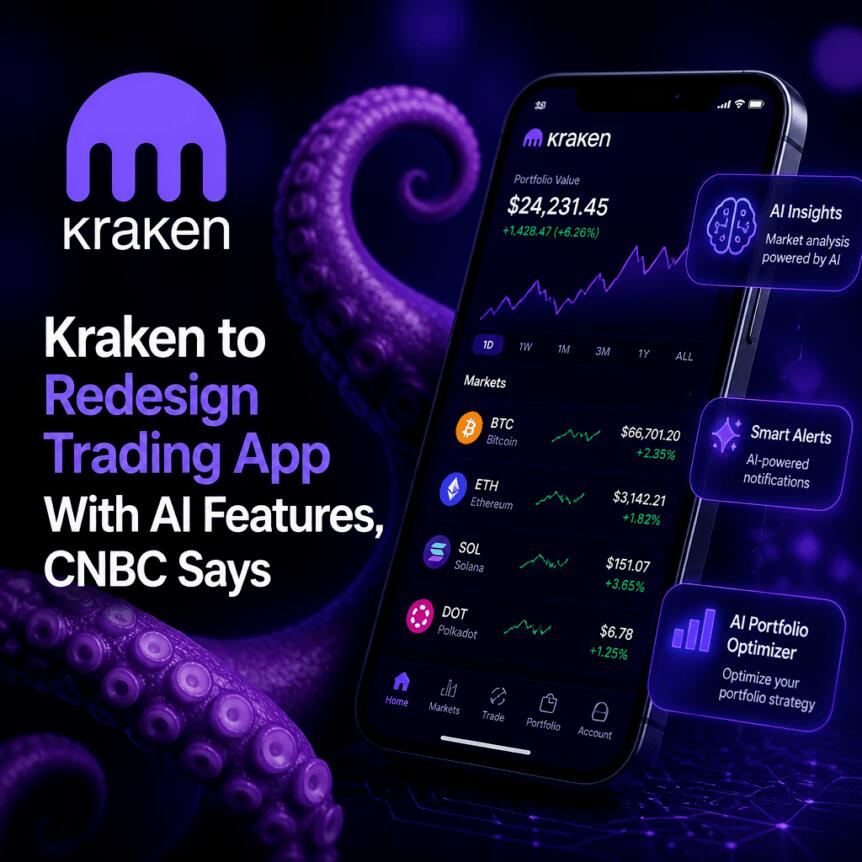
Kraken is rolling out a new set of AI-driven “financial intelligence” tools inside its mobile app, aiming to make crypto investing feel less like an interface challenge and more like decision support. The exchange says users will start by setting financial goals and preferences, after which the app will tailor what it shows and which portfolio recommendations it surfaces—without taking control of trades.
According to an announcement, Kraken’s system continuously monitors markets and flags opportunities, but every suggested action must be approved by the user. In reporting from CNBC, the updated app uses a customer’s goals, risk tolerance, funding preferences and broader financial profile to generate a suggested portfolio, which users can review and adjust before investing. After funds are deployed, it provides personalized portfolio updates and additional investment suggestions based on what the user holds.
Key takeaways
- Kraken’s mobile update personalizes recommendations around user-set goals like buying a home, retirement savings, or an emergency fund.
- Despite AI “financial intelligence,” Kraken’s recommendations are decision-support only—users must approve every trade before execution.
- The approach mirrors a wider industry shift: exchanges are moving from basic order entry toward conversational portfolio guidance.
- Other major platforms are already testing AI agents and assistants that can transact or place orders, though user review and consent remain a common requirement.
From trading screens to goal-based investing
Kraken’s update is built around a simple premise: most investors don’t want to start with complex trading tools—they want clarity around outcomes. The company says its redesigned app begins by asking users to define financial goals and preferences, then adapts its interface and recommendations to match those objectives. Instead of treating crypto as just another asset to trade, Kraken is positioning the tools as a way to support structured investing decisions.
Kraken describes its AI system as “financial intelligence” that watches markets for potential opportunities and recommends trades. However, the company draws a clear line between guidance and automation: it does not execute transactions on a user’s behalf. Each recommendation requires the user’s approval, making the experience more like an assistive layer on top of existing trading functions rather than an autonomous trading engine.
How the app generates portfolios—and where approval fits
CNBC reports that Kraken’s platform incorporates market monitoring data alongside personal inputs—risk tolerance, funding preferences and financial profile—to produce a suggested portfolio. That portfolio is not presented as a final instruction. Users are expected to review and adjust the proposal before investing.
Once a user has acted, the system continues to provide personalized portfolio updates and further suggestions that reflect the user’s holdings. The key element for investors and traders is the workflow: the AI proposes, the user disposes. That distinction matters for both risk management and compliance concerns, and it helps explain why exchanges are able to market AI capabilities without fully removing human control.
In comments to CNBC, Kraken chief data officer Kamo Asatryan said the technology is intended to give everyday investors visibility similar to what active traders may already have, by continuously monitoring markets, identifying opportunities and recommending trades. He framed the goal as enabling non-experts to participate in more sophisticated decision-making “using plain English,” rather than requiring constant manual interpretation of market data and trading mechanics.
The broader push for agentic tools across crypto
Kraken’s move fits a broader competitive pattern across crypto exchanges and fintech platforms: adding AI to help users analyze markets, manage portfolios, and interact with trading systems via more natural, assistant-like experiences. Instead of only supporting traditional order types, these products increasingly aim to translate user intent—often stated in conversational language—into actionable guidance.
In June, OKX launched a beta marketplace for AI agents that can transact autonomously, complete onchain tasks, and build blockchain-based reputations. Around the same time, Coinbase introduced a tool allowing AI agents to make payments and trade cryptocurrencies on behalf of users using its x402 payments protocol. In both cases, the industry debate is not whether AI can be useful, but how much autonomy it should be given and how responsibility is handled.
Chainalysis reported last month that agentic payment activity on Coinbase’s Base network surpassed 100 million transactions. While transaction growth has stabilized, the report indicated that higher-value transfers have become more common—suggesting agent-driven payments are evolving beyond the earliest wave of small, test-like activity. For investors and builders, that shift is a signal that AI-enabled “agentic” actions may increasingly be used for meaningful payments rather than only experimentation.
Meanwhile, fintech firm Revolut announced an upgrade to its Revolut X exchange, enabling customers to connect AI assistants—including Claude, Gemini, Cursor and OpenClaw—to analyze markets, backtest trading strategies and place orders through natural-language prompts. Like Kraken, Revolut’s approach requires customers to review and approve every trade before execution, reinforcing the notion that user consent remains the default boundary even as interfaces become more automated.
Why Kraken’s positioning matters for users
Kraken’s “financial intelligence” framing highlights an important distinction in how exchanges are adopting AI. Autonomy is one dimension, but user experience and decision architecture are another. By centering the workflow on goals and risk preferences, Kraken is trying to reduce friction for users who may otherwise struggle to map personal objectives onto trading choices.
For retail investors, goal-based guidance could make portfolio management more consistent—especially when combined with ongoing updates after investment. Still, the success of such tools will likely depend on how effectively recommendations reflect the user’s stated objectives and how clearly the system explains why a particular trade or portfolio shift is suggested. Kraken’s insistence on approval before execution provides a safety valve, but users will still need to understand the recommendations they accept.
For market participants more broadly, Kraken’s rollout underscores that AI features are becoming a competitive baseline rather than a differentiator reserved for the most tech-forward platforms. Even where full agentic autonomy is not enabled, exchanges are competing on the quality of their guidance, the speed at which they can interpret market conditions, and the clarity with which they translate complex strategies into something everyday customers can act on.
Next, investors should watch how Kraken measures engagement and outcomes from the new goal-based recommendations—particularly whether users stick with the guidance after the initial setup—and whether similar interfaces expand beyond portfolio suggestions into deeper automation. The remaining uncertainty is how quickly the market will move from decision support to fully autonomous action, especially as regulators, user expectations, and platform designs continue to converge.
https://www.cryptobreaking.com/kraken-to-redesign-trading-app/?utm_source=blogger%20&utm_medium=social_auto&utm_campaign=Kraken%20to%20Redesign%20Trading%20App%20With%20AI%20Features,%20CNBC%20Says%20
Comments
Post a Comment