
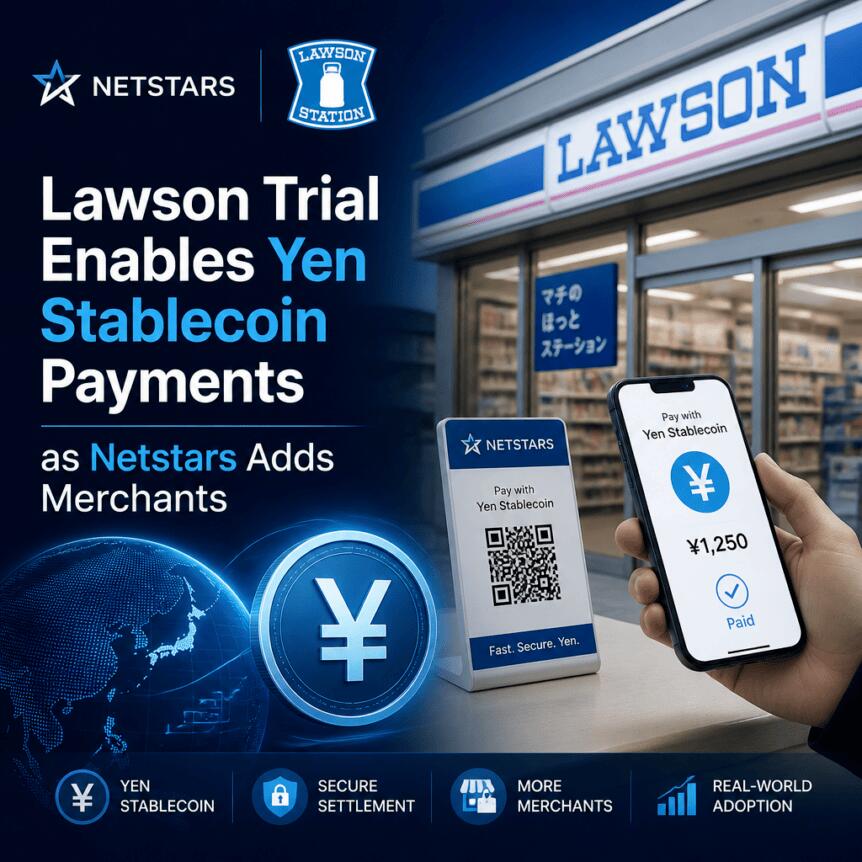
Japanese retail and payments firms are taking the next step toward real-world stablecoin usage, with two separate developments aimed at easing the gap between crypto rails and everyday checkout flows.
Lawson will test yen-denominated stablecoin payments at a convenience-store location in Tokyo in August, while Netstars has launched a merchant service that lets businesses accept multiple stablecoins and settle in yen using existing terminals in many cases.
Key takeaways
- Lawson’s August trial with HashPort and KDDI targets in-store stablecoin checkout—designed to limit merchant operational burden.
- HashPort will provide a non-custodial wallet, with the store handling payment processing through its point-of-sale system.
- Netstars’ new Stablecoin Pay supports USDC, USDT, and JPYC initially, operating on Solana and Polygon with MetaMask.
- Netstars sets its merchant fee at 0.98% and says the service helps businesses settle in yen without managing exchange-rate complexity.
Lawson and HashPort set up a stablecoin trial inside Japan’s convenience-store flow
HashPort said on Monday that it has signed an agreement with Lawson and telecom group KDDI to run a pilot at the Lawson Takanawa Gateway City store in Tokyo. The test will evaluate whether stablecoin payments can be integrated into a typical convenience-store checkout workflow.
According to HashPort, participants will use the company’s non-custodial wallet. At the same time, the store will process transactions through HashPort’s point-of-sale integration, with the intent of avoiding the need for the merchant to open or manage crypto wallets directly.
The stated goal of the pilot is practical: to examine the requirements for integration, how the checkout process behaves under real retail conditions, payment processing time, and whether the wallet experience is usable for participants.
For investors and builders, the emphasis on checkout operations matters. Many stablecoin pilots fail to progress because merchants see payment acceptance as adding new staff workflows, extra systems to manage, or operational uncertainty around settlement and verification. By focusing on how stablecoin payments behave at a standard POS checkout, the companies are effectively testing whether stablecoin payments can fit within existing retail infrastructure rather than replacing it.
Netstars launches Stablecoin Pay for merchants accepting multiple stablecoins
In a separate push, Netstars launched Stablecoin Pay on Monday and opened applications for merchants that want to offer stablecoins as payment options. Netstars positions the service as a way to broaden stablecoin acceptance beyond single-asset pilots and toward ongoing merchant operations.
Per Netstars, the initial rollout supports three stablecoins: USDC, USDT, and JPYC. The service will run over both the Solana and Polygon networks, and MetaMask is listed as the supported wallet for the payment flow.
Netstars set the merchant payment fee at 0.98% and said it plans to expand wallet and blockchain support over time.
A key part of Netstars’ pitch is how merchants handle pricing and records. The company says merchants can use existing payment terminals in most cases and manage product pricing, sales records, and settlement in yen even if customers pay with dollar-denominated stablecoins. Netstars also claims this reduces the need for merchants to hold crypto or actively manage exchange-rate mechanics.
From pilots to merchant services under Japan’s regulated stablecoin framework
Netstars’ product launch follows earlier trials carried out in Japan. The company previously tested in-store USDC payments at Tokyo’s Haneda Airport from January to February, and later conducted trials at a trading-card store in Himeji starting in April. The move from limited testing environments to a merchant-facing service suggests Netstars believes operational learnings from those pilots are now mature enough to support broader commercial deployment.
These developments arrive as Japan’s stablecoin ecosystem continues to take shape under a dedicated regulatory approach. On June 1, 2023, Japan introduced a specific framework for stablecoins after amendments to the Payment Services Act and related laws took effect. The framework created regulatory categories for fiat-linked stablecoins and requires intermediaries to register with the Financial Services Agency.
The regulatory pathway has continued to expand: Cointelegraph previously reported regulatory approval for USDC distribution in March 2025. Separately, Cointelegraph noted JPYC’s registration as a fund transfer service provider in August of the same year—before JPYC launched in October, according to the reporting.
Against that backdrop, Lawson’s planned yen-stablecoin payment trial and Netstars’ multi-stablecoin merchant service reflect a broader pattern: Japanese firms are not only experimenting with stablecoin payments, but also aligning them with existing retail systems and the compliance expectations created by Japan’s framework.
What to watch next
In the near term, the most important details will be how smoothly each trial handles real checkout conditions—especially payment processing time, the usability of non-custodial wallets in a retail setting, and whether merchants can keep yen settlement workflows simple as stablecoins diversify. Readers should also watch how Netstars expands wallet and network support after the initial USDC, USDT, and JPYC rollout.
HashPort announcement on the Lawson-KDDI stablecoin trial
Netstars announcement on Stablecoin Pay
Japan Financial Services Agency: stablecoin framework introduction (June 1, 2023)
Related Cointelegraph coverage (as referenced in the source)
https://www.cryptobreaking.com/lawson-trial-enables-yen-stablecoin/?utm_source=blogger%20&utm_medium=social_auto&utm_campaign=Lawson%20Trial%20Enables%20Yen%20Stablecoin%20Payments%20as%20Netstars%20Adds%20Merchants%20
Comments
Post a Comment