
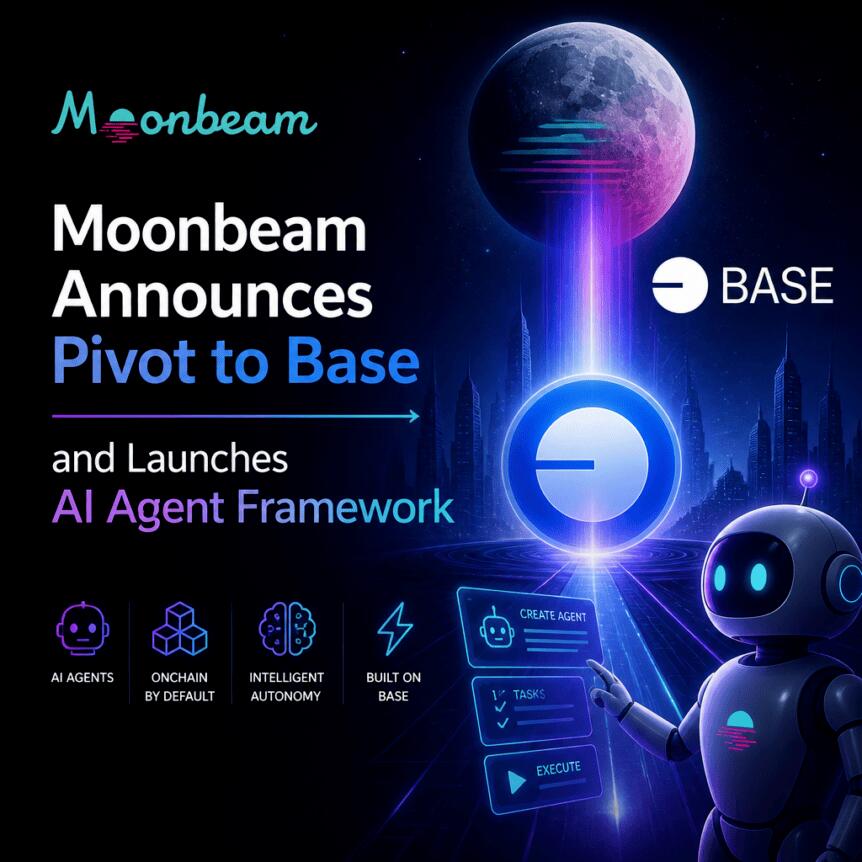
Moonbeam Network says it is shifting its focus from Polkadot to Ethereum layer 2 Base in order to build what it calls an “AI agent communication and settlement network.” The interoperability project framed the move as a strategic bet on autonomous, on-chain coordination between AI agents that can negotiate work and transact directly—without relying on a middleman.
In a Friday announcement, Moonbeam said the initiative is part of the “Moonbeam Protocol” and described the pivot as a reallocation of resources toward what it sees as the next major crypto frontier: agent-to-agent discovery, negotiation, and fully on-chain payments. The company did not provide a launch timeline for the Moonbeam Protocol.
Key takeaways
- Moonbeam is pivoting from Polkadot to Base to support an AI agent communication and settlement network.
- Moonbeam did not specify a launch date for the Moonbeam Protocol.
- GLMR token holders are instructed to bridge from Moonbeam’s Polkadot parachain to Base before July 31, 2026.
- Moonbeam says it will continue interoperability support on Polkadot during the transition and will not abandon existing builders or infrastructure providers.
Why Moonbeam is betting on Base for “agent settlement”
Moonbeam’s statement positions the Base pivot as more than a chain migration. The company argues that the most compelling long-term use case for blockchain is the emergence of autonomous AI agents that coordinate with each other on-chain and settle payments end-to-end.
That framing aligns with broader industry momentum around “agentic” workflows—an area where executives have repeatedly suggested that AI agents will become major users of blockchain-based payments. Cointelegraph previously reported on expectations from leaders including Coinbase CEO Brian Armstrong and Circle CEO Jeremy Allaire that AI agents could drive demand for on-chain payments in the coming years.
Still, adoption has been uneven. Cointelegraph noted earlier that while Coinbase’s x402 payments protocol has been a high-profile catalyst for the agent-payments narrative, Artemis data indicated only about $2 million in trading volume facilitated through x402 over the past 30 days. In parallel, Big Tech experimentation has not always translated into faster production deployment; Meta CEO Mark Zuckerberg said on Thursday that agent tools had not accelerated the company’s workflows as quickly as expected, according to Cointelegraph coverage.
Against that backdrop, Moonbeam’s move to Base suggests a strategic attempt to connect agent functionality with a more established Ethereum scaling ecosystem—while positioning its interoperability expertise as the connective tissue for cross-chain agent activity.
Community backlash and Polkadot ecosystem concerns
Not everyone welcomed the shift. Several community members characterized Moonbeam’s pivot as a setback for Polkadot, with some referring to Moonbeam as a flagship project for the ecosystem.
Moonbeam originally launched in January 2022 as a Polkadot parachain. At the time, it offered developers the ability to build Ethereum Virtual Machine-compatible applications within the Polkadot environment—an approach designed to lower the friction for Ethereum-native tooling and developer workflows while still benefiting from Polkadot’s broader interoperability vision.
Moonbeam’s new direction therefore changes the practical center of gravity for its future roadmap. Even if existing functionality remains supported for a transition period, the messaging implicitly signals that Moonbeam intends to prioritize agent-native settlement and coordination on Base going forward.
Bridging instructions for GLMR before mid-2026
The most immediate operational change concerns token movement. Moonbeam said holders of its token, GLMR, will need to bridge assets from Moonbeam’s Polkadot parachain to Base before July 31, 2026. This includes GLMR exposure in lending markets, staking contracts, and other DeFi protocols connected to the parachain.
Moonbeam also clarified that users who hold GLMR through a centralized exchange will not need to take action, implying that the exchange layer will handle the migration on their behalf.
Importantly, Moonbeam said it will keep providing cross-chain interoperability services on Polkadot through the transition period. The company added that it is not abandoning existing builders or infrastructure providers—an assurance intended to reduce the risk that the shift could leave teams stranded on Polkadot immediately.
For participants, the decision raises a practical set of questions that will matter as the deadline approaches: how bridge support will be maintained across different contract types, how long existing integrations will remain fully functional on the parachain, and what future liquidity and settlement patterns will look like once the activity concentrates on Base.
What investors and builders should watch next
Moonbeam did not provide a Moonbeam Protocol launch schedule, which leaves timelines and implementation details open. The next key items for market participants are likely to be: updates on the bridging process and user-facing tooling ahead of the July 31, 2026 deadline; clarification on how DeFi and staking setups will evolve during the transition; and—critically—whether Moonbeam’s agent-focused settlement network attracts real on-chain usage, particularly in light of past reports suggesting that agent payment adoption has been slow even where the concept has momentum.
https://www.cryptobreaking.com/moonbeam-announces-pivot-to-base/?utm_source=blogger%20&utm_medium=social_auto&utm_campaign=Moonbeam%20Announces%20Pivot%20to%20Base%20and%20Launches%20AI%20Agent%20Framework%20
Comments
Post a Comment