
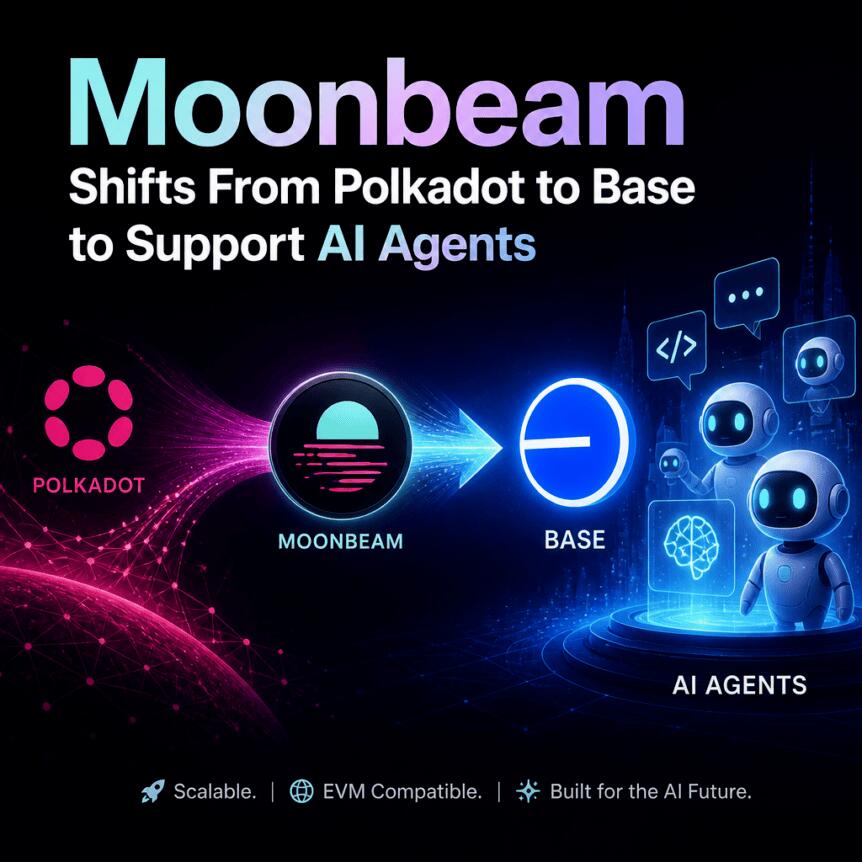
Moonbeam, an interoperability network originally built for Polkadot, says it is shifting its development focus to Ethereum’s Layer 2 Base. The company’s new plan centers on launching the “Moonbeam Protocol” as an AI agent communication and settlement network—an architecture it believes can benefit from growing interest in agent-driven, on-chain payments.
In a strategic update released Friday, Moonbeam framed the move as a pivot toward what it calls “autonomous AI agents” that can coordinate with one another, negotiate for work, and settle payments directly on-chain “without a middleman.” Moonbeam did not disclose a launch date for the Moonbeam Protocol.
Key takeaways
- Moonbeam says it is pivoting from its current Polkadot-centered roadmap to building an AI agent communication and settlement layer on Base.
- The company provided no timeline for the Moonbeam Protocol launch.
- Moonbeam tokenholders will need to bridge GLMR from Moonbeam’s Polkadot parachain to Base before July 31, 2026.
- Moonbeam says it will keep supporting its existing cross-chain interoperability services on the Polkadot parachain during the transition.
- The announcement lands as the broader “agentic” trend gathers institutional attention, but adoption in on-chain agent payment infrastructure remains limited.
Why Moonbeam is moving to Base for agent settlement
Moonbeam’s stated objective is to build an on-chain network designed for agent-to-agent coordination and settlement. The company argues that autonomous agents—programs that can locate each other, bargain over tasks, and execute payments—represent a “long-term opportunity” for blockchain infrastructure.
By relocating development resources to Base, Moonbeam is effectively betting that the practical bottleneck for agent-based ecosystems is moving from pure experimentation toward execution: enabling systems to transact reliably and automatically on-chain. The company didn’t specify the technical design of the Moonbeam Protocol, but its positioning suggests it intends to become a coordination layer for agent activity rather than just another cross-chain bridge.
Institutional and industry leaders have echoed similar expectations for agent-driven payments. Cointelegraph previously highlighted predictions from executives such as Coinbase CEO Brian Armstrong and Circle CEO Jeremy Allaire that AI agents could become major users of blockchain-based payments in the coming years.
At the same time, real-world adoption has not yet matched the narrative. Cointelegraph cited Artemis data indicating that only $2 million in trading volume had been facilitated through Coinbase’s x402 protocol over the prior 30 days, underscoring how early the space still is despite high-profile backing.
Polkadot concerns after Moonbeam’s pivot
The shift is also reverberating within the Polkadot community. Multiple voices on social media characterized Moonbeam’s pivot as a setback for Polkadot’s ecosystem, with at least one user calling it the network’s “flagship project.”
Moonbeam originally launched as a Polkadot parachain in January 2022, providing developers with the ability to build Ethereum Virtual Machine (EVM)-compatible applications inside the Polkadot environment. That origin is central to why the move is being seen as more than a simple product upgrade: it signals a reorientation of Moonbeam’s flagship direction away from its parachain-centric identity.
That said, Moonbeam’s statement also implies continuity during the transition period. The company says it will continue operating cross-chain interoperability services on the Polkadot parachain rather than immediately ceasing Polkadot-linked support.
How the GLMR migration works—and who must act
For existing users and decentralized finance participants, the most immediate question raised by the announcement is operational: what happens to GLMR tokens tied to Polkadot-based deployment.
Moonbeam said that GLMR holders will need to bridge their tokens from Moonbeam’s Polkadot parachain to Base before July 31, 2026. The update includes GLMR held in or connected to lending markets, staking contracts, and other DeFi protocols. That means many token balances that are not held in a simple wallet could require additional migration steps to preserve positions across chains.
Moonbeam also clarified that users who hold GLMR on a centralized exchange will not need to take action, suggesting exchanges will handle the process on behalf of customers.
Importantly, Moonbeam stated that it is not abandoning its existing builders or infrastructure providers. It intends to keep cross-chain interoperability running on the Polkadot parachain during the transition period, which may reduce the operational risk for teams and services that rely on ongoing interoperability rather than a clean cutover.
Still, for participants in lending, staking, and protocol integrations, the July 31, 2026 deadline effectively becomes the point by which on-chain and integration plans should be re-validated for Base. Investors and developers will likely want to track whether Moonbeam’s migration tools, cross-chain routing, and any protocol-level configuration changes are sufficient for complex DeFi positions—not just spot token transfers.
Agent hype meets slow infrastructure adoption
Moonbeam’s move reflects a broader push across crypto infrastructure to support agentic applications, but it also highlights the gap between expectations and current usage.
Coinbase’s x402 protocol has been one of the prominent catalysts in the “agentic payments” narrative, yet Cointelegraph’s cited Artemis figures indicate that activity remains comparatively small in dollar terms over a 30-day window. This suggests that even with major industry support, agent-driven on-chain payment flows are still early—and may depend on better consumer-facing products, clearer developer tooling, or stronger demand from actual agent deployments.
Outside crypto, progress is also uneven. Cointelegraph noted that Meta CEO Mark Zuckerberg said agent technology hadn’t accelerated the company’s workflows as quickly as expected, signaling that adoption cycles in the broader tech industry may be more gradual than early forecasts.
Within that context, Moonbeam’s strategy can be read as an attempt to move from agent experimentation toward an infrastructure layer that could standardize communication and settlement. Whether that standardization can translate into meaningful on-chain usage will be clearer only after the Moonbeam Protocol is deployed and used by developers and real agent systems.
For now, the key watchpoints are Moonbeam’s unspecified launch timeline, the execution details of the GLMR bridging process ahead of July 31, 2026, and whether early agent settlement activity grows enough to justify a full pivot to Base.
https://www.cryptobreaking.com/moonbeam-shifts-from-polkadot-to/?utm_source=blogger%20&utm_medium=social_auto&utm_campaign=Moonbeam%20Shifts%20From%20Polkadot%20to%20Base%20to%20Support%20AI%20Agents%20
Comments
Post a Comment