
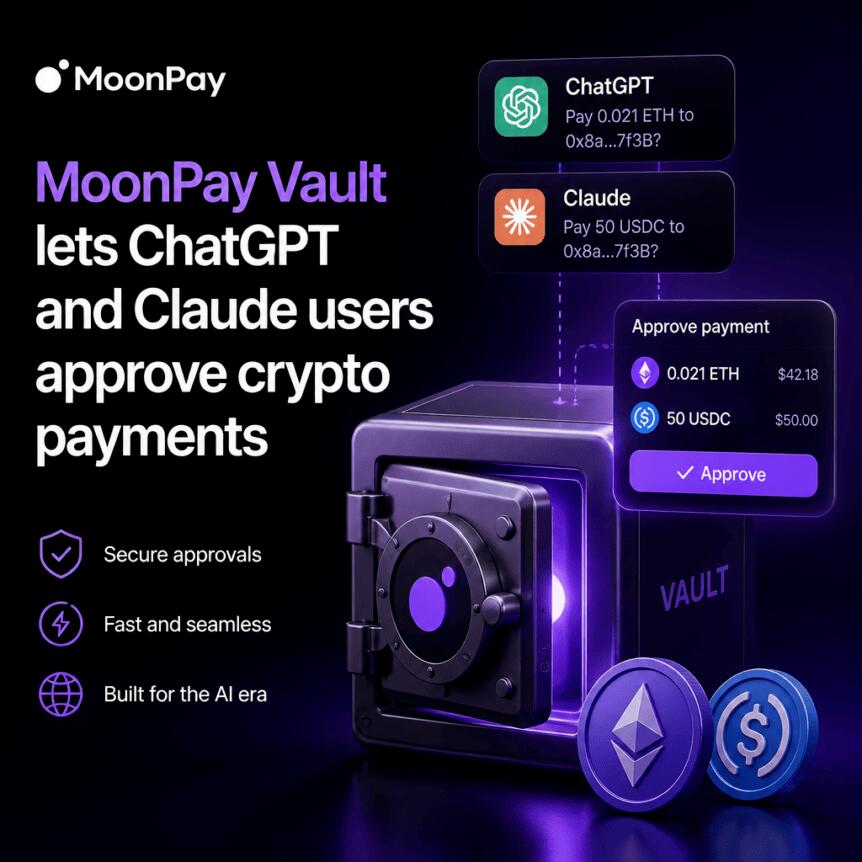
MoonPay has introduced PayBox, a “payment vault” designed to let users authorize AI assistants such as ChatGPT and Claude to carry out crypto actions directly from a conversation. The tool is positioned as a safer way for AI agents to handle tasks like token swaps, cross-chain transfers, and DeFi interactions—while keeping users in control of their funds.
Alongside PayBox, the launch highlights the growing role of x402, an open payments protocol developed by Coinbase for internet-native payments by AI agents. x402 has been moving toward wider industry standardization, including governance under the Linux Foundation and integration across cloud and custody infrastructure.
Key takeaways
- MoonPay’s PayBox aims to enable AI assistants to execute crypto transactions from chat, with user approvals supported via passkeys or spending limits.
- MoonPay says PayBox protects wallet keys using multi-party computation and trusted execution environments to prevent unilateral access by either the AI or MoonPay.
- PayBox supports multiple chains and payment rails, including debit cards, bank accounts, Apple Pay, and PayPal.
- x402 is expanding beyond Coinbase, including Linux Foundation governance and reported usage growth on Coinbase’s Base network.
- Public x402 ecosystem data (via x402scan) shows more than 12.7 million transactions over the past 30 days across participating services.
MoonPay’s PayBox: AI-initiated crypto with guardrails
PayBox is built to connect a user’s crypto wallet and payment methods to AI assistants, allowing those assistants to prepare on-chain actions after receiving natural-language prompts. According to MoonPay, the system can generate transaction flows such as token swaps, cross-chain transfers, and DeFi interactions.
A key design element is transaction authorization. MoonPay says users can approve each action using a passkey, or they can set spending limits that let the AI perform certain permitted operations automatically. Alternatively, users can require approval for every transaction, effectively keeping the assistant from executing any spend without explicit confirmation.
MoonPay also emphasized security around key custody. The company states PayBox uses multi-party computation and trusted execution environments to protect wallet keys, aiming to ensure neither the AI assistant nor MoonPay can independently access user funds. For users, that distinction matters because AI-driven payments introduce an obvious risk: the assistant might be capable of generating transactions, but should not be able to control the underlying assets without authorization.
Beyond consumer use, MoonPay says developers can integrate the payment vault into their own AI applications via its software development kit, positioning PayBox as infrastructure rather than only an end-user feature.
Why this matters: reducing friction without surrendering control
AI payments are often discussed in terms of convenience—an assistant handling purchasing, swapping, or settlement without requiring users to manually navigate wallets. PayBox takes a more security-forward angle by focusing on approval mechanisms and constraining what an AI can do.
For investors and builders, the most important question is where the “automation boundary” should be: how far should an assistant go before a user must sign off, and how should spending permissions be scoped. MoonPay’s approach—passkey-based approvals, optional per-transaction confirmation, and predefined spending limits—suggests an attempt to make that boundary explicit.
It also signals that AI payment systems may converge on user-consent patterns that resemble modern financial authorization workflows, rather than “fully autonomous” agent behavior. The market is already seeing demand for agentic capabilities, but the trust layer—especially key security and transaction approval—often determines whether mainstream users adopt these tools.
x402 traction and standardization under the Linux Foundation
PayBox also supports x402, an open payment protocol intended to let AI agents make internet-native payments. x402 was originally developed by Coinbase, and the protocol is now being governed as an open, vendor-neutral industry standard, following a contribution to the Linux Foundation in April 2026. The Linux Foundation announced the creation of a governance structure for x402 after welcoming the protocol contribution, and described it as an industry standard.
Coinbase has continued expanding the x402 ecosystem this year. In June, the exchange launched tools that reportedly enable AI agents to accept USDC payments, trade crypto, discover paid services through an AI marketplace, and handle high-frequency micropayments more efficiently. Earlier in the year, cloud provider Amazon Web Services integrated x402 into its Bedrock AgentCore Payments service, and Fireblocks introduced an x402-compatible payments framework for AI agents while joining the x402 Foundation.
These moves matter because x402 is not just a single integration—it’s aimed at enabling interoperability between AI services and payment execution layers. When multiple categories of infrastructure (cloud services, custody and tooling, and payment frameworks) adopt a common protocol, it can reduce fragmentation and speed up development of agent payment features across platforms.
On-chain activity signals growing usage—alongside uncertainty
Data cited by Cointelegraph’s earlier coverage suggests that agentic payments tied to Coinbase’s Base network have grown rapidly. In a June 3 report, blockchain analytics firm Chainalysis said agentic payments on Base surpassed 100 million transactions within roughly nine months. The report also noted that early usage was driven in part by speculative applications, highlighting that adoption metrics can include experimentation as well as sustained real-world demand.
At the time of writing, the x402 public dashboard hosted at x402scan shows more than 12.7 million transactions over the past 30 days across participating services. The continuing presence of large transaction counts on a short rolling window suggests activity is not confined to one-off launches, though it still leaves open how much of that volume reflects long-term utility versus short-cycle testing.
For readers tracking the broader “agent economy,” the practical takeaway is that payment protocols and execution frameworks are moving from concept to operational tooling. However, transaction volume alone doesn’t fully answer how many agents are used by real businesses, what percentage of payments are high-value versus micropayments, or how often transaction flows are gated by user permissions—questions that will likely become clearer as more product deployments mature.
Next, watch how PayBox’s authorization controls perform in real user workflows—especially whether per-transaction approvals become the default for mainstream use—and whether x402 ecosystem growth continues to translate into consistent, non-speculative payments across more services and chains.
https://www.cryptobreaking.com/moonpay-vault-lets-chatgpt-and/?utm_source=blogger%20&utm_medium=social_auto&utm_campaign=MoonPay%20Vault%20lets%20ChatGPT%20and%20Claude%20users%20approve%20crypto%20payments%20
Comments
Post a Comment