
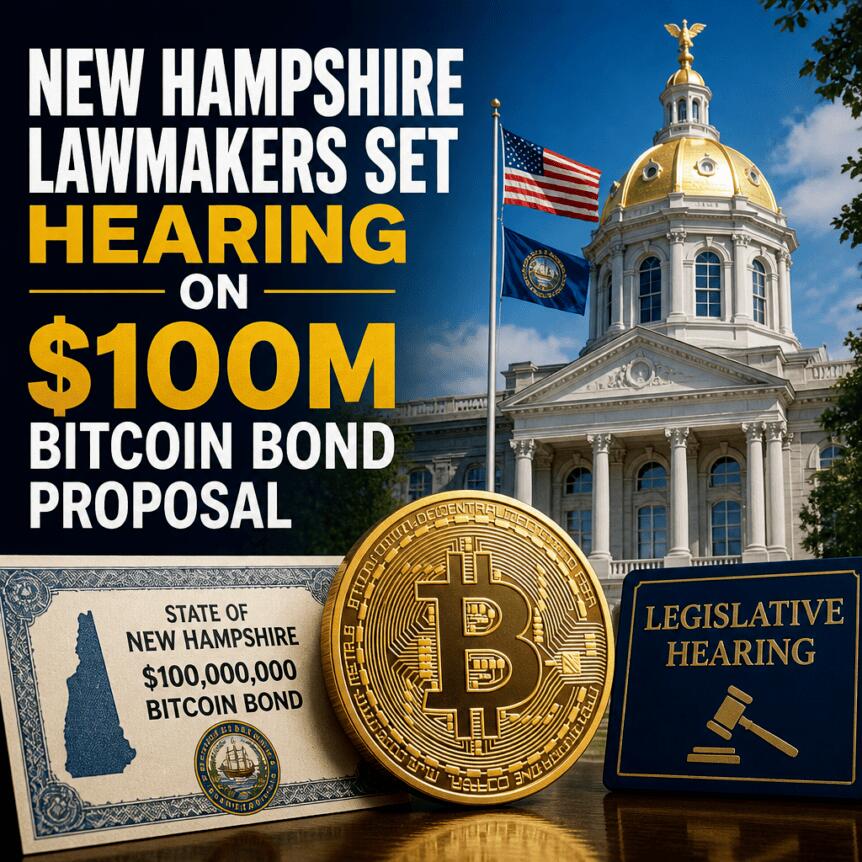
New Hampshire is moving closer to issuing what would be one of the first U.S. state-run municipal bond products backed by Bitcoin. The state’s Business Finance Authority (BFA) has scheduled a public hearing for Wednesday to discuss a proposed $100 million offering, following prior approvals that cleared the way for the plan to advance to the Governor and executive council.
According to the New Hampshire Secretary of State’s office agenda update, the BFA previously approved the BTC-backed bond arrangement in November 2025, with issuance tied to authorization from Governor Kelly Ayotte and the state’s five-member executive council. If granted, the structure would represent an attempt to integrate a highly volatile asset class into traditional public finance channels without placing state funds or taxpayers directly at risk—at least according to how the plan was framed by its proponents.
Key takeaways
- New Hampshire has scheduled a public hearing for Wednesday on a proposed $100 million Bitcoin-backed bond.
- The BFA approved the bond concept in November 2025, pending sign-off from Governor Kelly Ayotte and the executive council.
- A November 2025 framing by officials suggests the collateral is funded by a private party, aiming to avoid recourse to state funds.
- Moody’s assigned a provisional Ba2 rating (speculative grade), underscoring the credit risk tied to Bitcoin-linked structures.
- Similar Bitcoin-backed bond ambitions in El Salvador failed to progress after the crypto market downturn.
From approval to a public hearing
The latest development comes via an update to the New Hampshire governor and executive council agenda. The Business Finance Authority has scheduled a meeting for Wednesday focused on the proposed issuance of $100 million in bonds backed by Bitcoin.
The groundwork for the proposal was laid earlier. The BFA approved the bond in November 2025, indicating it planned to proceed only after receiving required authorizations from Governor Kelly Ayotte and New Hampshire’s five-member executive council. That sequence matters for investors and market participants because it shows the state is not treating the offering as an automatic follow-through—it remains subject to final governance checkpoints.
In connection with the approvals at the time, Ayotte described the effort as an “innovative way” to expand investment opportunities while positioning New Hampshire as a leader in digital finance, while emphasizing that it would not risk state funds or taxpayer dollars.
A new use case for digital finance—and an unresolved governance path
New Hampshire’s push toward Bitcoin-backed instruments fits a broader shift in state policy toward regulated experimentation. The state was the first to approve a law establishing a strategic Bitcoin reserve in May 2025, allowing public investments equal to 5% of funds, subject to a market capitalization threshold (over $500 billion). That legal direction provides the policy backdrop for why state institutions are exploring Bitcoin-adjacent financial products.
Still, the hearing scheduled for Wednesday highlights the practical reality: even if legislative policy is supportive, bond issuance typically depends on risk allocation, collateral mechanics, and credit considerations that rating agencies evaluate independently. Those concerns surfaced when industry scrutiny addressed whether a Bitcoin-backed municipal bond can function like conventional public finance debt.
Credit risk and the case for “proof of concept”
A key question for readers is how “municipal bond” applies when the underlying collateral is tied to a highly volatile cryptocurrency. In an analysis authored in April, David Krause, an emeritus associate professor of finance at Marquette University, argued that while the proposal could act as a proof of concept for integrating digital assets into structured finance, it is not suited to serve as a general-purpose public finance tool.
Krause’s assessment emphasized that although a private borrower, CleanSpark, would supply the funds for collateral, the structure provided “no recourse to state funds or taxpayers.” In other words, the risk profile is meant to be contained, but the broader challenge remains: adapting traditional financial frameworks to assets with large and rapid price swings.
Rating activity reflected those concerns. In March, Moody’s assigned the proposed Bitcoin bond a provisional Ba2 rating. In Moody’s scale, that places the offering in the speculative grade category, signaling substantial credit risk tied to the bond’s structure and asset exposure.
For investors and traders, this combination—contained recourse to the state but speculative-grade credit implications—suggests the market impact will likely hinge on collateral management rules, redemption protections, and how volatility is handled across the life of the bond. Those are the types of details that often determine whether such instruments behave more like structured credit products than traditional municipal debt.
El Salvador’s “Volcano Bonds” as a cautionary parallel
New Hampshire’s attempt follows earlier momentum that briefly looked promising elsewhere. Under President Nayib Bukele, El Salvador announced $1 billion in Bitcoin-backed “Volcano Bonds” intended to fund the proposed Bitcoin City project. The idea was revealed in 2022, alongside efforts that later culminated in Bitcoin being recognized as legal tender.
However, the Volcano Bonds plan did not move forward as intended. The source notes that the project fizzled out following a crypto market downturn—an outcome that matters for how market participants interpret New Hampshire’s current effort. If the global risk environment deteriorates or liquidity thins, Bitcoin-linked structured products can face additional operational and valuation pressures even when the legal framework is designed to isolate state exposure.
Comparing the two situations underscores a broader point: regulatory willingness and political support do not eliminate market-driven constraints. In both cases, price cycles and institutional risk appetite can determine whether Bitcoin-backed financing becomes scalable or remains experimental.
Going forward, the decisive question for New Hampshire will be whether the Governor and executive council clear the remaining authorization steps after the public hearing—alongside how bond terms address volatility, collateral requirements, and credit-risk mechanics under rating scrutiny. As the proposal advances, investors should watch for the final structure details that explain how speculative-grade risk is managed, and whether that framework can hold under changing Bitcoin market conditions.
https://www.cryptobreaking.com/new-hampshire-lawmakers-set-hearing/?utm_source=blogger%20&utm_medium=social_auto&utm_campaign=New%20Hampshire%20Lawmakers%20Set%20Hearing%20on%20$100M%20Bitcoin%20Bond%20Proposal%20
Comments
Post a Comment