
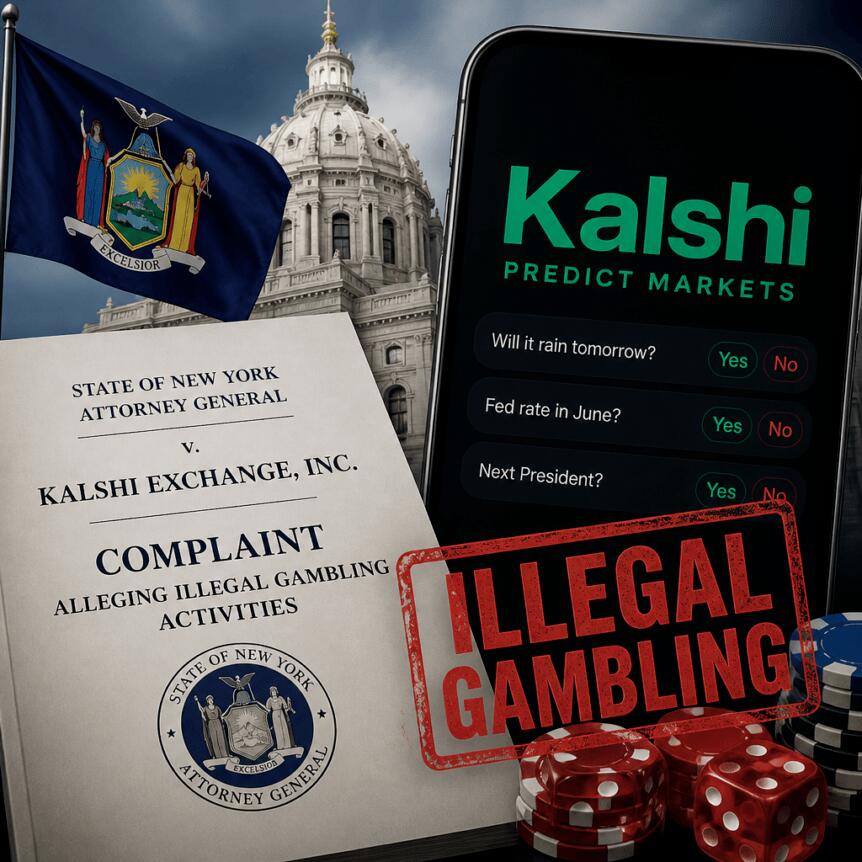
New York has filed a lawsuit against prediction market platform Kalshi, accusing the company of running an illegal, unlicensed gambling operation in the state. The case centers on Kalshi’s event contracts tied to outcomes such as sports results and elections.
In its filing, New York seeks an order stopping Kalshi’s alleged gambling activity, along with forfeiture of “illegal gains,” restitution to users, and civil penalties reportedly set at three times the amount of those gains. Attorney General Letitia James said prediction markets like Kalshi are gambling “plain and simple,” adding that the state is acting to enforce its laws and protect residents.
Key takeaways
- New York is pursuing injunctive relief and financial remedies against Kalshi, framing event contracts as unlicensed gambling.
- The lawsuit follows a cease-and-desist order from the New York State Gaming Commission issued in October 2025.
- Kalshi has challenged the regulator in federal court, but a judge denied its bid for a preliminary injunction in July 2026.
- The dispute escalates a wider fight over whether federally regulated prediction markets can be blocked under state gambling laws.
- Regulators have been increasingly scrutinizing the prediction market sector as it expands—both in mainstream visibility and blockchain-based infrastructure.
New York challenges Kalshi’s business model
The lawsuit targets Kalshi’s offering of contracts whose settlement depends on real-world outcomes, including sports and election-related events. New York’s position is that these products function as gambling and therefore require appropriate state licensing and compliance.
While Kalshi operates as a prediction market platform, New York’s complaint does not treat the platform as merely financial speculation. Instead, it argues that calling the contracts “prediction” does not change their practical nature as wagers on future results.
This action arrives after the New York State Gaming Commission issued a cease-and-desist order in October 2025. Kalshi responded by suing the regulator in federal court, and the immediate conflict has moved through multiple procedural steps.
Earlier this year, a judge denied Kalshi’s request for a preliminary injunction in July. An appeals court later rejected Kalshi’s attempt to halt enforcement while the appeal continues, meaning New York’s efforts can proceed even as the legal battle plays out.
Kalshi’s legal fight intersects with CFTC’s federal oversight
The New York case is part of a broader jurisdictional tug-of-war over prediction markets—specifically whether state gambling laws can restrict products that a federal regulator treats as within its own regulatory scope.
Just before New York filed, the U.S. Commodity Futures Trading Commission (CFTC) submitted an emergency motion in court seeking to block New York’s enforcement efforts. The CFTC argued that the state’s action interferes with the agency’s “exclusive authority” under the Commodity Exchange Act to regulate designated contract markets such as Kalshi.
The CFTC’s approach has been consistent in similar disputes involving other states. In those arguments, the commission has warned that if states can independently ban event contracts listed by federally regulated exchanges, it would create conflicting rules—undermining a uniform federal commodities framework.
That position has been cited in enforcement disputes the CFTC has taken against at least nine states, according to reporting that highlights how the agency frames state restrictions as a threat to federal oversight of commodities markets.
Prediction markets keep attracting mainstream attention
Prediction markets are built on a simple premise: users trade contracts tied to the outcome of future events, and the price of those contracts is intended to reflect market-implied probabilities. In theory, that mechanism helps participants aggregate information about what is likely to happen.
But as the sector grows, regulators across jurisdictions have increasingly treated certain prediction market products as gambling—especially when settlement depends on outcomes and participation mirrors typical wager-based behavior. The resulting legal uncertainty has encouraged closer scrutiny of how platforms structure their offerings and what regulatory category they fall under.
Kalshi is not the only high-profile operator to face regulatory pressure. Its competitor, Polymarket, has also encountered scrutiny from regulators abroad, with some authorities restricting or investigating operations over licensing and gambling-related concerns.
Beyond the regulatory front, prediction markets have also expanded technologically. Kalshi began broadening into blockchain-based infrastructure in December 2025, launching tokenized prediction markets on Solana and later adding support for multiple blockchain networks. That shift mirrors a wider trend in crypto markets, where trading venues seek faster settlement, greater programmability, and broader distribution.
Crypto analytics point to rapid growth in on-chain prediction activity
While the legal battles unfold, on-chain prediction markets have shown signs of growing participation. According to analytics firm Chainalysis, blockchain-based prediction markets processed about $20 billion in trading volume tied to the 2026 FIFA World Cup, with more than 400,000 wallets participating.
The implication for investors and builders is that even as regulators debate classification—commodities regulation versus gambling law—the user demand for outcome-trading continues to show up in measurable on-chain activity. That activity can raise the stakes for platforms that want to operate at scale without running afoul of differing legal interpretations.
For market participants, the tension is straightforward: platforms may market prediction markets as probability markets or informational tools, but regulators may focus on the wager-like economic structure and licensing requirements. The New York lawsuit against Kalshi is a direct test of how far state enforcement can go when a federal agency argues for exclusive jurisdiction under the Commodity Exchange Act.
What to watch next is whether the CFTC’s federal arguments continue to constrain or defeat New York’s enforcement, and whether Kalshi’s appeal of the preliminary-injunction denial changes the immediate timeline. The outcome could shape how other states pursue enforcement against prediction markets—and how platforms design their products to manage regulatory risk.
https://www.cryptobreaking.com/new-york-sues-kalshi-alleging/?utm_source=blogger%20&utm_medium=social_auto&utm_campaign=New%20York%20Sues%20Kalshi,%20Alleging%20Illegal%20Gambling%20Activities%20
Comments
Post a Comment