
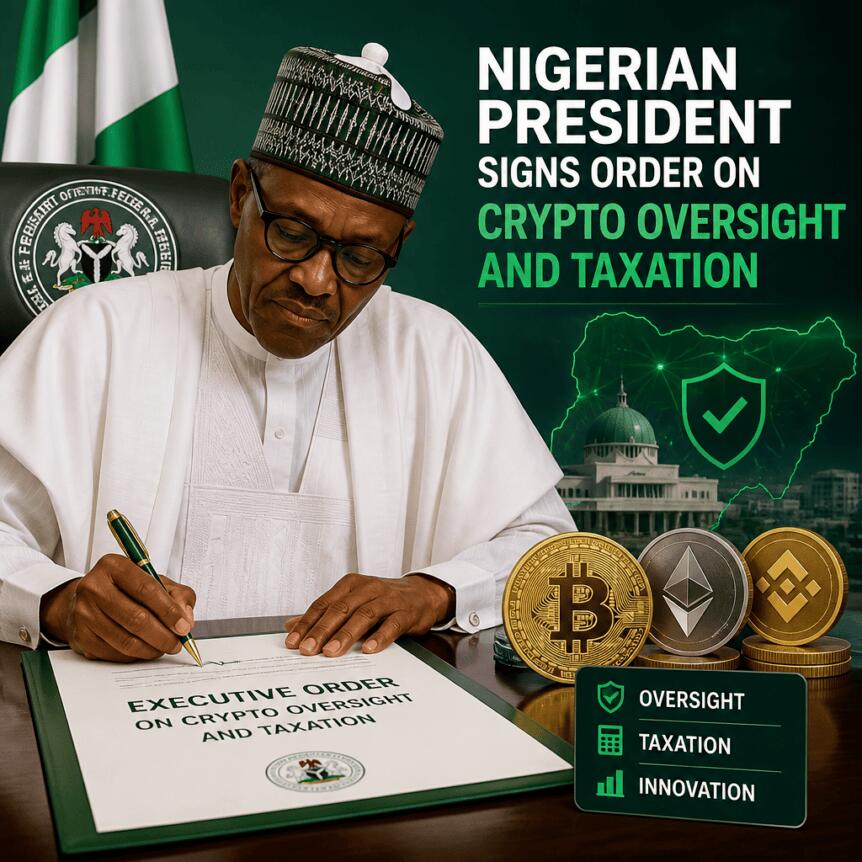
Nigeria’s President Bola Ahmed Tinubu has signed an executive order aimed at reducing what the government describes as fragmentation in how digital asset activities are regulated across agencies. In remarks relayed by the president’s special adviser, Bayo Onanuga, the order is framed as a coordination effort rather than a sweeping reallocation of powers.
According to Onanuga, the executive order seeks to “harmonize the regulation of virtual assets,” improve cooperation among financial, revenue, and capital markets agencies, and better protect citizens from fraud while enabling “responsible innovation.” It also sets up a virtual asset council to steer related policy work, while the Nigerian tax authority is directed to update its approach.
Key takeaways
- Nigeria’s executive order focuses on harmonizing digital asset regulation through coordination, not by creating a new regulator.
- A new virtual asset council is planned, bringing top regulators under a single policy direction structure.
- The Nigerian Revenue Service is expected to issue updated guidance on how digital asset activity is taxed.
- Officially, registration requirements are described as activity- and asset-dependent, designed to close oversight gaps for unregistered operators.
Executive order targets regulatory fragmentation
Onanuga said the framework established by the executive order does not create a new regulator or transfer statutory powers between Nigeria’s institutions. Instead, he described it as a method to coordinate existing mandates while maintaining independence for each agency.
In the government’s framing, the problem is that digital asset oversight has not been sufficiently unified, creating room for operators to operate without falling cleanly under regulatory scrutiny. Onanuga said the registration approach will be determined by the “nature of the activity and the asset involved,” and that this is intended to “close the gaps” through which unregistered actors have previously escaped oversight.
For market participants, the distinction between “coordination” and “new regulator” matters. When powers are not consolidated into a single authority, compliance requirements can remain distributed—but clearer harmonization can reduce ambiguity about which agency handles which aspect of onboarding, reporting, or enforcement.
Virtual asset council brings regulators under one policy umbrella
The executive order also establishes a virtual asset council headed by senior figures from Nigeria’s financial regulators. While the order’s intent is described as policy direction, the key practical takeaway is that regulators are being pulled into a more structured dialogue.
Onanuga’s comments suggest the council is meant to align policy across agencies without replacing their statutory roles. That structure could affect how rules evolve over time—especially if the council is used to reconcile differing interpretations of responsibilities among financial oversight bodies, revenue authorities, and capital markets regulators.
Nigeria’s adoption trajectory makes that coordination particularly important. The country has been a major hub for stablecoin and broader crypto activity in Africa, according to an IMF report cited in the government’s messaging.
Why Nigeria’s stablecoin and crypto footprint raises the stakes
In a June report referenced in the coverage, the International Monetary Fund (IMF) said Nigeria accounted for about 60% of stablecoin inflows within sub-Saharan Africa since 2019. The IMF report also estimated that Nigeria saw roughly $59 billion in crypto inflows between July 2023 and June 2024.
Those numbers underscore why Nigeria is a focal point for regulatory clarity—not only for local service providers but also for cross-border businesses and payment-linked use cases. When adoption is concentrated in one jurisdiction, regulatory uncertainty can quickly spill over into liquidity, on-ramps, and compliance planning for companies operating in or serving Nigerian users.
The IMF added that the policy challenge is to narrow the “workaround” incentives that arise in cross-border payments, while containing new risks. It characterized the solution as a clear strategy that remains open to innovation but anchored in strong macroeconomic policy and effective regulation.
In that context, Nigeria’s executive order can be read as an attempt to align regulation with actual usage patterns—particularly where stablecoins and other digital assets are used for value transfer and settlement.
Nigeria’s tax authority moves to tighten digital asset compliance
The executive order directs the Nigerian Revenue Service to update its policies on digital assets, building on steps already announced. As mentioned in the report, authorities in January said that, under the Nigeria Tax Administration Act, crypto service providers would be required to link transactions to tax identification numbers and, in some cases, national identification numbers.
The government position described in the coverage indicates that the additional details expected from the tax authority are intended to clarify the effects on taxpayers. For businesses, the existing direction toward identification linkage signals a compliance shift that could reshape onboarding procedures, transaction recordkeeping, and reporting workflows.
Because tax obligations often interact with financial regulation—especially where registration and oversight requirements are tied to who can operate—updated guidance from the Revenue Service may become a central piece of Nigeria’s broader digital asset compliance regime.
What to watch next
Investors, exchanges, and service providers in Nigeria will likely look for how the virtual asset council’s coordination translates into concrete, activity-specific registration rules and how the Nigerian Revenue Service operationalizes the tax identification linkage. The immediate uncertainty is not whether compliance will be tightened, but how quickly harmonized guidance will roll out across agencies and what standards will be used to determine registration requirements by asset type and business activity.
https://www.cryptobreaking.com/nigerian-president-signs-order-on/?utm_source=blogger%20&utm_medium=social_auto&utm_campaign=Nigerian%20President%20Signs%20Order%20on%20Crypto%20Oversight%20and%20Taxation%20
Comments
Post a Comment