
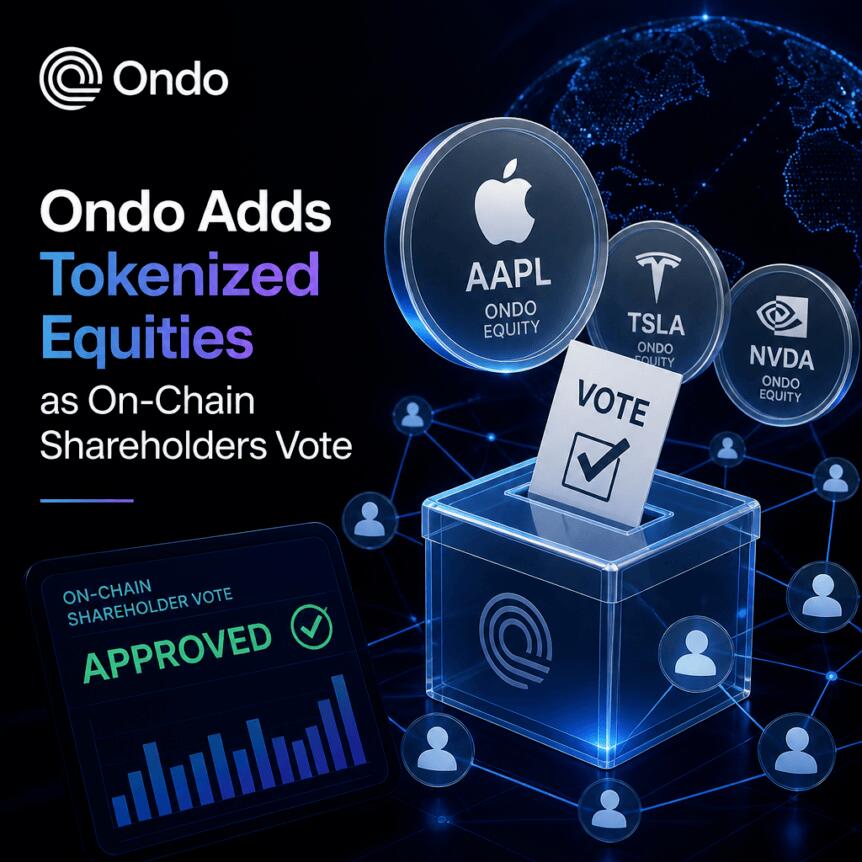
Ondo Finance says it is moving beyond simple “tokenized ownership” by adding shareholder-style governance tools to its onchain securities. Through a partnership with financial infrastructure provider Broadridge, holders of certain Ondo-issued tokenized stocks and ETFs will be able to participate in proxy voting and receive corporate communications through a Web3-enabled workflow.
The announcement targets a recurring concern in tokenized securities: even when users can buy and hold tokenized shares, it has not always been clear how, or whether, they receive the voting and notice rights that come with traditional direct stock ownership.
Key takeaways
- Ondo plans to enable proxy voting and access to corporate communications for holders of more than 250 tokenized securities issued through its platform.
- The solution is powered by a Web3-enabled version of Broadridge’s investor communications platform, designed to authenticate via blockchain wallets.
- Ondo says the governance features will accompany the launch of its first US custodial tokenized securities, including tokenized products tied to iShares Core S&P 500 ETF (IVV) and Micron Technology (MU).
- The company frames the rollout as aligned with the US SEC’s third-party custodial framework for tokenized securities.
- The move arrives as the tokenized equities market continues expanding, with growing competition among tokenization providers.
Why governance rights matter for tokenized equities
Tokenization has helped reshape parts of capital markets by enabling digital settlement and potentially more flexible access to investment products. But governance—specifically proxy voting and access to corporate materials—is where tokenized products often face scrutiny from investors and market structure observers.
Ondo’s new integration with Broadridge is designed to close that gap. According to the companies, holders can participate in proxy voting and receive corporate communications such as regulatory filings and other shareholder documents, using an interface that connects onchain identity (blockchain wallet authentication) to services traditionally reserved for registered shareholders.
For investors, this matters because governance rights are not merely an administrative feature. They are tied to how shareholders influence corporate decisions, respond to proposals, and receive timely disclosures—elements that can be central to due diligence and long-term ownership strategies.
Broadridge integration brings Web3 wallet authentication to investor communications
Ondo said its implementation uses a Broadridge investor communications platform adapted for Web3 use. The goal is to let users authenticate with blockchain wallets while accessing governance services that typically operate through conventional shareholder channels.
While the market has increasingly focused on execution—how quickly assets can transfer and trade—Ondo’s emphasis is on the “investor experience” layer. By connecting wallet authentication to proxy voting and document delivery, the company is effectively targeting the part of tokenized securities that can otherwise feel incomplete compared with traditional brokerage ownership.
Ondo’s announcement also indicates that the governance capability is expected to scale across a broad set of tokenized instruments—specifically, more than 250 securities issued through Ondo that are covered by the rollout.
Custodial tokenized securities and the SEC’s third-party framework
Ondo said the voting and corporate communications functions will be included with the launch of its first US custodial tokenized securities. The company named tokenized versions of BlackRock’s iShares Core S&P 500 ETF (IVV) and Micron Technology (MU) as part of that initial offering.
In its explanation of the regulatory approach, Ondo linked the rollout to the US Securities and Exchange Commission’s third-party custodial framework for tokenized securities. That framework, as discussed in earlier coverage from Cointelegraph, is one of the core regulatory pathways that distinguishes how tokenized securities may be structured and held.
By anchoring governance features to the launch of custodial tokenized products, Ondo is also signaling that it views custody, investor rights, and compliance mechanics as interconnected—not optional add-ons.
Tokenized equities keep growing—competition intensifies
Ondo’s governance push lands as tokenized equities show continued momentum. Foresight Ventures data, cited in Ondo’s recent reporting, indicated the tokenized stocks segment first surpassed $1 billion in March. Ondo later said that the market grew to $1.67 billion and reached nearly 181,000 unique holders, referencing data shared in its own publication.
In addition to Ondo, other firms are expanding their tokenized-stock offerings. Backed Finance, for example, issues tokenized stocks via its xStocks platform and has broadened distribution across multiple crypto exchanges and blockchain networks, according to the article context.
The broader category—tokenized real-world assets—has also attracted attention even during periods of weaker overall crypto sentiment. A recent 21shares report attributed sustained growth in institutional participation to improving infrastructure, while Binance data referenced in the source material said the value of tokenized RWA assets, including stocks, surged nearly 600% over the past year.
Together, these figures help explain why governance integrations are becoming more strategic. As more providers enter the space and assets proliferate, investors will likely demand more complete “shareholder-equivalent” functionality rather than only trading access and settlement speed.
What to watch next for investors
Investors should watch how Ondo and Broadridge operationalize proxy voting and document delivery across supported securities, including how wallet authentication maps to investor eligibility and participation. As tokenized equities continue to scale, governance functionality may become a differentiator as important as liquidity and custody.
https://www.cryptobreaking.com/ondo-adds-tokenized-equities-as/?utm_source=blogger%20&utm_medium=social_auto&utm_campaign=Ondo%20Adds%20Tokenized%20Equities%20as%20On-Chain%20Shareholders%20Vote%20
Comments
Post a Comment