
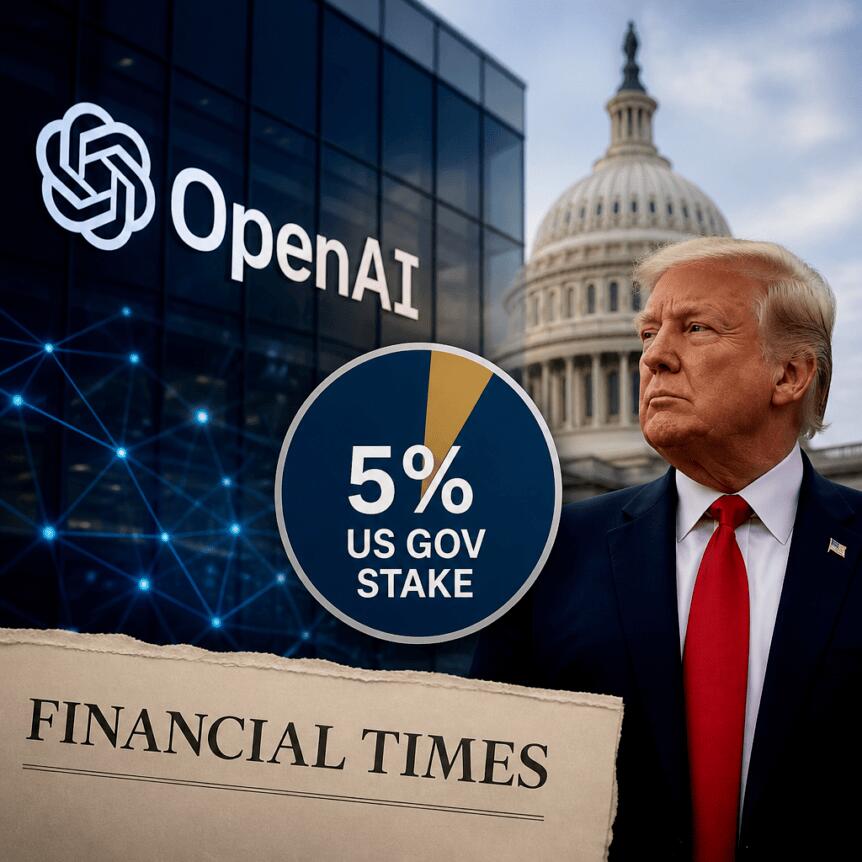
OpenAI has reportedly floated a plan to give the US government a 5% equity stake as Washington moves toward tighter oversight of frontier AI models. The proposal, discussed in early talks with the Trump administration, is tied to how the company and other major AI players might share in the economic upside of rapidly expanding AI capabilities, according to the Financial Times, citing people familiar with the matter.
The idea comes as OpenAI prepares for a potential US public listing, having confidentially submitted an S-1 for an initial public offering in the United States. Earlier coverage from Cointelegraph noted that OpenAI is joining Anthropic in preparing for a Wall Street debut this year, while the US government takes a more active role in how advanced models are built, released, and governed.
Key takeaways
- OpenAI reportedly discussed offering the US government a 5% equity stake as AI oversight intensifies in Washington.
- The proposal is framed as a way to share the economic benefits of AI, modeled by OpenAI CEO Sam Altman on Alaska’s Permanent Fund structure.
- It remains unclear whether major US AI firms beyond OpenAI would support contributing equity to a public investment vehicle.
- The discussions arrive alongside reported steps toward voluntary security and access standards for frontier AI models from the White House.
A shareholder-like approach to AI economics
The reported 5% stake would not be a one-off grant or regulatory fee, but an equity position—suggesting a longer-term relationship between AI developers and the public sector. According to the Financial Times, OpenAI raised the concept in early discussions with the Trump administration as the company weighs how it navigates a more demanding political environment ahead of a potential public listing.
OpenAI CEO Sam Altman argued that letting the public hold a financial stake could be the “best” mechanism to ensure Americans share in the economic benefits generated by the AI boom. The report says Altman modeled the proposal on Alaska’s Permanent Fund, which invests oil revenue into stocks and pays dividends to residents—an example often used to illustrate how natural resource earnings can be converted into ongoing public wealth.
How the plan could work—and what’s uncertain
Under the reported framework, several leading US AI companies would contribute a 5% equity stake to a public investment vehicle. While the direction is clear, the details are not: the Financial Times reports it remains unclear whether firms such as Anthropic, Google, or Meta would back the idea.
This uncertainty matters because any equity-based structure depends on broad coordination among market participants—particularly if the goal is to create a stable “public” ownership pool rather than a patchwork of separate deals. If major developers do not participate, the plan could fail to achieve the universal “sharing” effect Altman is aiming for, or it could lead to a narrower arrangement centered on specific companies.
The report also describes Altman as actively engaging in the political conversation beyond standard corporate lobbying. It says he has discussed the idea with President Donald Trump and senior officials including Commerce Secretary Howard Lutnick and Treasury Secretary Scott Bessent, and that he also spoke with Sen. Bernie Sanders, who earlier this year proposed a one-time 50% tax on the stock of the largest AI companies to help fund a nearly $7 trillion sovereign wealth fund for Americans.
For investors and builders watching AI policy, this angle is important: it suggests AI governance may increasingly blend market participation with public ownership models. Even if the exact equity structure changes, the underlying direction—linking national oversight with financial alignment—could shape how companies approach compliance, product timelines, and long-term strategy.
Washington’s shift from regulation to standards
The equity-stake discussion is occurring as the White House moves toward a more operational oversight posture for frontier AI systems. The Financial Times reports that the White House is preparing voluntary standards for frontier models following interventions involving recent systems from OpenAI and Anthropic.
Those standards are expected to be announced as early as next week and would cover security benchmarks, define review timelines, and clarify access rules for the most advanced models—both within the United States and abroad. In practice, that implies the US is seeking to formalize “how” advanced models are handled, not just “whether” they meet broad requirements.
Separately, reporting indicates that the Trump administration requested a staggered rollout of OpenAI’s GPT-5.6 and temporarily imposed export controls on Anthropic’s latest models due to cybersecurity concerns before later lifting the restrictions. Coverage from The Guardian describes these steps as part of a broader pattern of active involvement in model deployment and distribution.
Earlier reporting also highlighted how quickly the policy environment can change for model release and export. Cointelegraph, for example, noted that Anthropic planned to bring back its newest models after the US lifted export controls. That coverage underscores how regulatory or security decisions can directly affect availability.
Potential implications for IPO timing and governance
Because equity proposals intersect with capital markets, the timing of OpenAI’s public listing plans is hard to ignore. A potential IPO changes the internal calculus for any government-related ownership or governance mechanism: it can alter how negotiations are framed, how disclosures are handled, and how investors assess regulatory risk.
The reported talks also highlight a broader tension facing the largest AI firms. On one hand, they are moving toward greater transparency and public-market visibility. On the other, they are operating under a government that appears increasingly willing to intervene directly—whether through standards, access rules, rollout expectations, or export controls.
Cointelegraph reports it reached out to OpenAI for comment on the discussions but had not received a response at the time of publication. Until OpenAI or the administration provides further clarification, the equity-stake concept should be treated as a reported proposal rather than an announced policy.
Still, for market participants, the direction of travel is clear: AI oversight is evolving into something more detailed and more closely tied to how advanced models move through the economy and across borders. If voluntary standards harden into practical gatekeeping—or if equity-based public participation gains traction—AI companies may face a governance reality where policy alignment becomes part of competitive strategy rather than a post-launch compliance step.
Readers should watch next whether the White House’s upcoming voluntary standards are sufficiently specific to guide developers’ release and security processes, and whether any government-aligned ownership concept gains support from other major AI firms beyond OpenAI. Those two threads—standards and financial participation—could determine how quickly policy risk becomes predictable for the sector.
https://www.cryptobreaking.com/openai-considers-5-us-gov/?utm_source=blogger%20&utm_medium=social_auto&utm_campaign=OpenAI%20Considers%205%%20US%20Gov%20Stake%20as%20Trump%20Talks%20Continue:%20FT%20
Comments
Post a Comment