
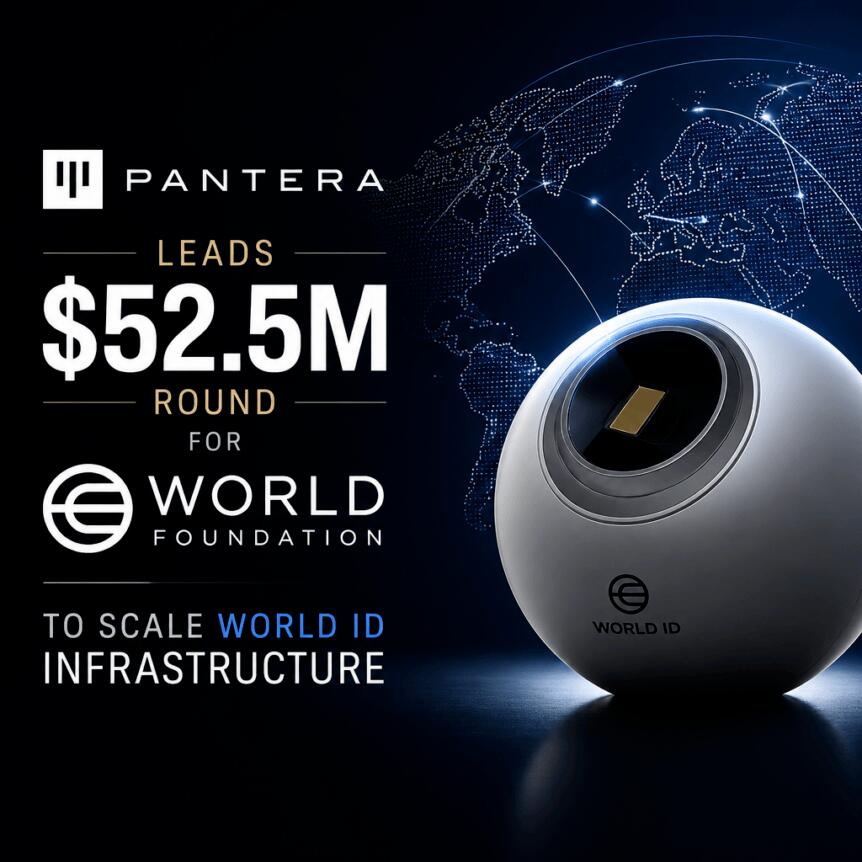
World Foundation, the nonprofit behind the World protocol, has raised an initial $52.5 million by selling locked WLD tokens to strategic investors, with Pantera Capital leading the round. The fundraising—announced on Friday and shared with Cointelegraph—adds fresh capital to World’s push to scale World ID, its biometric-based system for helping platforms verify whether an online user is a real person.
According to the announcement, the WLD tokens sold in the round are subject to a 12-month lockup. Other participants reportedly include Bain Capital Crypto, Eightco Holdings, Selini Capital, and Susquehanna Crypto, alongside additional investors.
Key takeaways
- $52.5 million raised through a sale of locked WLD tokens, with Pantera Capital leading.
- The sold tokens come with a 12-month lockup, limiting immediate liquidity from the strategic investors.
- World Foundation says new funding will go toward expanding World ID, its biometric credential system for distinguishing humans from AI agents.
- World ID relies on users completing biometric verification at a World Orb device to generate a digital credential.
- The broader market context reflects intensified investor focus on AI infrastructure and agent-era tooling, including security and verification solutions.
Locked token sale funds World ID expansion
World Foundation’s fundraising centers on WLD, the token ecosystem associated with the World protocol. In its announcement, the organization said the initial $52.5 million proceeds from the locked token sale will be used to expand World ID—a system meant to verify online identities in an era where synthetic content and automated agents are becoming more prevalent.
World describes World ID as a credential that can be issued after users complete biometric verification at a hardware point called a World Orb. Once verified, users receive a digital credential intended to help services determine that the account engaging with them is tied to a real person rather than an automated agent.
The stated motivation is practical: the nonprofit argues that demand for verification infrastructure is rising as AI-generated content and autonomous agents increase. Instead of trying to detect bots purely through behavior, the approach aims to anchor identity claims to a biometric verification step completed through the World Orb workflow.
Why verification matters as AI agents proliferate
World’s fundraising lands amid a broader shift in crypto and adjacent investment toward AI-related infrastructure and agent-first applications. That shift has been visible across multiple recent deals highlighted in Cointelegraph coverage.
For example, brokerage infrastructure provider Alpaca raised $135 million in equity financing earlier this month and reportedly secured access to up to $300 million in debt financing. The company said the funding would support infrastructure for AI-powered financial applications—an indication that agent-driven workflows are moving from experimentation toward more robust system-building.
Similarly, Cointelegraph previously reported that Coinbase introduced tools enabling businesses to accept USDC payments from autonomous AI agents. That update was framed in the context of AI-generated activity growing on its Base developer ecosystem, including a claim that AI-generated traffic exceeded human traffic on its Base developer documentation for the first time last month.
In this environment, identity and trust layers become more than a niche tooling problem. As more commerce, messaging, and platform interactions become automatable, the ability to verify whether an interaction represents a human user becomes increasingly relevant to everything from onboarding to fraud prevention to resource allocation.
Regulatory sensitivity remains part of the World ID story
World’s identity approach is not without controversy. The organization was originally conceived by Sam Altman, Max Novendstern, and Alex Blania, with World protocol efforts later drawing regulatory scrutiny in multiple jurisdictions over its biometric identity verification system.
While the current fundraising announcement focuses on scaling World ID, the mention of regulatory pressure underscores a critical uncertainty investors and builders should consider: biometric verification often intersects with privacy expectations, data protection requirements, and consent frameworks that can vary widely by jurisdiction. That reality can influence rollout speed, compliance costs, and the design of how credentials are issued and used.
For market participants, the token lockup may offer some near-term stability, but it does not resolve the core question of how World ID will navigate legal and regulatory constraints as it expands.
AI investment momentum extends to security and frontier tech
The investment climate around AI is also showing up in broader funding patterns, including cybersecurity. Cointelegraph notes that capital is increasingly flowing into AI-adjacent security efforts, with one example being AegisAI, a cybersecurity startup that raised $36 million in Series A funding to expand AI-powered email security. The company said the financing is intended to improve defenses against more sophisticated AI-generated phishing attacks.
Meanwhile, large crypto investment vehicles have been repositioning toward AI and frontier technologies. According to Cointelegraph reporting, Paradigm raised a $1.2 billion fund in July to invest across crypto, artificial intelligence, robotics, and other frontier technologies. Framework Ventures also reportedly closed a $400 million fund in June with a mandate spanning crypto, AI, robotics, and energy.
Taken together, these moves suggest a sector-wide bet: in an agent-driven future, infrastructure, trust, and security will be treated as interconnected components rather than separate silos. World ID’s biometric verification pitch fits into this larger landscape as one possible “human verification” layer for systems confronting rising automation.
Looking ahead, the key question for readers is how quickly World Foundation can scale World ID beyond its initial verification workflow while maintaining compliance in the jurisdictions that have already scrutinized biometric identity verification. With AI agents becoming more common—and platforms increasingly adapting payment and interaction tools for them—investors and builders should watch for concrete adoption milestones for World ID and any updates on regulatory posture as World expands.
https://www.cryptobreaking.com/pantera-leads-52-5m-round/?utm_source=blogger%20&utm_medium=social_auto&utm_campaign=Pantera%20Leads%20$52.5M%20Round%20for%20World%20Foundation%20to%20Scale%20World%20ID%20Infrastructure%20
Comments
Post a Comment