
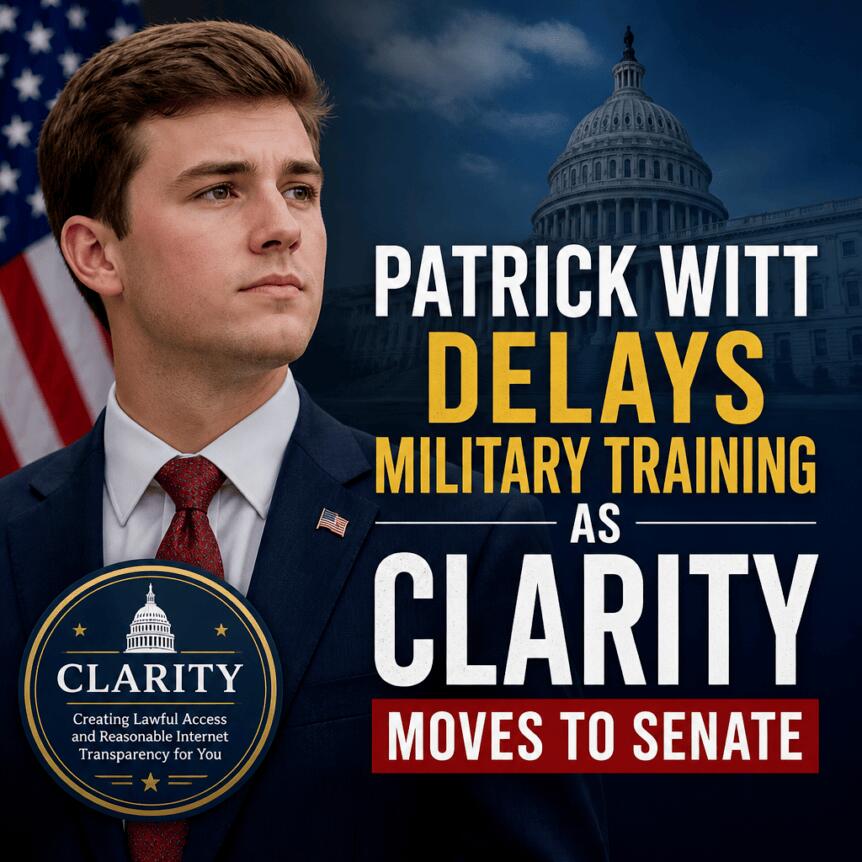
The White House’s chief crypto adviser Patrick Witt said he will not begin his scheduled military training at the end of the month, keeping him in place as a key negotiator on the CLARITY Act. Witt’s update comes as the legislation approaches a narrow Senate window ahead of the chamber’s Aug. 8 recess.
In an X post on Monday, Witt said that while he remains committed to fulfilling his service obligation, his training has been deferred, allowing him to “see this effort through to the end.” The change matters because Witt is described as the White House’s lead negotiator for the bill and a central figure in ongoing talks over how the US will regulate crypto.
Key takeaways
- Patrick Witt says his end-of-month military training has been deferred, letting him remain at the White House to keep working on CLARITY.
- The CLARITY Act needs to pass the Senate before the Aug. 8 recess, giving the legislative push a tight timetable.
- Witt had previously been reported to return for Judge Advocate General (JAG) training with the Georgia Army National Guard on July 27, but that plan has been adjusted.
- Harry Jung, Deputy Director of the President’s Council of Advisors for Digital Assets, announced he will leave government service in about two weeks.
Witt’s deferred training keeps Senate talks on track
According to Witt, the report that he would leave for mandatory training—timed around the moment CLARITY could reach the Senate floor—has changed. He said in his post that his training has been deferred, meaning he will not depart when expected and can continue working through the end of the legislative process.
The White House’s crypto policy priorities have increasingly depended on named individuals who can bridge positions between the executive branch and lawmakers. Witt’s role as the White House’s lead negotiator places him at the center of negotiations that typically involve narrowing differences on regulatory scope, compliance requirements, and consumer-related guardrails.
Why the Aug. 8 Senate deadline raises the stakes
The CLARITY Act is intended to establish what the article describes as the first comprehensive US regulatory framework for the crypto market. The bill’s prospects, however, hinge on procedural timing as much as policy design—particularly with the Senate recess looming on Aug. 8.
Witt’s continued presence at the White House during this period signals that officials are treating the current push as urgent. Earlier reporting referenced Witt being expected to report for JAG training with the Georgia Army National Guard on July 27. Under that earlier plan, his absence could have created a handoff challenge at a moment when the Senate is deciding whether it has sufficient support to advance the bill.
With Witt now stating he will stay, the White House appears to be reducing the risk of a personnel gap during the final stretch of Senate negotiations. The bill’s passage window remains the same, but the ability to sustain day-to-day talks may be improved by keeping the lead negotiator available.
Second deferment underscores ongoing CLARITY pressure
The change is not the first adjustment to Witt’s training schedule. A Tuesday report from Crypto In America said Witt had already deferred mandatory military training in April so he could remain at the White House to work on CLARITY Act negotiations. That reporting also suggested the negotiations took longer than expected.
In practical terms, this is a reflection of how political timelines can collide with other obligations—even for senior officials. Witt’s current statement indicates the intersection remains unresolved in the short term, but that the executive branch is prioritizing the legislative work during this specific Senate window.
Investors and market participants typically watch for movement in policy milestones because regulatory clarity can affect how crypto firms plan compliance, custody, market structure, and product offerings. While personnel decisions do not determine bill text on their own, they can influence how consistently negotiators engage lawmakers as deadlines approach.
Harry Jung to leave the Council as Witt stays
Witt’s decision to remain at the White House coincides with another personnel shift inside the administration’s crypto advisory structure. Harry Jung, the Deputy Director of the President’s Council of Advisors for Digital Assets, announced he will leave his post.
Jung said in an X post on Monday that he will leave government service in two weeks, adding that the past two years “transformed America’s position on crypto.” The timing of his departure is relevant because Jung had been expected, according to Crypto In America, to take over Witt’s responsibilities while Witt was on military leave.
With Witt now reporting that his training has been deferred, the need for a near-term transition may be reduced. Still, Jung’s exit changes the Council’s internal leadership landscape during the same Senate deadline period, which could affect how work is coordinated after Witt’s involvement later in the summer.
For readers tracking the CLARITY Act, these overlapping personnel updates highlight a larger theme: the bill’s advancement depends not only on committee mechanics and votes, but also on the continuity of the people tasked with negotiating and translating policy goals into legislative language.
As the Senate moves toward its Aug. 8 recess, attention should stay on whether the CLARITY Act can secure the momentum required for final passage, and on how the Council’s leadership changes play out alongside Witt’s continued involvement. The next signals to watch are procedural—committee scheduling, floor movement, and any public negotiation benchmarks—since that is where the impact of these staffing decisions is most likely to become visible.
https://www.cryptobreaking.com/patrick-witt-delays-military-training/?utm_source=blogger%20&utm_medium=social_auto&utm_campaign=Patrick%20Witt%20Delays%20Military%20Training%20as%20CLARITY%20Moves%20to%20Senate%20
Comments
Post a Comment