
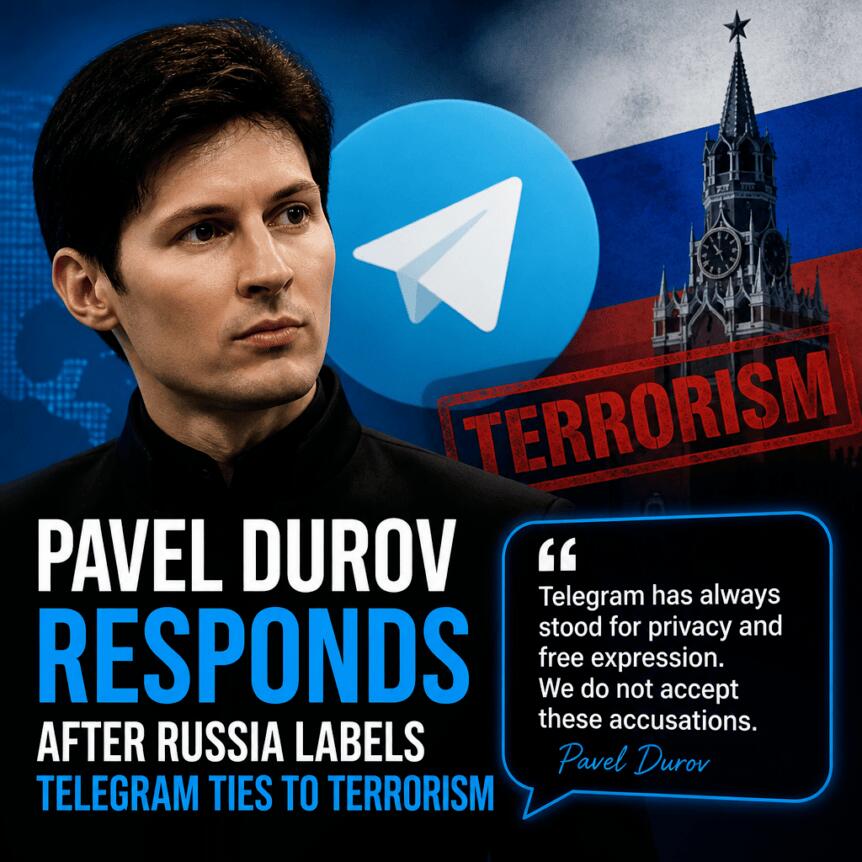
Telegram founder Pavel Durov says Russian authorities have designated him a “terrorist” after he refused government demands for mass surveillance and censorship on the messaging platform. Durov posted his response publicly in a Telegram message published a day after Russia announced new criminal charges against him.
In that post, Durov claimed Russia also blocked him from “publishing information on the Internet,” adding that authorities appear to have “got confused about who can ban whom from the Internet.”
Key takeaways
- Durov’s latest statement follows Russia’s announcement of charges, after Russia’s security service accused him of facilitating terrorist activity.
- The Russian allegations center on Telegram’s alleged failure to remove channels tied to terrorist groups and Ukrainian intelligence services.
- Russia’s case builds on a criminal probe reportedly launched in February over alleged non-compliance with Russian rules on extremist and terrorism-related content.
- Durov is also facing separate legal scrutiny in France, and regulators in Australia have reportedly initiated court proceedings over terrorism-related content.
Russia escalates case with “terrorist” label
Russia’s Federal Security Service (FSB) accused Durov of facilitating terrorist activity, according to earlier coverage from Cointelegraph. The claim is that Telegram did not remove certain channels used by terrorist organizations as well as channels linked to Ukrainian intelligence services.
Durov’s rebuttal came through his own Telegram account the day after Russia made the allegations public. In addition to responding to the charges, he framed the dispute as a conflict over Telegram’s stance toward government demands, particularly around surveillance and content restrictions.
The message also suggests a broader disagreement about control of online speech and information access—Durov saying Russian authorities barred him from publishing information on the internet, while disputing the legitimacy of who can impose such restrictions.
February investigation tied to alleged content non-removal
Russia’s current push does not appear out of nowhere. Cointelegraph previously reported that a criminal investigation in February followed regulatory accusations that Telegram left nearly 155,000 channels, chats, and bots accessible despite Telegram’s alleged violations of Russian laws relating to extremist material, terrorism, drug trafficking, and other illicit categories.
That earlier context matters because it indicates that the case is tied to a longer-running compliance argument—how Telegram moderates content and how it responds to removal requests. For investors and platform users watching the regulatory risk landscape, these developments reinforce that messaging platforms can face escalating consequences when regulators argue they are not acting quickly or thoroughly enough to meet local legal standards.
At the same time, much remains uncertain: public allegations do not automatically translate into immediate changes on the ground, and the specifics of what was or wasn’t removed—and under what procedural thresholds—are not detailed in the statements referenced here.
Legal pressure extends beyond Russia
Durov’s legal situation has been international. Cointelegraph reported that he was arrested in France in August 2024 and has remained the subject of a judicial investigation over allegations that Telegram facilitated criminal activity, including by allegedly failing to moderate illegal content adequately and respond to law enforcement requests.
According to earlier coverage, Durov has denied wrongdoing, arguing that French authorities did not follow due process when seeking information from Telegram. His arrest was followed by a TON Community-backed campaign that collected more than 9 million signatures on an open letter urging French authorities to release him.
There have also been reported changes in travel conditions: French authorities initially allowed Durov to return temporarily to Dubai in March 2025 before lifting travel restrictions entirely later that year, as noted by Cointelegraph. The implication is that while legal pressure can be intense, authorities may adjust constraints over time depending on the status of the proceedings.
Meanwhile, Cointelegraph also reported that Australia has moved toward court proceedings, with regulators alleging Telegram failed to remove terrorism-related content. The platform’s exposure in multiple jurisdictions highlights a recurring regulatory theme worldwide: governments increasingly expect major communication platforms to take meaningful action against content they deem illegal, even when the platforms frame enforcement as complex, global, and constrained by legal standards.
Privacy, surveillance, and the EU debate
Beyond the courtroom, Durov has publicly positioned himself around digital privacy and free speech. In April, he warned that a proposed European Union age-verification app could open the door to broader online surveillance, according to Cointelegraph. The argument—tying age verification to a wider data-collection trajectory—signals how Durov views regulatory measures as potentially expanding monitoring rather than simply improving safety.
In the same period, Cointelegraph reported that Durov blamed alleged tax data leaks for an increase in crypto-related kidnappings in France. He said Telegram would leave the country rather than grant authorities access to users’ private messages, tying the debate back to the line between lawful access and what he frames as unacceptable intrusion into private communications.
Taken together with the Russia and France allegations, these public remarks suggest that Durov is consistent in his framing: that enforcement actions aimed at removing content or complying with requests can also become mechanisms for surveillance or compelled access to private data.
What to watch next is how each jurisdiction’s process unfolds—whether courts compel specific operational changes, whether regulators escalate further, and how Telegram responds in practice. For users, the key question is whether enforcement will lead to tangible moderation shifts; for the broader industry, it will be whether these cases set precedents for how governments can pressure encryption-adjacent communication platforms to cooperate with investigations.
https://www.cryptobreaking.com/pavel-durov-responds-after-russia/?utm_source=blogger%20&utm_medium=social_auto&utm_campaign=Pavel%20Durov%20Responds%20After%20Russia%20Labels%20Telegram%20Ties%20to%20Terrorism%20
Comments
Post a Comment