
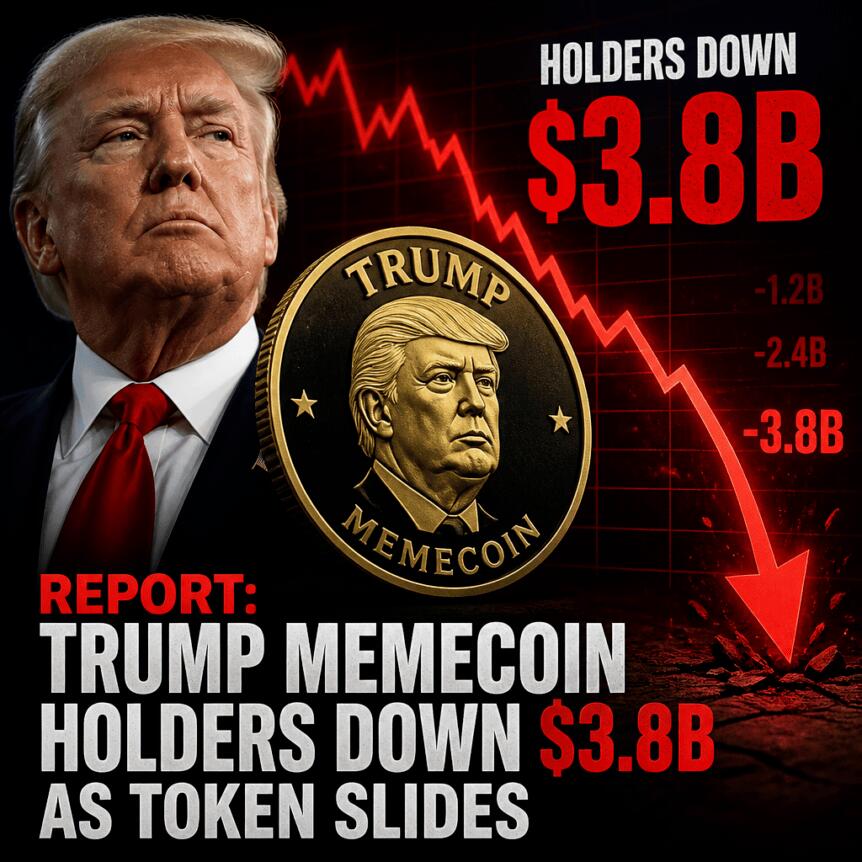
Nearly one million investors in Donald Trump’s memecoin, Official Trump (TRUMP), are sitting on paper losses totaling about $3.8 billion, according to an analysis published by The New York Times that relies on on-chain analytics from Nansen. The findings underscore a familiar pattern in retail-heavy memecoins: a small group of early wallets capture outsized gains while the broader base carries most of the downside.
The same Nansen analysis also points to losses among buyers of World Liberty Financial’s token (WLFI), a crypto asset tied to a trading platform co-founded by Trump and his three sons. Together, the data arrives amid renewed scrutiny sparked by Trump’s financial disclosures describing substantial crypto-related income.
Key takeaways
- According to Nansen data cited by The New York Times, 988,905 TRUMP wallets (about two-thirds of buyers) were losing money as of the end of June.
- Total TRUMP losses for those wallets were reported at $3.81 billion, while a smaller group of wallets recorded gains totaling about $4 billion.
- Separate Nansen analysis of WLFI found that 85% of the company-tracked wallets held losses, totaling $83 million, with the rest profiting $23 million.
- Trump’s recent financial disclosure described substantial income from his crypto ventures, adding fuel to concerns about conflicts of interest while in office.
TRUMP holders face broad losses, early buyers capture gains
The New York Times reported that as of the end of June, 988,905 TRUMP buyers—roughly two out of every three—were underwater. Across those wallets, losses were estimated at $3.81 billion, with Nansen’s analysis including both holders who were still holding at a loss and those whose positions were already marked negative by the time of measurement.
By contrast, just under half a million wallets recorded profits. In total, the reporting stated that profitable wallets accounted for about $4 billion in gains. Nansen characterized the distribution as skewed, describing it as “a small number of early buyers capturing enormous gains while the broad retail majority absorbed the losses.”
The contrast matters for how investors interpret memecoin risk. These tokens often start with hype and easy participation, but the on-chain outcome can be highly uneven—especially when early buyers benefit from momentum and late entrants become liquidity providers to the exit of better-positioned traders.
In terms of performance since launch, the token’s peak is reported at more than $73 shortly after it debuted. Since then, it has fallen by over 97%, and CoinGecko data in the report placed TRUMP at about $1.70 at the time of publication.
Financial disclosure raises new questions around crypto involvement
The TRUMP loss analysis arrives days after Trump’s annual financial disclosure, released earlier in the week, drew attention for crypto-related earnings. The filing reportedly showed that Trump earned more than $1.4 billion in income from crypto ventures last year, renewing debate around how personal financial interests intersect with public duties.
The disclosure, described as nearly 1,000 pages, also reportedly indicated Trump made over $630 million on the TRUMP memecoin. Meanwhile, the filing suggested that all token buyers combined made a net profit of around $200 million—an aggregate that contrasts sharply with the large number of losing wallets highlighted by Nansen.
This mismatch points to a crucial detail investors may overlook: even if the broader market settles slightly positive in aggregate, individual outcomes can still be heavily negative for most participants. Large early wins can dominate totals even when most holders end up losing money.
Trump launched the memecoin in January 2025, shortly before returning to office. The New York Times coverage and the Nansen-based approach place particular emphasis on buyer-level outcomes as of the end of June, offering a more granular view than price-only narratives.
WLFI token analysis suggests similar imbalance for retail buyers
Nansen’s work also extended to World Liberty Financial (WLFI), a token connected to the crypto trading platform of the same name. The platform’s co-founders include Trump and his three sons, according to the reporting in the article.
The token was reportedly sold directly to investors in two early rounds: first at 1.5 cents, and later at 5 cents. The analysis cited by The New York Times suggested that buyers who entered at 5 cents likely made a small profit overall. But among the nearly 27,000 wallets Nansen tracked, 85% recorded losses totaling $83 million, while the remaining wallets profited $23 million.
The article also cautioned that losses may be understated. Nansen reportedly noted that additional buyers likely purchased WLFI on exchanges where the relevant data is not public, meaning some losing positions may not be captured in the wallet set the firm analyzed. It was also noted that WLFI later became available to the public via secondary exchanges in September.
From a business-flow perspective, the reporting stated that Trump’s financial disclosure indicated he earned just under $800 million from the World Liberty Financial platform last year. The same section of the article said the Trump-linked business received 75% of WLFI sales regardless of the token’s price—an arrangement that could matter when assessing who captures value as token pricing fluctuates.
Scrutiny continues as Trump addresses conflict-of-interest concerns
In an interview with CNBC reported by Cointelegraph, Trump was described as dodging questions about perceived conflicts of interest related to his crypto activity and said there was “nothing illegal” and “nothing wrong” with the disclosed profits, adding that others were responsible for the investments.
For market participants, the emerging theme across these different threads—wallet-level loss concentration for both TRUMP and WLFI, and the scale of crypto-related income described in financial disclosures—is that retail participation may be riskier than price charts alone suggest. The on-chain outcomes reported by Nansen point to an uneven value transfer, where early access and execution timing can outweigh later entry enthusiasm.
Investors should watch whether additional on-chain breakdowns expand beyond the tracked wallet sets (especially for WLFI), and whether future disclosures provide clearer detail on how token-linked revenues and allocations are structured. As long as memecoins and tokenized platform interests remain central to attention, the key question is how consistently late participants are protected—or whether, as the Nansen analysis implies, they continue to pay most of the cost of early wins.
https://www.cryptobreaking.com/report-trump-memecoin-holders-down/?utm_source=blogger%20&utm_medium=social_auto&utm_campaign=Report:%20Trump%20Memecoin%20Holders%20Down%20$3.8B%20as%20Token%20Slides%20
Comments
Post a Comment