
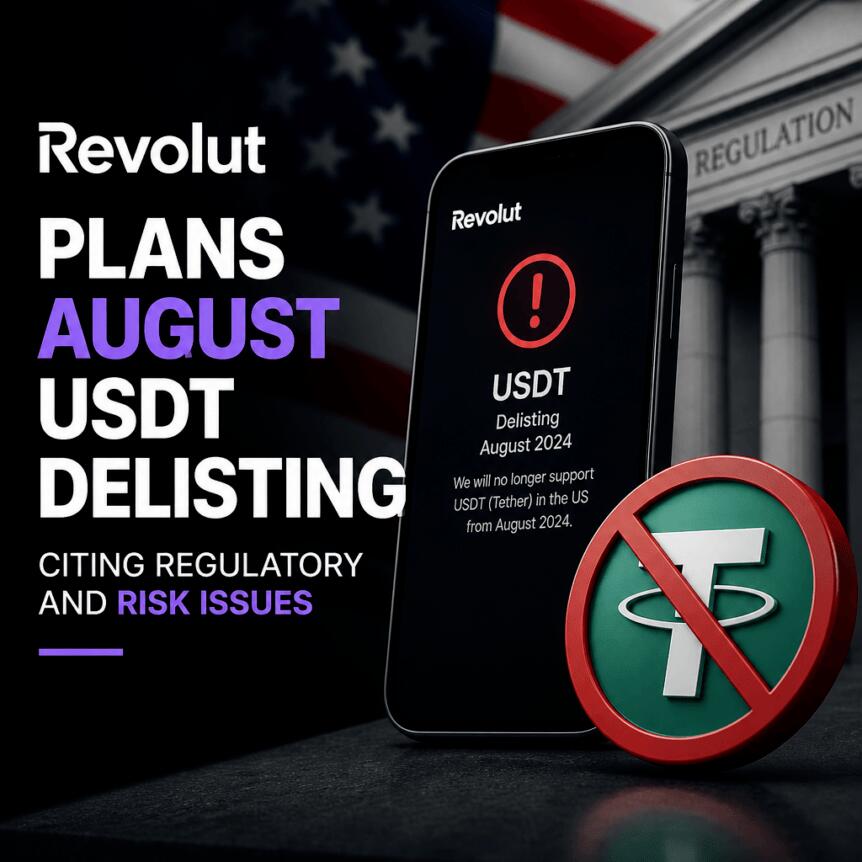
UK-headquartered fintech Revolut has informed some users that it will remove support for the Tether USDT stablecoin, with restrictions beginning in July and a full delisting scheduled for the end of August 2026. The bank said the change is driven by “regulatory and risk considerations,” while it also outlined how remaining USDT balances will be handled.
According to a customer notice reviewed by Cointelegraph, Revolut will stop letting users buy USDT starting July 6, 2026. Deposits will no longer be supported after July 30, 2026, and any incoming USDT transfers after that date will be rejected. Revolut’s final step is a full delisting by Aug. 31, 2026, after which it will automatically convert any remaining USDT into the user’s base currency at the exchange rate for that day.
Key takeaways
- Revolut will restrict USDT purchases from July 6, 2026, with full delisting set for Aug. 31, 2026.
- USDT deposits will end July 30, 2026, and transfers made afterward will be rejected.
- Unsold USDT after August will be automatically converted to users’ base currency using that day’s exchange rate.
- The company cites “regulatory and risk considerations” but does not specify which regulatory framework triggered the decision.
- The move fits a broader pattern of stablecoin access being reduced by European crypto service providers under MiCA.
Revolut’s timeline for USDT removal
Revolut’s notice divides the process into three practical phases for users. First, new USDT purchases will stop on July 6, 2026. Second, USDT deposits will cease on July 30, 2026, meaning users will not be able to add fresh USDT into Revolut accounts from that point onward. Third, if any USDT remains after the Aug. 31, 2026 delisting deadline, Revolut will convert those remaining holdings into a user’s base currency at the prevailing daily exchange rate.
That structure is important for anyone holding or planning transfers: the ability to receive USDT stops roughly a month before the complete delisting, and conversion happens automatically if the asset is still on-platform. In other words, even users who do nothing between the end of deposits and the end of August should expect their USDT exposure to be removed from Revolut.
Regulatory pressure in Europe, without a clear jurisdiction answer
The notice, seen by Cointelegraph, frames the USDT delisting as the result of “regulatory and risk considerations.” However, Revolut did not clarify whether its delisting applies globally or only to particular jurisdictions.
For users, that ambiguity matters. Many regulated crypto service providers in Europe have adjusted product offerings in response to the EU’s Markets in Crypto-Assets (MiCA) regime, but the scope of those adjustments can differ by region. Cointelegraph said it reached out to Revolut to ask which jurisdictions are affected and for clarification on the scope of its crypto offering, but did not receive a response by publication.
Revolut’s own regulatory status appears to be intertwined with the European framework. Cointelegraph reported that Revolut was granted a MiCA license as a crypto asset service provider (CASP) in November 2025, citing the ESMA register. The license was reportedly issued by the Cyprus Securities and Exchange Commission (CySEC), according to ESMA’s published information.
Why MiCA-era stablecoin compliance keeps reshaping access
The Revolut decision echoes a broader European trend. Cointelegraph noted that other exchanges, including Coinbase, began delisting USDT in Europe in 2024 to align with MiCA requirements. The underlying issue is that MiCA imposes rules on crypto asset service providers and expects stablecoin issuers that serve those markets to meet particular compliance expectations.
In this case, Cointelegraph also referenced reporting that Tether has refused to comply with MiCA. As Cointelegraph described, USDT has been gradually delisted by CASPs in Europe since late 2024, with the issuer’s stance contributing to the access reductions.
Tether’s leadership has criticized MiCA in public. Cointelegraph reported that CEO Paolo Ardoino has repeatedly argued that aspects of the framework are flawed, including reserve-related requirements applicable to certain stablecoin issuers—requirements that involve holding a portion of reserves with EU credit institutions. Cointelegraph also noted Ardoino’s remarks in a May 2025 interview criticizing the legislation as “very not well thought.”
The tension is straightforward: stablecoins may be widely used by traders and payment-oriented users, but the ability of regulated intermediaries—exchanges, platforms, and banks—to offer those tokens can depend on how the stablecoin issuer interacts with the relevant rule set.
Stablecoin scale remains large even as on-ramps shrink
Even as access is tightened by certain regulated providers, USDT remains a major part of the crypto ecosystem. Cointelegraph stated that USDT is the third-largest crypto asset by market capitalization after Bitcoin and Ether, citing a market value of $184 billion at the time of publication. It also referenced CoinGecko data for broader ranking context, stating Circle’s USDC has a market cap of about $73 billion and is positioned as the fifth-largest crypto asset according to CoinGecko.
For investors and active users, the key question is less whether USDT exists in the market and more how easily it can move through mainstream channels. When banks and fintech platforms reduce purchase options, stop deposits, or delist stablecoins entirely, users may be pushed toward alternative routes such as on-exchange trading, self-custody, or different regulated products—each with different costs, user experience, and risk profiles.
In that environment, Revolut’s move is likely to be viewed as another step in the “stablecoin access” tightening cycle in Europe: even where a platform holds a relevant MiCA authorization, its product lineup can still shift if it determines the compliance and risk picture for a specific issuer is not acceptable under its operating requirements.
Users affected by Revolut’s notice should watch the cut-off dates closely—particularly July 30 for incoming deposits and Aug. 31 for automatic conversion. What remains uncertain is the exact geographic scope of Revolut’s action, and whether further stablecoin adjustments will follow as Europe continues to implement and enforce MiCA requirements.
https://www.cryptobreaking.com/revolut-plans-august-usdt-delisting/?utm_source=blogger%20&utm_medium=social_auto&utm_campaign=Revolut%20Plans%20August%20USDT%20Delisting,%20Citing%20Regulatory%20and%20Risk%20Issues%20
Comments
Post a Comment