
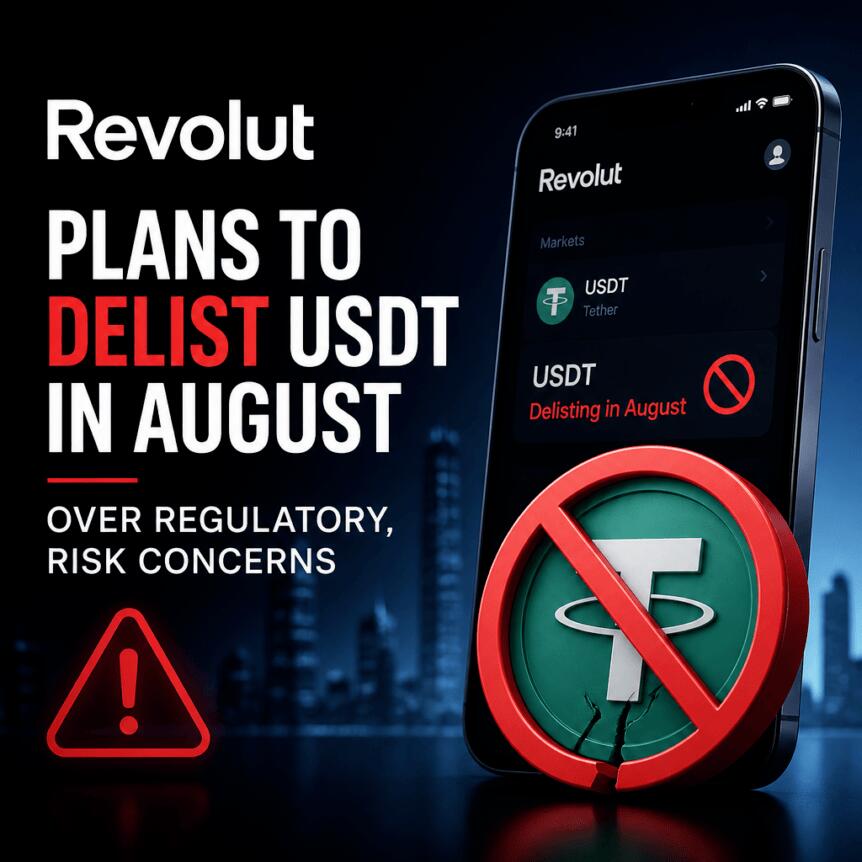
Revolut, the UK-headquartered digital banking platform, has informed some users that it will delist the Tether USDt (USDT) stablecoin starting in July, with the full removal scheduled for Aug. 31, 2026. The company says the decision is driven by “regulatory and risk considerations,” highlighting how stablecoin access is being reshaped across mainstream financial apps as rules tighten.
According to a customer notice reviewed by Cointelegraph, users will stop being able to buy USDT beginning July 6, 2026. Revolut will continue to support USDT until the end of August, but any USDT not sold or withdrawn by then will be automatically converted into the user’s base currency using that day’s exchange rate.
Key takeaways
- Revolut will block USDT purchases from July 6, 2026, followed by full delisting on Aug. 31, 2026.
- USDT deposits will no longer be supported after July 30, 2026, with incoming transfers rejected.
- Users who still hold USDT at the end of August will be converted into base currency at the applicable exchange rate.
- Revolut cited only broad “regulatory and risk considerations,” without specifying which framework applies.
- The move fits a wider European pattern of stablecoin delistings tied to the EU’s MiCA regime.
Timeline for Revolut users
Revolut’s notice lays out a phased exit for USDT within its platform. The first restriction comes earlier than the final delisting: users will no longer be able to buy USDT starting July 6, 2026. That effectively limits new exposure to USDT well ahead of the end date, giving holders time to decide whether to sell or withdraw.
Support for deposits ends later, on July 30, 2026. From that point, any attempted USDT transfer into Revolut’s system will be rejected, narrowing the options for users who might have planned to move stablecoins into their accounts after the purchase restriction begins.
If users do not act before the end of August, Revolut says it will automatically convert remaining USDT holdings into the user’s base currency on the day’s exchange rate. That detail matters for anyone using USDT as a temporary parking asset or settlement tool inside a broader workflow, because it removes the ability to hold stablecoins through the delisting date without triggering conversion.
Revolut’s regulatory rationale remains vague
While Revolut attributes the delisting to “regulatory and risk considerations,” it does not spell out which specific rules or jurisdictions are behind the decision. The notice also does not clarify whether the changes apply globally or only to certain markets where Revolut operates under particular regulatory constraints.
For readers trying to understand the practical impact, the lack of jurisdictional clarity leaves an open question: whether the delisting is limited to particular European locations, or whether the company is preparing a broader policy that could affect users beyond the EU. Cointelegraph reported that it contacted Revolut for comment on affected jurisdictions and the scope of its crypto offering but did not receive a response by publication.
What is clear from public regulatory records is that Revolut received a Markets in Crypto-Assets (MiCA) license as a crypto asset service provider (CASP in November 2025. The authorization was issued by the Cyprus Securities and Exchange Commission (CySEC), according to the European Securities and Markets Authority’s (ESMA) MiCA register. You can review ESMA’s MiCA information through its official page: ESMA’s MiCA overview.
Why Europe’s stablecoin delistings keep accelerating
Revolut’s decision follows a broader European trend in which exchanges and crypto service providers have reduced or removed access to USDT as they adjust to MiCA compliance expectations. Earlier coverage from Cointelegraph noted that exchanges began delisting USDT in Europe in 2024 to align with MiCA requirements, including Coinbase’s preparations to delist USDT in Europe: Cointelegraph report on Coinbase’s move.
The key tension is that MiCA does not only regulate how crypto services are delivered; it also imposes obligations on stablecoin issuers and the stablecoin ecosystem, which in turn affects whether specific products can continue being offered by regulated platforms. In practice, CASPs can decide that the compliance burden—or the perceived regulatory risk—does not justify continuing a stablecoin listing.
Cointelegraph’s reporting also describes the issuer side of this story: Tether has refused to comply with MiCA, and CASPs have gradually delisted USDT across Europe since late 2024. In earlier coverage, Cointelegraph pointed to Tether’s stance, including the issuer’s critique of aspects of the MiCA framework—such as reserve requirements for certain stablecoin issuers and the stipulation that part of reserves be held with EU credit institutions. See Cointelegraph’s related reporting: Tether’s refusal to comply with MiCA.
Tether CEO Paolo Ardoino has publicly argued that the legislation is poorly designed. Cointelegraph previously noted Ardoino’s comments to the outlet, including criticism of the EU rules, as well as his concerns about reserve-related provisions and how they apply. According to Cointelegraph, Ardoino told the publication that MiCA is “very not well thought legislation.”
Market stakes: USDT’s size vs. platform constraints
Even as USDT’s presence shrinks on some regulated platforms, it remains one of the largest stablecoins in the market. Cointelegraph reported that USDT is currently the third-largest crypto asset by market capitalization after Bitcoin and Ether, with a market value of $184 billion at the time of publication. It also cited CoinGecko data indicating that USDC—Circle’s stablecoin—has a $73 billion market cap and ranks as the fifth-largest crypto asset.
This mismatch—USDT’s scale versus the willingness (or ability) of platforms to keep listing it—illustrates how stablecoin distribution increasingly depends on regulatory alignment, not just liquidity or demand. For users, that can translate into operational friction: stablecoin rails that once felt “always available” can change under compliance reviews, leaving customers with forced exits or automated conversions like the one Revolut describes.
It also underlines an important practical point for traders and builders: stablecoin availability on on-ramps and app-based finance is becoming a policy issue. Even when a stablecoin remains liquid in broader markets, individual providers may reduce access based on issuer compliance positions, platform risk assessments, or specific interpretations of regulatory expectations.
For now, USDT’s delisting path on Revolut is scheduled in clear steps, but the broader question is still unsettled—whether Revolut’s actions will remain local to certain jurisdictions or expand across its entire user base. As more CASPs adapt their stablecoin listings to MiCA, market participants should watch for additional platform announcements, potential switches in preferred stablecoins, and whether issuer compliance disputes continue to narrow access on mainstream financial apps.
https://www.cryptobreaking.com/revolut-plans-to-delist-usdt/?utm_source=blogger%20&utm_medium=social_auto&utm_campaign=Revolut%20Plans%20to%20Delist%20USDT%20in%20August%20Over%20Regulatory,%20Risk%20Concerns%20
Comments
Post a Comment