
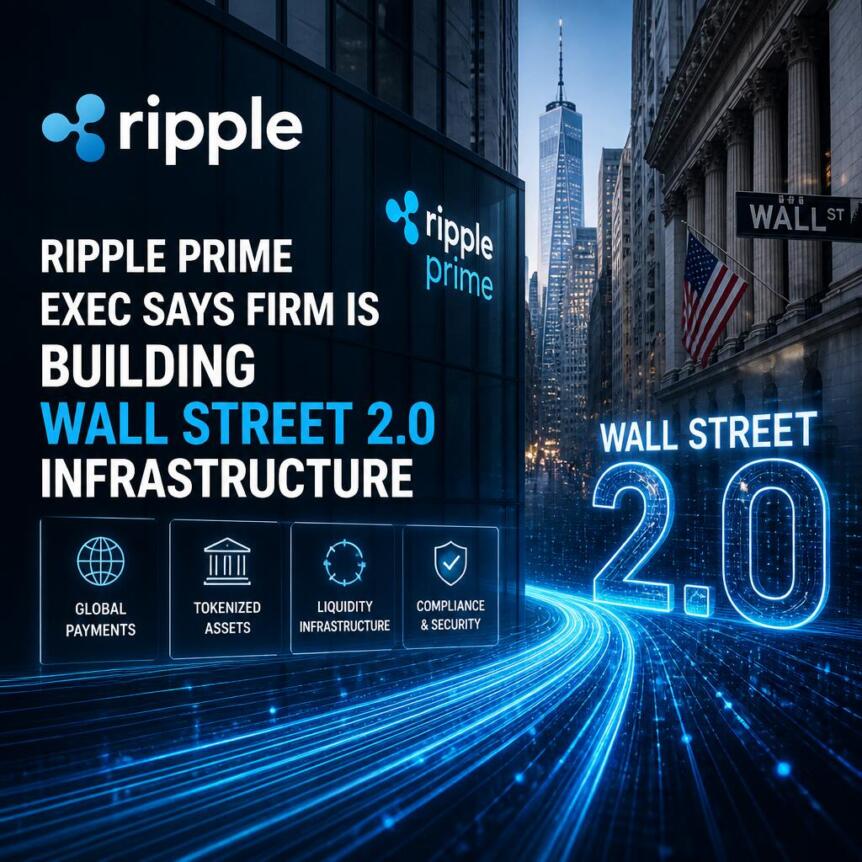
Ripple Prime says institutional demand for blockchain infrastructure continues growing despite weaker digital asset market conditions. Ripple Prime executives describe the company as a key provider of continuous financial infrastructure for modern institutional markets. The latest comments follow expanding adoption of blockchain settlement, financing, and collateral management across multiple asset classes.
Executive Outlines Institutional Blockchain Strategy
Michael Higgins, international chief executive, said Ripple Prime is building infrastructure for continuous institutional market operations. He told Markets Media that blockchain networks support financial services beyond traditional banking hours. He described this shift as the foundation of "Wall Street 2.0."
Higgins said, "The current crypto winter is not a digital asset winter." He added that Ripple Prime supports markets requiring always-on blockchain infrastructure and uninterrupted access. He said those capabilities help institutions operate beyond conventional settlement schedules.
Ripple completed its Hidden Road acquisition for approximately $1.25 billion during October 2025. The transaction expanded Ripple Prime through broader institutional brokerage and financing capabilities. Executives said the business has since reported triple year-over-year revenue growth.
Expansion Supported by Financing and Infrastructure
The company recently secured a $200 million debt facility from Neuberger Specialty Finance. Executives said Ripple Prime will use the financing to increase institutional margin lending capacity. The facility supports clients operating across digital assets, foreign exchange, derivatives, swaps, and fixed income.
Traditional prime brokerage often limits collateral movements to standard banking hours. However, Ripple Prime enables continuous collateral management through the RLUSD dollar-backed stablecoin. That approach reduces operational delays during weekends and public holidays.
Executives said institutions increasingly require unified infrastructure across several financial markets. They stated Ripple Prime applies one operational framework across digital assets, foreign exchange, and traditional exchanges. The company said this design improves operational consistency for institutional clients.
Competition With Traditional Financial Providers
Higgins said established banks are expected to expand digital prime brokerage after regulatory frameworks become clearer. However, he said many existing providers still depend upon older technology systems. He added that non-bank market makers already dominate several important trading segments.
Higgins said the largest market makers in United States equities and foreign exchange are no longer banks. He argued Ripple Prime can integrate new trading venues faster because of its unified technology platform. He said consistent operational workflows simplify onboarding across different financial markets.
Ripple Prime said institutional demand continues supporting revenue growth and broader infrastructure expansion. Company executives maintain that continuous blockchain-powered financial services remain central to evolving institutional market operations. The latest statements reinforce the company's focus on supporting around-the-clock financial infrastructure through blockchain technology.
https://www.cryptobreaking.com/ripple-prime-exec-says-firm/?utm_source=blogger%20&utm_medium=social_auto&utm_campaign=Ripple%20Prime%20Exec%20Says%20Firm%20Is%20Building%20Wall%20Street%202.0%20Infrastructure%20
Comments
Post a Comment