
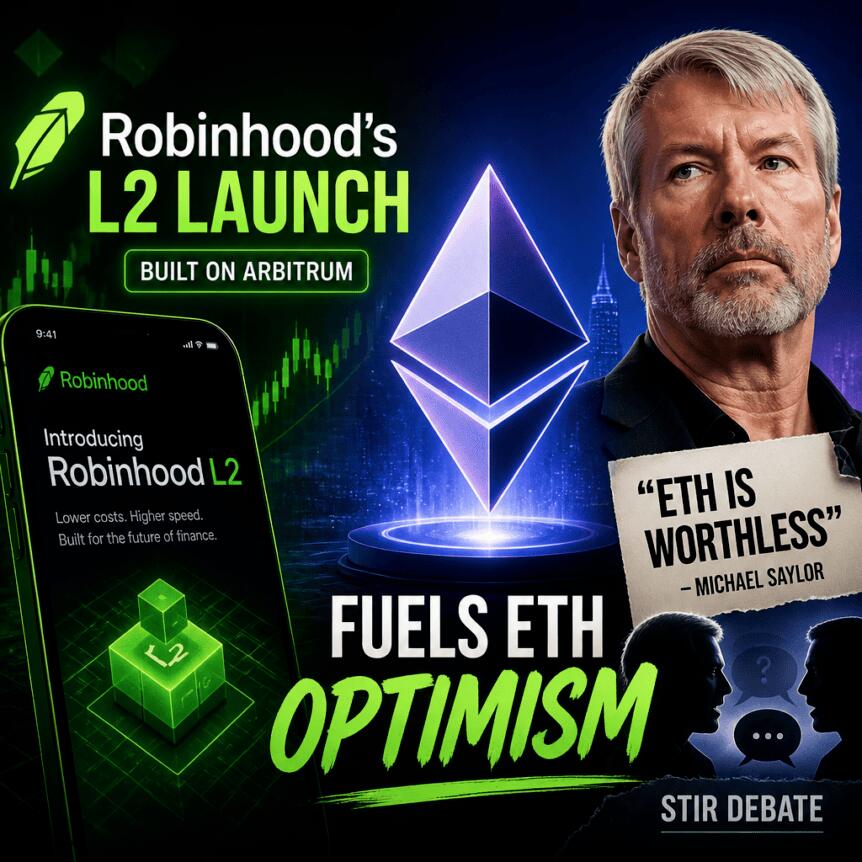
The launch of Robinhood Chain, a new layer-2 network that uses Ethereum as its core settlement environment, is drawing fresh attention to the ETH ecosystem. In its first week, the network reportedly saw more than $141 million worth of ETH bridged, and the chain now counts over half a million wallets holding ETH, according to data referenced by Cointelegraph.
At the same time, broader Ethereum narratives are receiving support from on-chain activity and asset tokenization trends. Analysts are pointing to strong Real World Assets (RWA) concentration on Ethereum and to valuation signals suggesting ETH may be priced lower relative to the value locked on its network than it was during the 2022 bear market.
Key takeaways
- Robinhood Chain’s first-week launch activity includes over $141 million in ETH bridged, with the network now drawing more than 500,000 ETH-holding wallets.
- DEX volume on Robinhood Chain reportedly reached $877.56 million over the past 24 hours, indicating fast user traction.
- Some commentators are reassessing the long-held view that layer-2 growth is inherently bearish for Ethereum because of reduced L1 fees.
- Ethereum’s RWA dominance is cited as a key catalyst, with one dataset putting Ethereum’s RWA market share at 47%.
- Separate fundamentals debate continues: an analyst at Lisk argues Ethereum’s TVL-to-ETH value ratio resembles a distorted valuation pattern seen in the 2022 bear market.
Robinhood Chain draws liquidity and wallet growth
Robinhood Chain’s early momentum is being credited with improving sentiment around Ethereum. The network is reported to run with ETH as its native gas token, and Cointelegraph notes that roughly $141 million in ETH has already been bridged to the chain since launch.
Wallet distribution also appears to be accelerating. Cointelegraph cited data showing more than half a million wallets holding ETH on the network. Over the past day, Robinhood Chain’s activity reportedly helped it outpace Ethereum L1 and the rival L2 Base in terms of daily DEX volume, which was reported at $877.56 million.
Robinhood Chain is positioned as an offshoot tied to the Robinhood brand—an important detail because it extends the familiar EVM-compatible narrative beyond purely crypto-native audiences. Robinhood’s broader business includes tokenized stocks offered to customers in 120 countries, which supporters say strengthens the appeal of EVM-aligned infrastructure.
Why L2 activity may not be the bearish signal some expected
Layer-2s have long been debated as potential headwinds for Ethereum. The core criticism is straightforward: if transactions move from Ethereum’s mainnet to L2s, Ethereum L1 can lose some of the activity that supports fee generation, without necessarily receiving a commensurate increase in compensation for validators.
But Cointelegraph points out that even some former ETH skeptics are revisiting that stance in light of Robinhood Chain’s early traction. Influencer Ansem described lighter implementations and Robinhood L2s as a “sneakily” good setup for a long-delayed ETH bull thesis. Mike Dudas of 6th Man Ventures called Robinhood Chain “the single most bullish thing” he had seen in ETH-related developments for years.
While these are opinions rather than market data, they underscore an investor question that matters for positioning: do new L2s merely divert demand away from Ethereum L1, or do they strengthen the entire EVM value chain by pulling users, liquidity, and DeFi trading into a system where ETH remains the base asset for gas and settlement?
RWA concentration and a TVL-to-value distortion argument
Beyond retail-facing narratives, Cointelegraph highlights Ethereum’s relationship to Real World Assets. One dataset cited in the report puts Ethereum at 47% market share of RWA activity, using Rwa.xyz data.
Separately, Leon Waidmann, head of Research at Lisk, makes a valuation argument based on a comparison between Ethereum’s Total Value Locked and Ether’s market cap. Waidmann said Ethereum’s TVL of $260 billion has surpassed the $210 billion market cap of Ether, calling the gap a “distortion” that suggests ETH may be “underpriced.” He further linked this relative valuation pattern to conditions seen in the 2022 bear market.
For investors, this type of comparison is useful—but also incomplete. TVL can be influenced by token incentives, bridged assets, and changing DeFi risk appetite. Still, the direction of the argument is clear: if the value being secured on Ethereum continues to expand while Ether’s market cap does not keep pace, then relative valuation could become supportive for ETH sentiment.
What to watch after Robinhood Chain’s initial surge
Robinhood Chain’s early metrics—bridged ETH, wallet count, and high DEX volume—are the most tangible evidence in the story so far. But what remains uncertain is whether this activity is sustainable and how it translates into ongoing demand for ETH over time, especially as new competition among L2s intensifies.
Investors and builders should track whether daily DEX volume holds beyond the launch window, how much ETH continues to be bridged relative to the size of the user base, and whether broader RWA and DeFi flows keep reinforcing Ethereum’s dominant role—particularly if the TVL-to-valuation narrative continues to align with price expectations.
https://www.cryptobreaking.com/robinhoods-l2-launch-fuels-eth/?utm_source=blogger%20&utm_medium=social_auto&utm_campaign=Robinhood’s%20L2%20Launch%20Fuels%20ETH%20Optimism%20as%20Saylor%20Claims%20Stir%20Debate%20
Comments
Post a Comment