
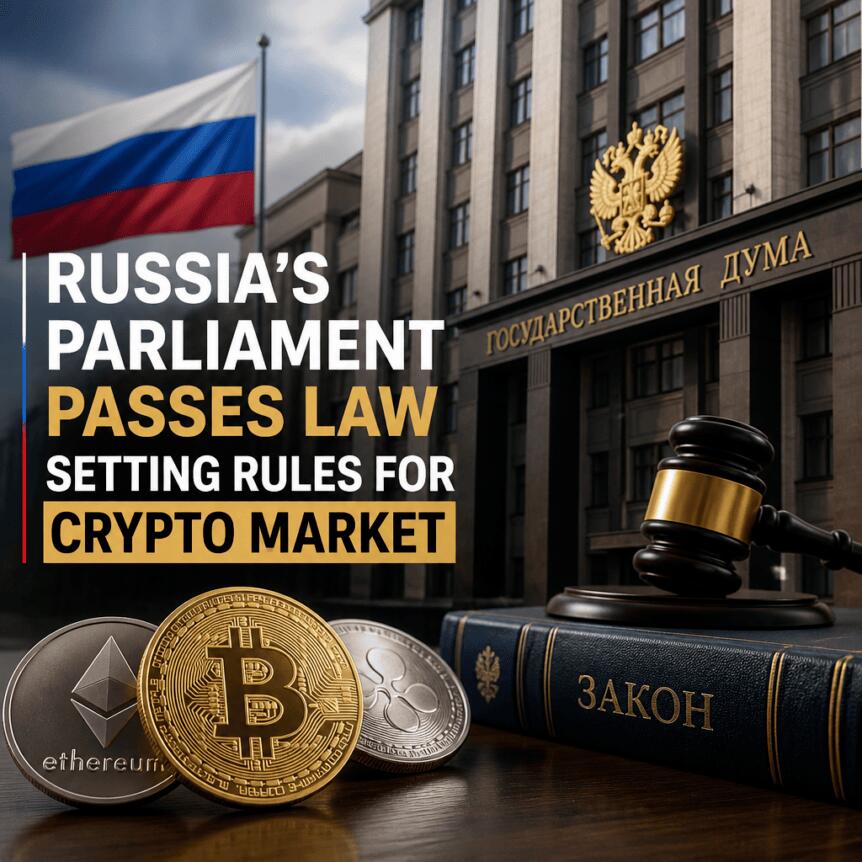
Russia’s State Duma has completed the final readings that bring the country’s long-awaited crypto regulatory bill one step closer to becoming law, approving draft legislation that would create a comprehensive framework for digital assets and define how regulated intermediaries can operate.
According to official parliamentary records, lawmakers approved bill No. 1194918-8, titled “On Digital Currency and Digital Rights,” in its second and third readings on Tuesday. The measure is now set to move to Russia’s upper house, the Federation Council, and then to President Vladimir Putin for signature before it can take effect.
Key takeaways
- The bill would establish rules for a regulated crypto market, including exchanges, brokers, asset managers, and custodians.
- The Bank of Russia would be given wide authority to supervise the framework and decide which crypto assets can be offered via licensed intermediaries.
- Crypto use for payments inside Russia would remain prohibited, while the bill allows digital assets to be used in foreign trade operations.
- Non-qualified investors would face purchase and cross-border transfer limits, with higher thresholds for qualified investors.
- If enacted, most provisions would begin on Sept. 1, 2026, with a compliance transition period lasting until July 1, 2027.
Bank of Russia oversight takes center stage
A central feature of the proposed framework is the role assigned to the Bank of Russia. Under the bill, the central bank would oversee the regulated market, including the power to determine which crypto assets are eligible to be offered through licensed intermediaries and to publish implementing regulations.
The bill also lays out five categories of participants that would operate within the new rules: crypto exchanges, brokers, asset managers, custodians, and exchange service providers. By defining who can buy, sell, hold, and exchange crypto assets, lawmakers aim to formalize the market structure and reduce reliance on informal or unlicensed activity.
For investors, the bill differentiates between “qualified” and “non-qualified” participants. Non-qualified investors would be subject to an annual ceiling of 300,000 rubles (about $3,800) on purchases made through a single intermediary, and a 100,000-ruble annual limit on transfers abroad. Qualified investors would have annual purchase limits of 3 million rubles and annual cross-border transfer limits of 1 million rubles.
Payments at home remain blocked, cross-border use allowed
While the bill expands the legal perimeter around crypto markets, it also preserves a key restriction: it would continue to ban the use of crypto assets to pay for goods and services within Russia.
At the same time, lawmakers chose to make room for digital assets in international commerce. The legislation would allow crypto assets to be used in foreign trade operations, aligning with Russia’s broader push to facilitate cross-border settlement alternatives outside conventional payment rails.
Timeline: broad provisions from September 2026, transition through 2027
Most of the bill’s provisions are scheduled to take effect on Sept. 1, 2026, contingent on presidential approval. A transition period runs through July 1, 2027, designed to give market participants time to adapt to the new compliance requirements.
After the transition window closes, the bill indicates that crypto transactions would need to be executed through regulated organizations. It also states that banks would have to reject transactions that do not comply with the framework laid out in the law.
Russia’s legislative push does not stop at market rules. Lawmakers are also drafting related measures, including proposals on taxation and penalties for violations. A separate tax bill has already passed its first reading, while expectations are that penalty provisions would be considered before the transition period ends.
Industry activity appears to be moving alongside the policy work. Earlier coverage from Cointelegraph noted developments involving Russia’s banking sector, including Alfa-Bank testing crypto trading.
Legal framework is not the finish line
Even if the bill becomes law, implementation would still depend heavily on the regulatory follow-through and supporting infrastructure. Olga Goncharova, head of the Digital Financial Assets and Digital Currencies Expert Center at the Association of Russian Banks, told Cointelegraph that the measure creates a legal foundation but requires “extensive follow-up regulation” before the market can function smoothly.
“The law itself is only the beginning,” Goncharova said, adding that practical effectiveness depends on mechanisms that are still being developed by the banking community together with the Bank of Russia.
According to Goncharova, the central bank plans to issue around 80 additional regulatory acts by the end of the year. These would be intended to specify how the framework operates in practice, particularly around compliance expectations for institutions and market participants.
She also pointed to work on operational infrastructure needed for a regulated environment, including development of a domestic Travel Rule system, blockchain node infrastructure, and crypto analytics tools. These elements would be important for monitoring transactions, reporting, and ensuring that regulated intermediaries can meet the requirements that come with licensing and oversight.
The broader regulatory trajectory will also need to align with licensing and supervisory expectations for custody services. Earlier Cointelegraph reporting referenced that custodians face scrutiny even under the EU’s MiCA regime, underscoring that custody regulation is typically a key test case for any emerging framework.
With the State Duma’s approval now secured, the next critical moment is whether the Federation Council and President Vladimir Putin sign the bill. Investors and market participants should watch closely for the Bank of Russia’s forthcoming regulatory acts—especially details on asset eligibility, licensing requirements, and how banks will operationalize the transaction rejection rules once the transition period ends.
https://www.cryptobreaking.com/russias-parliament-passes-law-setting/?utm_source=blogger%20&utm_medium=social_auto&utm_campaign=Russia’s%20Parliament%20Passes%20Law%20Setting%20Rules%20for%20Crypto%20Market%20
Comments
Post a Comment