
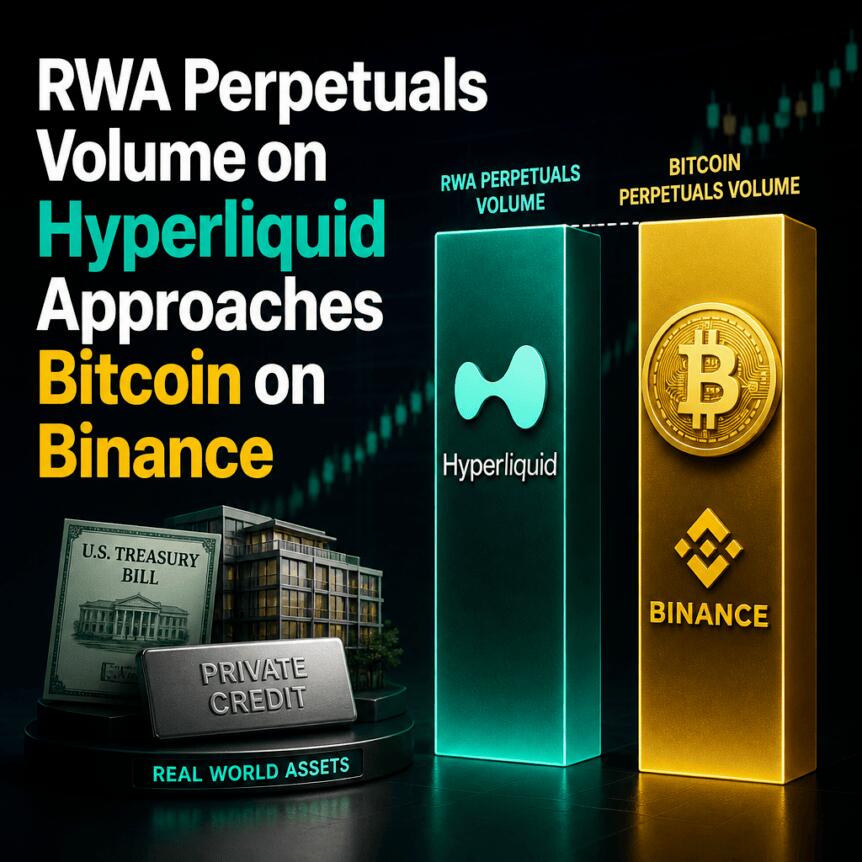
Real-world asset (RWA) perpetual futures are starting to look less like a side experiment and more like a meaningful part of crypto derivatives. Data shared by Talos indicates that, over the past week, trading volume in RWA-linked perpetuals on major venues came close to Bitcoin perpetuals—an outcome that underscores how quickly tokenized finance is finding a home in onchain markets.
Talos estimates that tracked seven-day volume across RWA perps reached $61.7 billion as of a Thursday snapshot, equivalent to 99.2% of Bitcoin perpetual volume on Hyperliquid and Binance, the two venues where most of the activity is concentrated. Equity-linked contracts made up the largest share at 57.8%, followed by commodities at 28.2%.
Key takeaways
- RWA perpetuals nearly match Bitcoin perpetuals—tracked seven-day RWA perp volume was $61.7 billion, or 99.2% of Bitcoin perp volume on Hyperliquid and Binance.
- Equities dominate the RWA mix, accounting for 57.8% of RWA perp volume, while commodities represent 28.2%.
- Hyperliquid leads the category, reporting $25.1 billion in RWA perpetual trading volume for July 13–19.
- Tokenized RWA activity is expanding beyond trading, with onchain RWA value cited at about $36.8 billion excluding stablecoins (per RWA.xyz).
- RWA perps still remain a fraction of overall derivatives, with tracked RWA perpetuals at roughly 7.5% of total futures volume over the same seven-day period.
RWA perpetuals surge toward parity with Bitcoin derivatives
The acceleration in RWA perpetual futures is notable because it reflects demand for tradable exposure to tokenized assets—equities, commodities, and other instruments—using the same core mechanics that have driven much of crypto’s derivatives growth.
According to Talos, the combined seven-day volume of tracked RWA perps was $61.7 billion, representing 99.2% of Bitcoin perpetual volume across Hyperliquid and Binance. The breakdown highlights that traders have leaned most heavily into tokenized equity exposure, with 57.8% of the RWA perp tally linked to equity contracts. Commodities accounted for 28.2% of volume, while the remainder came from other categories including indexes.
Talos also frames the activity as broadly aligned with the current market concentration: Hyperliquid and Binance capture the majority of perp trading for these instruments, making them the key venues to watch for continued RWA derivatives traction.
Hyperliquid posts a clear lead as RWA contracts diversify
Venue-level data further clarifies where liquidity is forming. Hyperliquid recorded $25.1 billion in RWA perpetual trading volume during the week of July 13 to July 19—more than the combined volume of all other perpetual categories on its platform during that period, based on Talos’ reporting.
That performance is consistent with a broader narrative from market participants who argue onchain perpetuals offer structural advantages over traditional, expiry-based products. Pantera Capital previously suggested that perpetual futures could evolve into a dominant trading instrument beyond crypto, pointing to factors such as 24/7 trading, the absence of contract expiries, easier position management, and continuous price discovery (earlier coverage referenced by the article).
As for the composition during the early days of the current week, Talos’ dashboard shows RWA perpetual trading volume already at $37.2 billion, exceeding Bitcoin perpetual volume by about 9%. In that same snapshot, equity-linked contracts were $22.8 billion, commodities were $9.1 billion, and indexes were $4.2 billion. ETFs contributed about $338 million, while foreign exchange, pre-IPO, and other RWA contracts made up the remainder.
Why traders and platforms are leaning into tokenized assets
Beyond the perps themselves, the ecosystem backdrop also matters. The article cites RWA.xyz for the claim that the value of onchain RWAs has grown to about $36.8 billion, excluding stablecoins. While that figure is separate from derivatives volume, it provides context for why tokenized instruments are becoming more frequently used in trading strategies rather than simply being held or settled.
Crypto exchanges are also expanding past “pure” crypto listings, increasingly offering tokenized stocks and commodities alongside digital assets. This kind of product expansion can reduce friction for mainstream participants—particularly those already familiar with equity and commodity exposure—while also giving crypto-native traders additional instruments to hedge, speculate, or rotate into.
Circle co-founder and CEO Jeremy Allaire tied this momentum to a market narrative shift in an X post dated July 24, suggesting that rising RWA trading on Hyperliquid indicates crypto markets are moving “away from speculating on endogenous digital commodities.” While that framing is opinion, it aligns with the measurable trend Talos reports: RWA-linked perp activity is large enough to meaningfully compete with the scale of Bitcoin perpetuals on major venues.
Regulatory pressure and the “24/7” question for traditional markets
As onchain perpetuals grow in importance, traditional finance is starting to engage more directly with how regulation should treat blockchain-based markets. Intercontinental Exchange CEO Jeffrey Sprecher, whose company owns the New York Stock Exchange, has urged regulators to create a “level playing field” for 24/7 onchain perpetual futures—arguing that market structure should not block development of blockchain-based trading (referenced by the article’s link).
The central tension is that perpetual futures are built around continuous trading and perpetual exposure, while many legacy market products are tied to standardized trading sessions and defined product mechanics. If onchain platforms continue to deepen liquidity in tokenized instruments, regulators may face increasing pressure to define how such venues and products should be supervised, including issues around participant access, disclosures, and market integrity.
That said, Talos’ figures also imply that RWA perpetuals are still early relative to the full derivatives universe. The article states that aggregate futures trading volume across tracked platforms was about $821.4 billion over the past seven days, with tracked RWA perpetuals accounting for roughly 7.5% of that total—large enough to matter, but not yet dominant.
Going forward, traders and builders should watch whether weekly RWA perp volume can sustain the momentum indicated by Talos’ early-week snapshot (already $37.2 billion, ahead of Bitcoin perps by about 9%) and whether Hyperliquid’s outsized RWA activity persists as more venues potentially deepen liquidity. The bigger question for the market is whether RWA derivatives continue to move from experimental exposure into a durable, mainstream trading category—especially as regulators decide how to handle 24/7 onchain perpetual futures.
https://www.cryptobreaking.com/rwa-perpetuals-volume-on-hyperliquid/?utm_source=blogger%20&utm_medium=social_auto&utm_campaign=RWA%20Perpetuals%20Volume%20on%20Hyperliquid%20Approaches%20Bitcoin%20on%20Binance%20
Comments
Post a Comment