
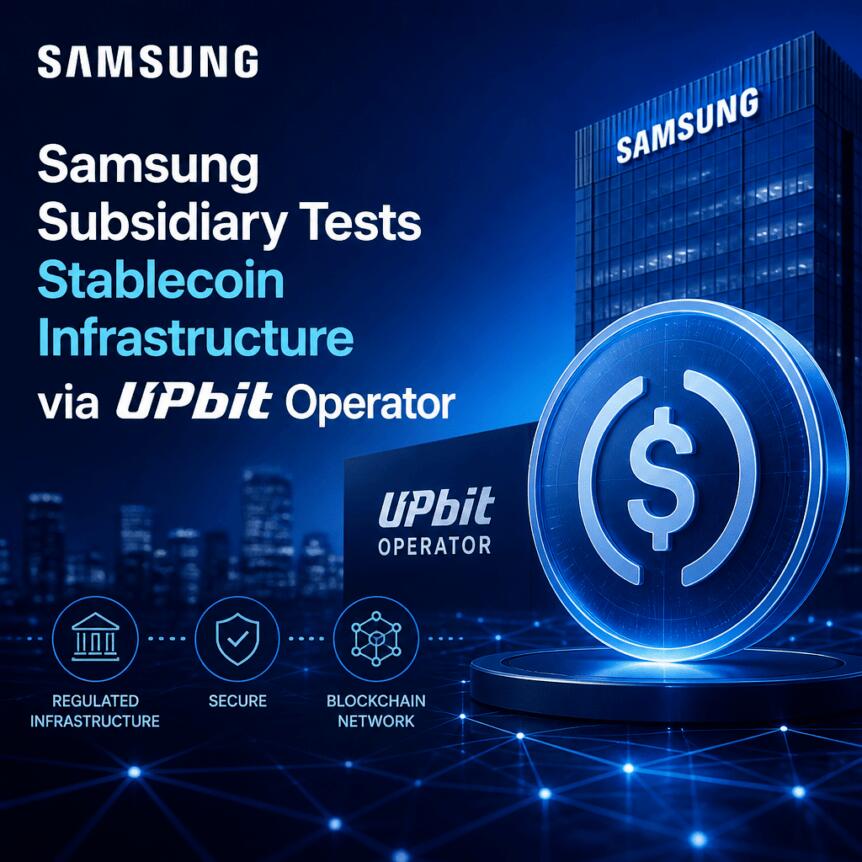
Samsung SDS, the IT services arm of Samsung Group, is exploring cooperation with Dunamu—operator of the South Korean exchange Upbit—across stablecoin infrastructure, digital asset systems, and AI-enabled payment models, according to comments made by Samsung SDS CEO Lee Jun-hee during the company’s Q2 earnings call on Thursday.
The discussions signal that Samsung SDS is trying to translate its existing work in tokenization and settlement into commercial offerings in digital finance, at a time when South Korea is actively shaping its approach to stablecoins.
Key takeaways
- Samsung SDS is in talks with Dunamu on stablecoin infrastructure and end-to-end digital asset processing, including issuance-to-settlement workflows.
- The company points to prior capabilities built through Korea Securities Depository’s tokenized securities platform project and stablecoin process validation.
- This effort builds momentum for Samsung’s broader digital asset strategy following separate plans to add stablecoin support to Samsung Wallet.
- Samsung SDS frames its Dunamu investment and collaboration as strategic for digital finance infrastructure rather than purely financial returns.
- Samsung SDS’ AI and cloud expansion appears to be running in parallel with its push into digital finance services.
Samsung SDS and Dunamu explore stablecoin and digital asset infrastructure
During Samsung SDS’s Q2 earnings call, CEO Lee Jun-hee said the company is discussing potential cooperation with Dunamu on three fronts: stablecoin infrastructure, digital asset systems, and AI-based payment business models. Samsung SDS indicated that it expects the partnership to help expand its presence in the digital asset infrastructure market.
Lee tied the planned collaboration to capabilities Samsung SDS says it has already developed. According to the CEO’s remarks, the company has “secured differentiated business capabilities” in digital asset infrastructure through work connected to the Korea Securities Depository’s tokenized securities platform project, as well as “end-to-end validation” across the stablecoin lifecycle—from issuance through settlement.
The practical implication for market participants is straightforward: infrastructure providers that can demonstrate reliable settlement-grade processes tend to be better positioned to support compliant, enterprise-grade stablecoin use cases—especially where tokenization needs to interoperate with existing financial systems.
Collaboration follows Samsung’s wider stablecoin direction
The Dunamu talks come shortly after Samsung Electronics announced plans to add stablecoin support to Samsung Wallet, extending the group’s digital asset push beyond traditional hardware and consumer apps.
While the earnings call details focus on Samsung SDS and Dunamu’s infrastructure and systems work, the wallet development underscores a larger pattern: Samsung’s internal technology stack—from device-side wallets to enterprise-grade blockchain infrastructure—appears to be converging around stablecoins and tokenized finance.
For investors and builders, this matters because stablecoin adoption often depends on multiple layers working together: compliant issuance and settlement infrastructure, plus consumer-facing and merchant-facing distribution channels. Samsung’s efforts span both ends, even if the exact integration steps were not detailed in the Q2 remarks.
Earlier Samsung affiliate investment deepens the relationship
Samsung SDS’s latest comments also build on prior moves by Samsung affiliates. In May 2026, Samsung Securities, Samsung SDS, and Samsung Card agreed to buy a combined 4% stake in Dunamu, according to earlier coverage from Cointelegraph.
In the most recent Q2 call, Lee reportedly described the Dunamu investment as a strategic step rather than a financial one, stating that the companies plan to refine potential business models for digital financial infrastructure. The transcript referenced by the company’s earnings materials positions the partnership as an effort to combine Samsung SDS’s IT, cloud, and security capabilities with Dunamu’s blockchain expertise.
Samsung SDS’ framing is notable because it suggests the collaboration is intended to produce repeatable infrastructure offerings, not merely one-off experiments. The company’s emphasis on stablecoin process validation—issuance through settlement—also points toward operational readiness as a differentiator.
AI and cloud growth run alongside the digital finance push
Samsung SDS’s digital asset initiative is unfolding alongside a broader expansion drive in AI and cloud services. The company’s Q2 financial update showed revenue rising 5.9% year on year to 3.72 trillion Korean won (about $2.6 billion), as cited in its quarterly earnings presentation.
Cloud revenue increased 17% from the prior year, and external cloud business revenue grew 75%, driven by demand for Samsung’s cloud platform and graphics processing unit-as-a-service offerings. These figures matter because stablecoin and digital asset infrastructure increasingly requires data handling, security controls, and scalable compute—areas where cloud and AI investment can directly support deployment and monitoring.
Samsung SDS also reportedly outlined plans to expand its AI infrastructure footprint from 110 megawatts today to 230 MW by 2029 and more than 800 MW by 2031, according to the same earnings materials. While those AI capacity targets are not specific to stablecoin systems, they indicate management’s intent to build the compute backbone that can support both AI-enabled services and the operational needs of digital finance platforms.
In other words, the Dunamu collaboration looks like part of a wider platform strategy: infrastructure capabilities for tokenized finance paired with scalable computing and security.
Next, readers should watch for whether Samsung SDS and Dunamu move from partnership discussions to defined product or deployment milestones—especially any details about stablecoin issuance, settlement tooling, or AI-based payment workflows. The immediate uncertainty is timing: earnings call cooperation signals direction, but adoption and market impact will depend on how quickly concrete infrastructure plans are executed within South Korea’s evolving stablecoin regulatory environment.
https://www.cryptobreaking.com/samsung-subsidiary-tests-stablecoin-infrastructure/?utm_source=blogger%20&utm_medium=social_auto&utm_campaign=Samsung%20Subsidiary%20Tests%20Stablecoin%20Infrastructure%20via%20Upbit%20Operator%20
Comments
Post a Comment