
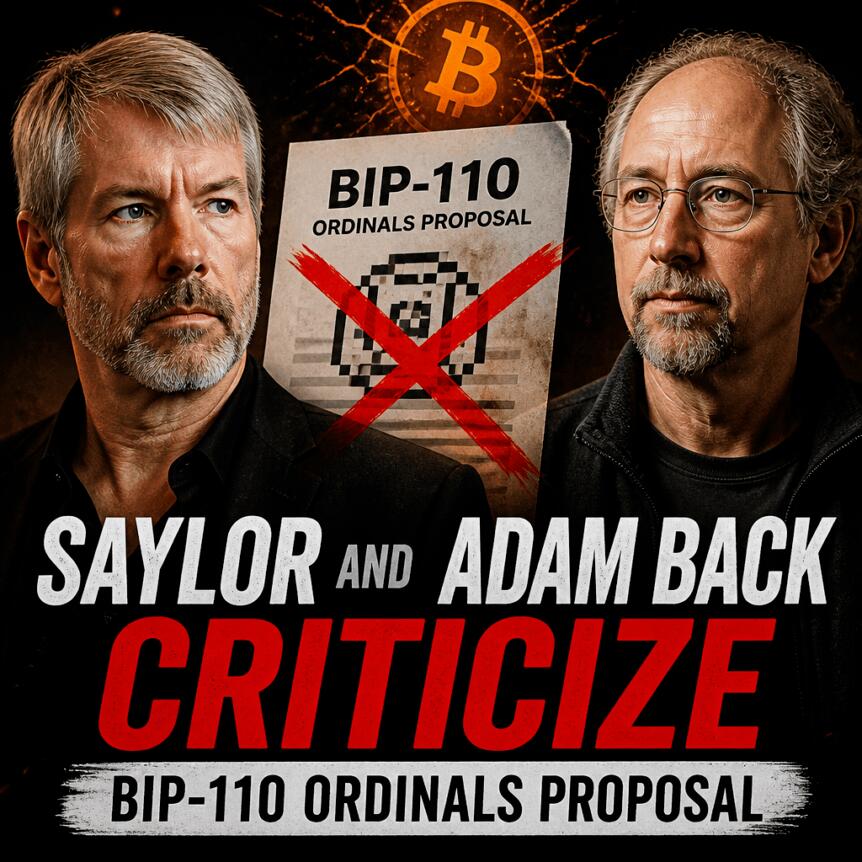
Michael Saylor and Adam Back have renewed their opposition to BIP-110, a proposed Bitcoin protocol change aimed at curbing certain “non-monetary” data activity associated with Ordinals-like inscriptions. Their critique highlights a recurring fault line in Bitcoin governance: whether developers should intervene at the protocol level to address perceived network bloat, and what such intervention could cost in terms of credibility and user safety.
BIP-110 was introduced in December 2025 with the stated goal of discouraging arbitrary data from clogging the blockchain and preserving Bitcoin’s core role as a peer-to-peer cash network. In response, Saylor argued the proposal is more likely to create harm than solve the problem, adding that the risks extend beyond “spam.”
Key takeaways
- Strategy’s Michael Saylor and Blockstream CEO Adam Back both oppose BIP-110, warning that a protocol-level fork could damage Bitcoin’s credibility and potentially disrupt normal transactions.
- BIP-110’s activation is contingent on broad node support: at least 55% of validating nodes must back the proposal during a Bitcoin “block period.”
- Recent data cited in the discussion suggests only a small fraction of blocks within the last evaluated period showed BIP-110 support.
- Ordinals activity has reportedly fallen sharply from its August 2023 peak, raising questions about whether a contentious fix is needed now.
A protocol fork framed as an anti-bloat measure
BIP-110 enters a sensitive part of Bitcoin’s history. Rather than addressing bloat through soft, non-contentious policy or user-level behaviors, it proposes a temporary fork intended to limit certain categories of non-monetary transactions. According to the proposal’s proponents, the aim is to stop Ordinals-like inscriptions and other arbitrary data from “spamming” the network while keeping Bitcoin focused on its cash-first design.
The proposal was introduced by a pseudonymous developer, “Dathon Ohm,” and received support from Ocean protocol founder Luke Dashjr. While both critics and supporters agree that inscriptive activity can increase on-chain data usage, the disagreement is over whether a temporary, protocol-enforced limit is the right tool—and whether the costs of implementing it outweigh the benefits.
Why Saylor and Back think the risk is bigger than “spam”
Saylor’s criticism centers on the potential for broader damage. In a post on X, he claimed there are “110 things more dangerous to Bitcoin than spam,” arguing that BIP-110 could invalidate ordinary transactions on the network.
Back’s objections are similarly pointed, but the framing is more philosophical. He described BIP-110 as a “quest to police other people,” emphasizing that Bitcoin’s decentralization should prevent any group from imposing its preferences on others. In his view, a permissionless, censorship-resistant money system is fundamentally incompatible with rules that effectively restrict activity based on the preferences of a subset of participants.
Together, their statements reflect a core tension within Bitcoin’s development culture: even if a change targets a real technical concern, critics worry that introducing protocol-level enforcement could undermine neutrality and the expectation that Bitcoin doesn’t require permission to use the network.
Support appears limited—and the Ordinals peak is already fading
Even if BIP-110 remains controversial, it is not automatically enforceable. The proposal would not activate unless 55% of Bitcoin nodes validating blocks support it across a Bitcoin block “period.” In the last evaluated period—period 475, covering blocks 955,584 to 957,599—only about 1% of blocks were reported as BIP-110-supportive.
The dispute is unfolding alongside what appears to be a major change in on-chain behavior. According to activity tracked by Dune Analytics, fewer than 10,000 Ordinals inscriptions have been recorded per day over the last month. That is a sharp decline from a peak in August 2023, when daily inscriptions reportedly exceeded 400,000.
This matters for the credibility of the urgency argument. If Ordinals activity has already receded toward near all-time lows, critics may see BIP-110 as an overreaction—especially one that requires hard coordination to enact a fork. Supporters, meanwhile, may argue that even if the peak has cooled, the underlying incentive structures and transaction patterns could rebound, and waiting could allow bloat to persist longer than is acceptable.
Supporters argue it won’t “split” the chain
Proponents of BIP-110 describe Ordinals-driven bloat as a “serious threat” to the network and have argued that an imminent fix is needed to protect Bitcoin’s long-term integrity. A frequent concern from skeptics is whether protocol changes like this could cause a chain split—an outcome that would force users and infrastructure to choose between incompatible rules.
According to proponents, BIP-110 is designed to reduce that risk by limiting the change’s scope and duration. They have stated it would not cause a chain split and have argued that the fork’s temporary, one-year limitation means it would not invalidate fee-paying transactions over the long term.
Still, the dispute is likely to persist because “temporary” enforcement at the protocol layer is exactly what many decentralization-focused critics resist. Back’s point about preventing one group from imposing views on others, and Saylor’s warning about invalidating ordinary transactions, both suggest that even a limited-duration change could create unpredictable outcomes—either technically or socially—depending on how different parts of the ecosystem implement and interpret the upgrade.
With reported node support so low in the latest block period and Ordinals activity already far below its earlier peak, the immediate question is whether BIP-110 can gain the kind of majority backing required for activation. Readers should watch next for shifts in validating-node support rates across subsequent block periods, as well as whether Ordinals inscription volumes remain depressed or start climbing again—both of which could reshape how participants weigh the urgency and acceptability of BIP-110.
https://www.cryptobreaking.com/saylor-and-adam-back-criticize/?utm_source=blogger%20&utm_medium=social_auto&utm_campaign=Saylor%20and%20Adam%20Back%20Criticize%20BIP-110%20Ordinals%20Proposal%20
Comments
Post a Comment