
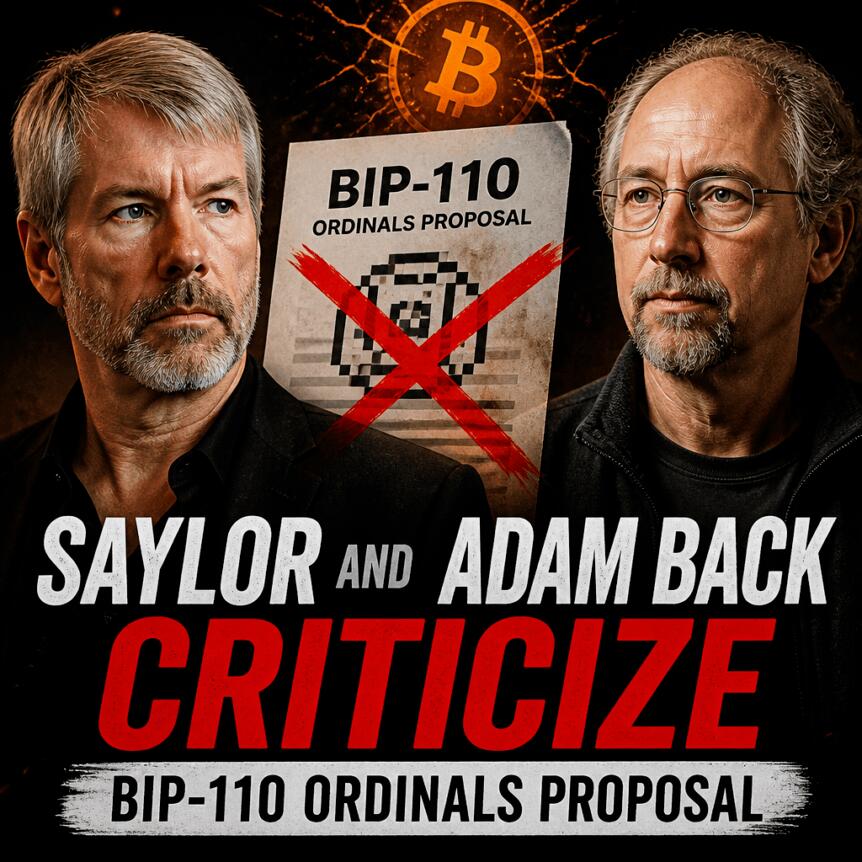
Strategy executive chairman Michael Saylor and Blockstream CEO Adam Back have renewed their opposition to Bitcoin Improvement Proposal 110 (BIP-110), a proposed temporary protocol fork aimed at curbing “non-monetary” data on the network, including Ordinals-style inscriptions.
The debate has taken on the tone of another major Bitcoin governance dispute, with both sides framing the proposal as either a necessary defense of Bitcoin’s core purpose or an unnecessary risk to network credibility. According to Saylor, BIP-110 could even invalidate ordinary transactions.
Key takeaways
- Supporters position BIP-110 as a short-term way to reduce Ordinals-like “arbitrary data” that they say contributes to network bloat.
- Saylor and Back argue a fork would do more harm than good, warning it could undermine Bitcoin’s reliability and permissionless ethos.
- BIP-110 is unlikely to pass: activation requires 55% of validating nodes to signal support during a Bitcoin block period, and recent signaling has been minimal.
- Ordinals activity appears far lower than its 2023 peak, which may weaken the case for urgent protocol-level intervention.
Why Saylor and Back say a fork is the wrong remedy
Saylor’s criticism centers on the potential downstream effects of the proposal. In an X post on Saturday, he argued that “110 things more dangerous to Bitcoin than spam” exist, adding that BIP-110 could invalidate ordinary transactions on the network. He cited concerns that attempting to police the type of data allowed could spill over into broader transaction compatibility issues.
Back’s objection is both philosophical and practical. In a separate X post, he described BIP-110 as a “quest to police other people,” arguing that Bitcoin’s decentralization means no single group should be able to force its preferences onto everyone else. Back framed the proposal as conflicting with Bitcoin’s cypherpunk foundation of permissionless, censorship-resistant money.
While both executives agree that “spam” concerns are real enough to discuss, their shared view is that a protocol fork introduces risk that may exceed the problem it targets.
How BIP-110 would need to be adopted—and why it’s struggling
BIP-110 would not activate unless 55% of Bitcoin nodes validating blocks signal support for the proposal during a specific Bitcoin block “period.” That threshold makes the proposal inherently difficult to win, and the most recent signaling data points to a lack of momentum.
During period number 475—covering blocks 955,584 to 957,599—only about 1% of blocks were supportive of BIP-110, according to the figures cited in the reporting. The proposal therefore remains a long shot rather than an imminent network change.
This activation mechanism also underscores what’s at stake in the current dispute: unlike mere software debates or policy disagreements, BIP-110 would require broad, explicit participation from validating nodes to proceed.
Ordinals activity is much lower than its peak—does urgency still hold?
The controversy is unfolding while Ordinals activity is reported to be near all-time lows. Over the last month, fewer than 10,000 Ordinals inscriptions have been added to the Bitcoin blockchain per day, according to data from Dune Analytics referenced in the article. That is a sharp contrast to the more than 400,000 daily inscriptions recorded during the height of Ordinals in August 2023.
For observers, the timing creates tension. If the “data spam” problem is already fading, critics argue the incentive to rush a protocol fork diminishes—especially given the network-level risks of incompatible transaction behavior or credibility damage.
For proponents, the lower current activity could still be interpreted as evidence that a temporary constraint would prevent any resurgence and reduce the odds of future bloat. Yet on the other side, the reduced activity also weakens the argument that the network requires urgent, last-mile protocol changes right now.
The protocol fight echoes earlier Bitcoin governance battles
The BIP-110 dispute is being compared to earlier high-stakes moments in Bitcoin’s development history. The article notes that it resembles the kind of ecosystem-level division seen during the Blocksize Wars of 2015–2017, when participants debated whether changing the block size limit was worth risking a chain split for scalability.
BIP-110 was introduced by pseudonymous Bitcoin developer “Dathon Ohm,” with support mentioned from Ocean protocol founder Luke Dashjr. The proposal is framed as a response to Ordinals-driven “bloat,” which some advocates describe as a serious threat to the network. Proponents have also argued that BIP-110 would not cause a chain split—an expectation that critics will likely view skeptically given how contentious past protocol amendments have been.
Supporters further claim that BIP-110’s effect would be limited in time—described as imposing a temporary one-year cap—so they argue it would not invalidate fee-paying transactions in the long run. Even so, the disagreement remains fundamentally about how far Bitcoin developers should go in restricting data or changing validation rules, versus relying on user norms, enforcement at the margins, or other non-fork approaches.
With activation still far from realistic—given the low share of supportive blocks in the last signaling period—readers should watch whether node signaling changes and whether Ordinals activity remains subdued. The broader question will be whether the community treats the fork as a prudent safety valve or an avoidable governance overreach as the Ordinals debate evolves.
https://www.cryptobreaking.com/saylor-and-adam-back-criticize-2/?utm_source=blogger%20&utm_medium=social_auto&utm_campaign=Saylor%20and%20Adam%20Back%20Criticize%20BIP-110%20Ordinals%20Proposal%20
Comments
Post a Comment