
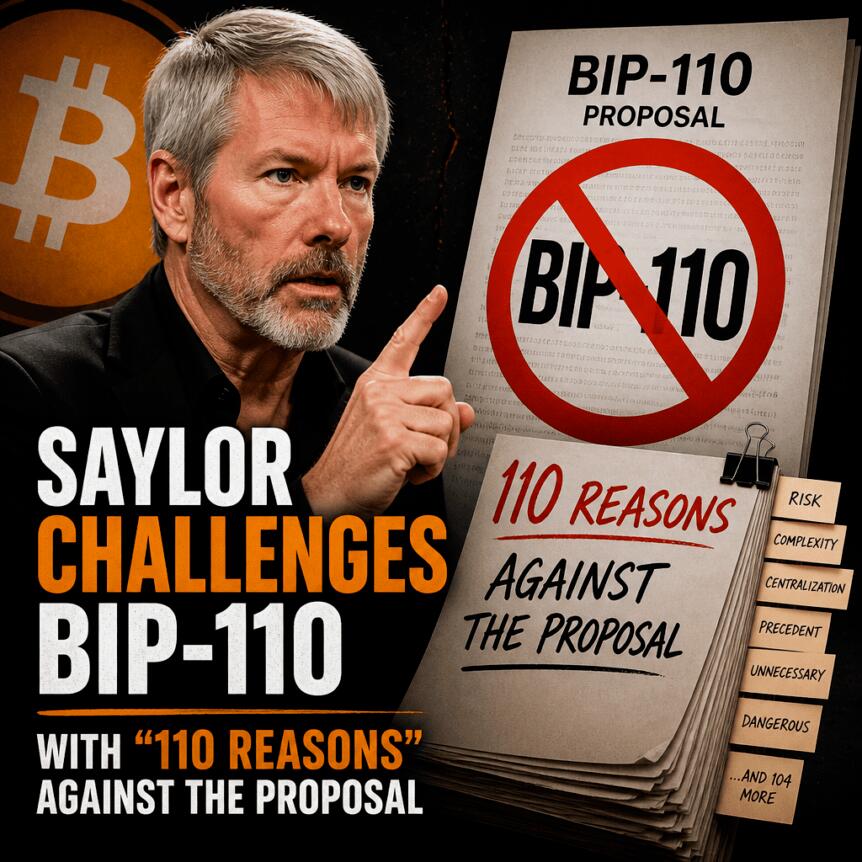
Bitcoin’s internal debate over how to curb network spam and non-monetary data has intensified after Michael Saylor published a detailed critique of Bitcoin Improvement Proposal 110 (BIP-110). In a long post on X.com dated Sunday, Saylor argued that a proposed temporary fork to restrict certain types of data on the Bitcoin network is the wrong solution—despite acknowledging that the underlying concerns raised by supporters are legitimate.
Introduced in December 2025, BIP-110 has become one of the more prominent protocol-level disputes in the Bitcoin development community since the Blocksize Wars of 2015–2017, when scalability questions sparked intense disagreement over whether changes should risk a chain split. Saylor’s intervention comes as Ordinals activity has cooled from its 2023 peak, raising questions about how urgent such a protocol change really is.
Key takeaways
- Saylor supports the goals behind BIP-110—such as protecting validation and affordable payments—but rejects the proposal’s mechanism as a remedy.
- BIP-110 would only move forward if 55% of validating nodes signal support during a Bitcoin “block period,” and recent support levels have been low.
- Ordinals inscriptions have fallen sharply from their August 2023 highs, potentially reducing the immediate pressure driving urgency for protocol-level fixes.
- The debate mirrors past governance tensions, including the Blocksize Wars, where disagreements over enforcement and network rules frequently threatened to split the ecosystem.
Saylor’s critique: shared goals, different fix
According to Saylor’s post on X.com, his argument is aimed at the proposal itself rather than people who support it. He said many Bitcoiners he respects back BIP-110 for reasons including keeping validation accessible, shielding node operators from unwanted costs, preserving low-cost payments, and preventing Bitcoin from drifting into general-purpose data storage.
Saylor emphasized that he agrees with those objectives but disagrees with the proposed remedy. In the same post, he framed his stance as a call to preserve “neutral rules, hard consensus, open markets, and permissionless innovation,” while stressing that vigorous disagreement should not turn into personal factionalism.
As of Sunday at 12 p.m. ET, Saylor’s post had accumulated 879,000 views, along with 692 replies and 852 retweets, highlighting how quickly the discussion has spread beyond core developer circles.
What BIP-110 would change—and why approval is difficult
Protocol changes like BIP-110 are not automatically activated; they depend on broad agreement among validators. BIP-110 cannot be enacted unless 55% of Bitcoin nodes validating blocks signal support for the proposal during a Bitcoin block “period.”
Based on the latest period referenced in reporting, period number 475—covering blocks 955,584 to 957,599—showed only about 1% of blocks in support. That figure suggests that, even if the proposal is technically live for discussion, it currently lacks the signaling momentum required for activation.
This approval threshold matters for investors and operators because it determines whether the change is likely to take effect in practice versus remaining a contested idea within the dev community. A proposal that fails to reach the required support level may still influence future policy debates, but it is less likely to produce immediate network-level consequences.
The spam-bloat dispute meets a cooling Ordinals market
The BIP-110 controversy is tied to concerns about “non-monetary transactions” and data patterns that proponents describe as spamming. BIP-110 was introduced to limit Ordinals-style inscriptions and other arbitrary data that supporters argue can overload the network and distract from Bitcoin’s primary function as peer-to-peer cash.
However, the political and technical urgency of such proposals is harder to gauge when on-chain activity is shifting. The dispute comes while Ordinals activity is reported to be near all-time lows. According to Dune Analytics data cited in the source material, fewer than 10,000 Ordinals are inscribed into the Bitcoin blockchain daily over the last month—down from more than 400,000 per day during its peak in August 2023.
Lower inscription volumes can change the risk calculus for both sides of the debate. Supporters of protocol limits may argue that even reduced activity can still set harmful precedents for how data is used on-chain. Opponents may counter that if demand and congestion pressure have already eased, a fork—especially one that introduces restrictions—becomes harder to justify without more consensus.
Backers, critics, and echoes of earlier Bitcoin governance fights
BIP-110 was introduced by pseudonymous developer “Dathon Ohm,” with backing that includes Ocean protocol founder Luke Dashjr, according to the source. On the opposition side, Blockstream CEO Adam Back is cited as a vocal critic of BIP-110.
Back has previously described the proposal as an attempt to police other people, arguing that Bitcoin’s decentralization should prevent any faction from imposing its preferred rules on the broader community. The objection is framed not only as technical but ideological—rooted in the cypherpunk principle of permissionless, censorship-resistant money.
Meanwhile, supporters of BIP-110 argue that Ordinals-driven bloat represents a serious threat that demands action. They also maintain that BIP-110 would not cause a chain split, a concern raised by those wary of temporary restrictions. Supporters further argue the fork is intended to be limited—described as a one-year constraint—so that it would not invalidate fee-paying transactions over the long run.
These arguments have led to parallels with the Blocksize Wars between 2015 and 2017, when disagreements over how to scale Bitcoin and whether to risk contentious changes sharpened into a broader debate about enforcement and legitimacy. In both cases, the underlying question is the same: how should the network evolve under pressure while preserving decentralized governance?
In this current cycle, the data points being used by each side are not symmetrical. Saylor is not denying that bloat concerns exist; he is questioning whether the governance approach—introducing temporary restrictions through a fork-like mechanism—is compatible with Bitcoin’s broader commitment to neutrality and hard consensus. At the same time, low recent Ordinals activity weakens one common justification for immediate intervention: that the network is actively under severe strain from inscriptions.
As the debate continues, readers should watch two things closely: whether BIP-110’s support signals rise toward the 55% activation threshold in subsequent block periods, and whether Ordinals activity meaningfully returns or stays subdued. Those developments will likely determine whether the proposal remains a theoretical flashpoint—or becomes a real test of how Bitcoin manages conflict over data usage and network rules.
https://www.cryptobreaking.com/saylor-challenges-bip-110-with/?utm_source=blogger%20&utm_medium=social_auto&utm_campaign=Saylor%20Challenges%20BIP-110%20With%20“110%20Reasons”%20Against%20the%20Proposal%20
Comments
Post a Comment