
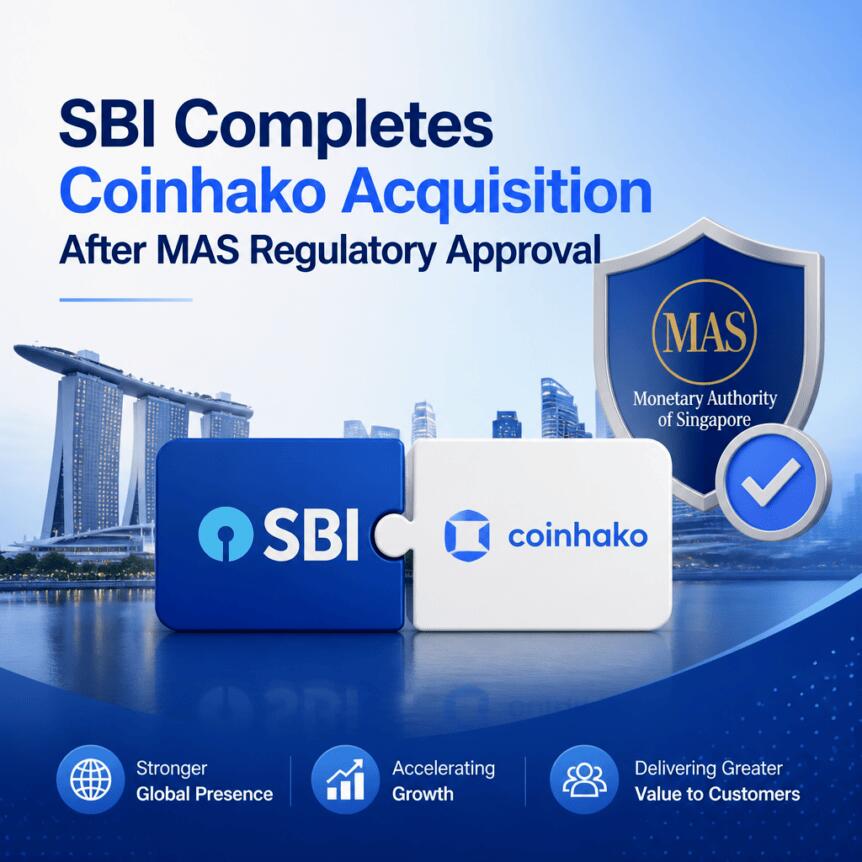
SBI Holdings has secured regulatory approval from Singapore’s central bank to take control of Holdbuild, the parent company behind crypto exchange Coinhako, completing a deal that strengthens the Japanese financial group’s footprint in Southeast Asia.
In a statement released Thursday, SBI said it received authorization from the Monetary Authority of Singapore (MAS), allowing the company to acquire shares from existing shareholders via a capital injection. Following the transaction, Coinhako will become a consolidated subsidiary of SBI.
Key takeaways
- SBI’s majority stake in Coinhako was enabled by MAS regulatory approval, making the acquisition effective through a capital injection.
- Coinhako operates under a Major Payment Institution license in Singapore via its subsidiary, Hako Technology Pte. Ltd.
- SBI plans to combine Coinhako’s customer base and regional network with its own financial services and digital asset initiatives.
- SBI’s strategy in Asia is advancing through a mix of acquisitions and infrastructure-building, including tokenization and stablecoin-related efforts.
Regulatory green light in Singapore
The move hinges on MAS authorization, which SBI said was a prerequisite to completing its majority acquisition of Holdbuild. Once the capital injection was carried out, SBI positioned Coinhako for consolidation within its group structure.
For Coinhako, the Singapore compliance framework matters. The exchange holds a Major Payment Institution license under MAS through Hako Technology Pte. Ltd., the operating subsidiary referenced in coverage of the transaction. That regulated footing is one reason the approval process is closely watched by market participants evaluating how smoothly crypto businesses can scale in highly supervised jurisdictions.
From February intent to majority control
SBI first disclosed its intention to buy a majority stake in Coinhako in February, signaling an expansion beyond Japan into a market it described as strategically important for digital assets. The latest announcement confirms that the deal cleared Singapore’s regulatory gatekeeping, turning a planned move into an operational corporate change.
While SBI did not provide financial details, its structure of acquisition—purchasing shares from existing holders through additional funding—suggests a direct ownership consolidation rather than a partnership model. For investors and industry watchers, that difference typically affects how future growth initiatives can be managed, financed, and integrated across the parent and subsidiary.
How SBI says it will use Coinhako
According to SBI, the acquisition is designed to merge Coinhako’s customer base and regional distribution capabilities with SBI’s broader financial services and digital asset businesses. The company specifically pointed to its JPYSC stablecoin initiative as part of its longer-term integration plans.
Such linkages are meaningful because stablecoin infrastructure and regulated exchange distribution can reinforce each other: exchange users often serve as on-ramps for stablecoin settlement and collateral use cases, while stablecoin rails can improve how value moves across services. SBI’s stated intent indicates it is aiming to align its Singapore presence with its payments and tokenization direction.
Financial terms of the transaction were not disclosed, and SBI did not immediately respond to a request for additional deal details. That leaves several practical questions open for the market, including the pace of operational integration and whether Coinhako’s product suite will be expanded with SBI-linked services.
SBI’s wider push across digital assets and tokenization
This acquisition fits within a broader pattern of SBI expanding in digital assets through investments, acquisitions, and infrastructure. Earlier this month, SBI led a $76 million Series C funding round for institutional crypto exchange EDX Markets, positioning the group in markets aimed at professional trading. SBI also previously shared plans to acquire Bitbank for $289 million, a move intended to build one of Japan’s largest crypto exchange platforms.
Beyond exchange ownership, SBI has been investing in the infrastructure layer. The company partnered with Ondo Finance to bring tokenized Japanese stocks and to integrate its JPYSC stablecoin for settlement and collateral, according to reporting that circulated this week. Earlier, SBI and Startale Group unveiled Strium, a layer-1 blockchain focused on tokenized securities and real-world assets, with designs intended to support continuous trading and tokenized equity settlement for institutional applications.
Taken together, SBI’s approach appears to be converging three areas: regulated distribution (via exchanges), tokenized asset issuance and settlement (via blockchain and tokenization efforts), and stablecoin utility (via JPYSC). Coinhako’s regulated status in Singapore and its regional network could give SBI a clearer pathway to deploy those capabilities outside Japan.
What to watch next
Readers should watch for how SBI operationally integrates Coinhako—particularly around stablecoin-related settlement and collateral use cases—and whether Coinhako’s product offerings expand in step with SBI’s tokenization and blockchain infrastructure. With MAS approval already in hand, the next milestones are likely to be execution details: integration timelines, governance changes, and any new regional initiatives announced after consolidation.
https://www.cryptobreaking.com/sbi-completes-coinhako-acquisition-after/?utm_source=blogger%20&utm_medium=social_auto&utm_campaign=SBI%20Completes%20Coinhako%20Acquisition%20After%20MAS%20Regulatory%20Approval%20
Comments
Post a Comment