
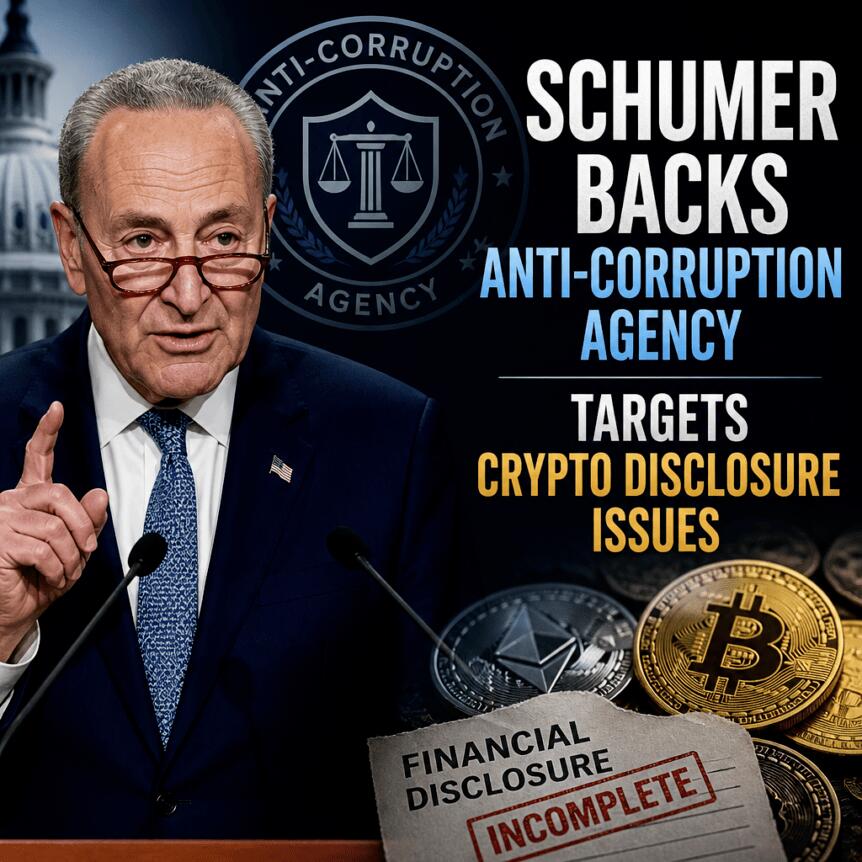
Senate Minority Leader Chuck Schumer has introduced legislation aimed at creating a dedicated US anti-corruption bureau, arguing that existing oversight is not designed to stop presidents from profiting while in office—an accusation he ties directly to President Donald Trump’s cryptocurrency-related investments.
Schumer’s proposal, the Anti-Corruption Bureau Creation Act, would establish a new federal agency with authority to “investigate, enforce, and prevent executive branch corruption,” according to a Thursday announcement from Schumer’s office. The bill also seeks to consolidate key ethics and enforcement bodies under one roof—an approach lawmakers supporting the measure say could strengthen accountability more than the current “patchwork” of watchdogs.
Key takeaways
- Schumer’s bill would create a new federal anti-corruption bureau with investigative, enforcement, and preventive powers focused on executive branch conduct.
- The legislation points to reported Trump earnings from investments, including cryptocurrency exposure, as part of a broader argument for tighter safeguards.
- The proposed bureau would incorporate the Federal Election Commission, the Office of Government Ethics, and the Office of Special Counsel into a single structure.
- Supporters are also pushing the measure alongside continued negotiations over the Senate’s crypto market-structure effort, the CLARITY Act, which still lacks a scheduled vote.
- Even if the bureau legislation clears Congress, Trump could veto it; overriding a veto would require a two-thirds majority in both chambers.
A new enforcement model pitched as a response to crypto-related conflicts
In a statement released with the bill introduction, Schumer said he had introduced the Anti-Corruption Bureau Creation Act to address executive branch corruption more directly. The proposal is built around Congress’ findings—stated in the bill text—that Trump disclosed earning more than $2 billion from investments in 2025, including $1.4 billion associated with cryptocurrency, and that his family holds more than $1 billion in a crypto fund tied to foreign governments.
Schumer framed the new agency as having “real teeth,” emphasizing that it would include enforcement authority rather than acting only as a monitor. He also said the bureau would be staffed by a bipartisan group of seven members confirmed by the Senate.
To address remedies for wrongdoing, the bill includes mechanisms allowing private citizens and state authorities to pursue recovery of funds that Schumer described as stolen from Americans “through corruption.”
“This new bureau is one where these institutions work in symbiosis, strengthening each other and eliminating barriers between them which often got in the way,” Schumer said. “It replaces a broken patchwork of watchdogs, none of which were built for this moment, with one, powerful anti-corruption agency, ready to act anywhere, anytime corruption strikes.”
White House pushes back on conflict claims tied to investment accounts
The anti-corruption push arrives amid persistent Democratic criticism of Trump’s involvement in the crypto industry while in office. Schumer’s office noted concerns that have also hovered over the Senate’s broader crypto policy effort, the Digital Asset Market Clarity (CLARITY) Act.
While the White House agreed to certain ethics provisions in CLARITY, many lawmakers have argued those changes do not adequately address potential conflicts of interest.
In a statement to Cointelegraph, White House Principal Deputy Press Secretary Anna Kelly reiterated the administration’s position that there were “no conflicts of interest” related to Trump’s investments. Kelly said the investments were “held in fully discretionary accounts managed by independent third-party financial institutions.”
Consolidating ethics and enforcement under one “roof”
A notable feature of Schumer’s bill is its plan to reorganize parts of the federal oversight landscape. The proposal would place the US Federal Election Commission, the Office of Government Ethics, and the Office of Special Counsel “under one roof” within the new bureau.
The intent, as described in Schumer’s remarks, is to reduce the friction between agencies and streamline action when corruption is alleged—an argument he made by contrasting the proposed bureau with what he characterized as outdated or mismatched oversight structures.
Schumer introduced the bill with cosponsors Andy Kim, Alex Padilla, and Jeff Merkley.
What’s happening with the Senate’s CLARITY Act remains uncertain
Schumer’s anti-corruption initiative is moving alongside a separate, more technical fight in the Senate: whether and when the CLARITY Act will advance.
The article notes that the Senate has just over a week before lawmakers break for a month-long state work period. That calendar pressure is heightening uncertainty for pending legislation, including CLARITY, especially as lawmakers face the prospect of competing priorities ahead of the 2026 midterms.
As of Thursday, the Senate had not scheduled a vote on the CLARITY Act, despite encouragement from some Republican lawmakers and industry figures. Former Securities and Exchange Commission official John Reed Stark said the situation is difficult to predict, describing “enormous drama” surrounding the bill and stating that experts he spoke with could not confidently forecast what would happen that week.
Industry leaders have also signaled confidence while acknowledging timing risks. Coinbase CEO Brian Armstrong said the bill was at the “one-yard line,” while Senator Cynthia Lummis continued pushing for a vote, according to posts cited in the report.
Legislative math: momentum doesn’t eliminate veto risk
Even if Schumer’s anti-corruption bureau legislation gains traction, it still faces major hurdles. The bill would require Republican support in both chambers to pass, with the party holding only a slim majority in the Senate. If it clears the Senate and House before 2028, President Trump could still veto the legislation.
Overriding a presidential veto would require a two-thirds majority in both the House and Senate, leaving the outcome dependent on whether Democrats can sustain enough cross-party backing.
For crypto watchers, the near-term focus is likely to split: whether the Senate can find a path forward on the CLARITY Act before its schedule runs out, and whether Schumer’s anti-corruption bureau proposal gains enough bipartisan traction to survive both legislative and veto thresholds—especially given the ongoing dispute over how (or whether) current ethics arrangements address potential conflicts tied to crypto.
https://www.cryptobreaking.com/schumer-backs-anti-corruption-agency/?utm_source=blogger%20&utm_medium=social_auto&utm_campaign=Schumer%20Backs%20Anti-Corruption%20Agency,%20Targets%20Crypto%20Disclosure%20Issues%20
Comments
Post a Comment