SEC Reviews 24-Hour Trading for U.S. Stock Markets


The SEC in the U.S. is scheduled to review the future of longer hours of the stock market after multiple exchanges in the nation have embarked on the journey of adopting trading that goes on almost through the day and night.


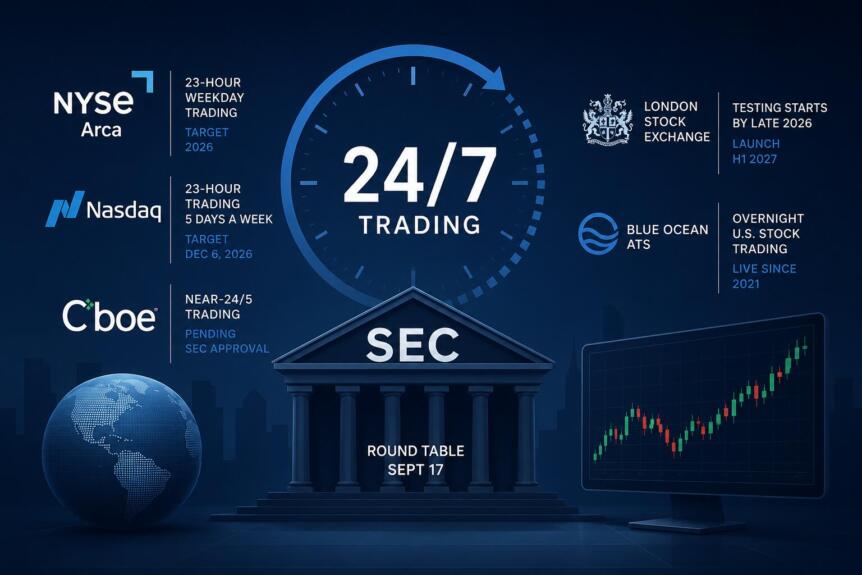
In a post made by Coin Bureau on X, it has been revealed that the SEC will organize a roundtable meeting on September 17, 2026 to discuss the implications of 24-hour trading in American financial markets.


SEC Plans Roundtable on Extended Trading Hours


According to Coin Bureau, it is reported that the SEC plans to organize a roundtable meeting to discuss the adoption of 24-hour trading for the U.S. stock exchange markets. The meeting will be held on September 17 and will revolve around the impact such changes will have on trading operations and the trading infrastructure.


The decision comes after rising interest from exchanges looking to extend their trading times. Even though the SEC has not granted permission for a national conversion to 24-hour trading, the discussion is a clear indication that the regulator is assessing proposals by exchanges.


Major Exchanges Advance 23-Hour Trading Plans


NYSE Arca is set to roll out 23-hour trading on weekdays and hopes for an implementation in 2026, based on information cited by Coin Bureau.


Nasdaq is planning to initiate 23-hour trading from December 6, 2026.


In the meantime, Cboe plans to roll out nearly 24/5 trading pending approval from the Securities and Exchange Commission. Across the globe, the London Stock Exchange is set to commence trials of extended hours trading by the end of 2026 and roll out a more comprehensive implementation in the first half of 2027.


Blue Ocean ATS Already Operates Overnight Trading


In contrast to other exchanges that are currently in the process of formulating their proposals, Blue Ocean ATS has provided its users with overnight U.S. stock trading since 2021. The company's current system shows that an extended trading setup is operational, but it is used by a different category of customers.


With an increase in applications from exchanges for extending their trading periods, investors will have greater freedom to react to events beyond regular trading hours. Any further implementation will be subject to regulators' decisions after their review process at the SEC.


Crypto Markets Provide a Reference for Continuous Trading


The cryptocurrency trading markets, from inception, have followed a trading model that is operational for 24 hours a week without market hours constraints. The current propositions being made by exchanges seem to indicate an increasing desire to extend similar flexibility to equity traders.


As things stand now, the SEC's roundtable discussion is what constitutes the next phase in determining how extended trading can be integrated into the American financial framework. In any case, any modifications to market hours will have to be first sanctioned by the regulators.


https://www.cryptobreaking.com/sec-reviews-24-hour-trading/?utm_source=blogger%20&utm_medium=social_auto&utm_campaign=SEC%20Reviews%2024-Hour%20Trading%20for%20U.S.%20Stock%20Markets%20

Comments

Popular posts from this blog

Mastercard Launches AI Agent Pay System With Ripple and Solana Help

Mastercard has launched Agent Pay for Machines, a payments system built for autonomous software agents. The service allows AI agents to send and receive payments without direct human action. It brings Ripple, Coinbase, and Solana Foundation into Mastercard’s push for automated digital commerce. Ripple Brings XRPL and RLUSD to Mastercard’s Agent Pay System Mastercard introduced Agent Pay for Machines on June 10 as a tool for machine-led payments. The system targets high-volume and low-value transactions across business and consumer use cases. It also supports automated settlement between software agents and connected machines. Ripple will support the system through the XRP Ledger and its RLUSD stablecoin. The company said that settlement will become more important as automated commerce grows. It also sees blockchain rails as useful for fast and rule-based payments. RippleX senior vice president Markus Infanger said XRPL and RLUSD support enterprise-grade agent payments. He said the tool...

Coinbase's x402 launches AI agents app store for payments

Coinbase-backed x402 has unveiled Agentic.market, a dedicated marketplace aimed at increasing the usefulness of AI agents by aggregating thousands of apps and services that agents can access without any API keys. The rollout positions the platform as a central hub for agents to discover, evaluate, and deploy capabilities across a standardized payments layer. Coinbase product lead Nick Prince described Agentic.market in a video posted on X as a storefront for discovering, comparing, and using x402 services. The marketplace is designed to give both humans and their AI agents access to a wide range of tools—from data feeds to consumer apps—without the friction of managing API credentials. A storefront for discovering, comparing, and using x402 services. Thousands of services. Zero API keys. Powered by x402. Prince added that the market offers a web interface for humans to browse and assess services, alongside a programming layer that lets AI agents autonomously search, filter, and integra...

Solana Policy Institute Calls on SEC to Safeguard DeFi Developers from Overly Strict Regulations

US Crypto Policy Innovation: Advocates Push for Clear Regulations and Developer Protections The Solana Policy Institute has urged the U.S. Securities and Exchange Commission (SEC) to differentiate between centralized crypto exchanges and non-custodial decentralized finance (DeFi) software. The nonprofit emphasizes that developers creating and publishing non-custodial code should not be classified as intermediaries, advocating for balanced regulation that fosters innovation without compromising security or legality. Key Takeaways Advocates call for regulatory clarity distinguishing between non-custodial DeFi protocols and centralized exchanges. The Institute argues that applying traditional securities laws to DeFi code risks stifling innovation and pushing activity offshore. Authorities are encouraged to adopt a custody-and-control-based framework to clarify legal liabilities. Legislation proposals aim to shield developers from legal liabilities associated with blockchain code and activ...