
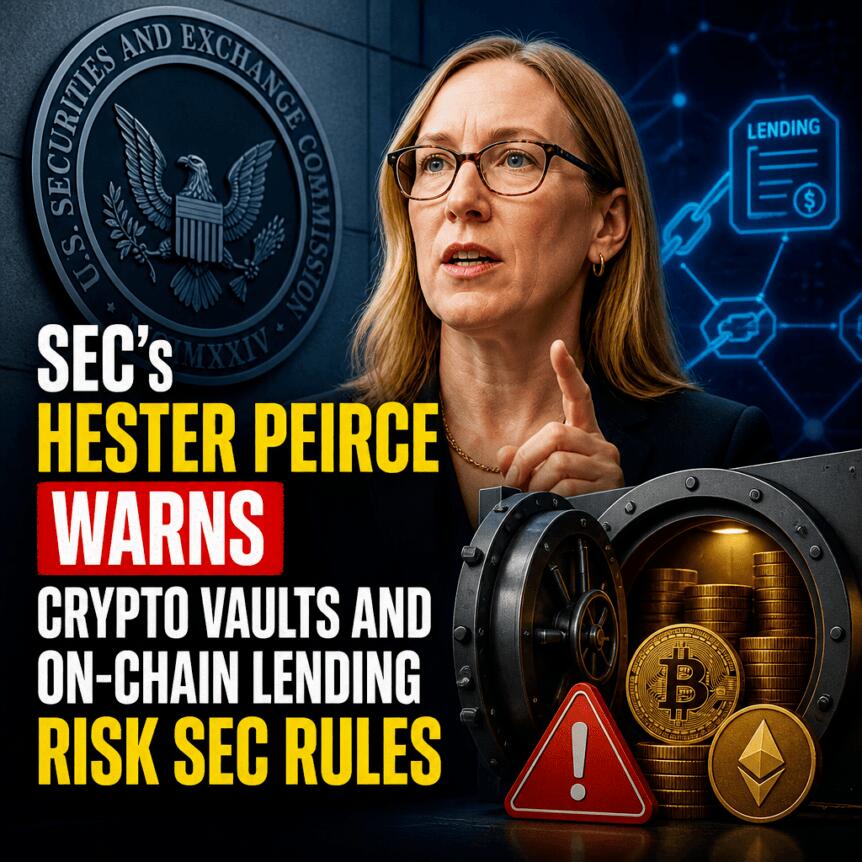
U.S. SEC Commissioner Hester Peirce has warned that crypto “vaults” and onchain lending products may fall within federal securities laws—especially when the design involves discretionary decisions about how user assets are managed. In a statement released Wednesday, Peirce focused on strategies where operators actively determine key parameters such as asset allocation, the choice of yield activities, lending terms, and even liquidation thresholds.
The remarks arrive as onchain yield products continue to proliferate and are increasingly packaged for retail and institutional users. Peirce emphasized that shifting activity onto a blockchain does not automatically remove it from securities-law scrutiny, urging developers and operators to assess compliance early rather than after launch.
Key takeaways
- Peirce said crypto vaults and lending strategies that use discretionary management decisions may be subject to U.S. securities laws.
- Some vault structures could potentially be treated as securities offerings or investment companies, depending on how they operate.
- Operators who control allocation choices or lending parameters may also face investment adviser regulatory exposure.
- Whether certain onchain loans qualify as securities depends on how they are structured, distributed, and used.
Why “onchain” doesn’t automatically mean “outside” securities law
Peirce’s statement targets a common assumption in parts of the crypto market: that moving asset-management mechanics onto a blockchain somehow changes the legal analysis. She argued that it does not, stating that moving activities that fall within federal securities laws to onchain systems does not remove those activities from the laws the SEC enforces.
Her core point is functional rather than technical. When product logic or operational design results in users’ returns being driven by decisions that resemble investment management—such as choosing where funds are allocated, what yield strategy is used, what lending terms apply, or when liquidations occur—the SEC’s jurisdiction may come into play. Peirce said the applicability of federal securities laws would vary based on the vault or lending product’s structure and operation.
How vaults and lending strategies could trigger securities-related requirements
Peirce said some crypto vaults could fall into categories that are historically associated with securities offerings or investment companies. She also suggested that the parties setting or managing vault allocations and the parameters of lending strategies could trigger investment adviser requirements, again depending on who makes the relevant decisions and how.
She further noted that even certain onchain loans may qualify as securities based on how they are structured, distributed to users, and used in practice. This matters for the industry because it reframes regulatory risk around product behavior and decision-making—rather than whether the product uses smart contracts, custody models, or decentralized interfaces.
For developers, the message is straightforward: if a product involves discretionary choices about how user assets are deployed to pursue yield, it may need legal review to determine whether it is functioning as a regulated investment product.
Onchain yield products keep expanding despite regulatory scrutiny
Vault-style yield offerings have grown rapidly this year, with companies packaging DeFi strategies into products that aim to make returns and risks more accessible. Instead of requiring each user to individually select lending venues, liquidity pools, and risk controls, these products often present strategy comparisons and automated execution.
Earlier this year, Sentora opened its Smart Yield platform to the public in April, positioning it as a way for users to compare DeFi vaults based on strategy, yield, and risk metrics. Wallet in Telegram also launched self-custodial Bitcoin, Ether, and USDT vaults earlier, offering automated yield generation while avoiding a centralized custodian model—an approach designed to reduce custody friction for users.
Separately, Kraken rolled out a Bitcoin vault in May. According to earlier coverage, the offering targeted up to 2.5% variable APY by deploying wrapped Bitcoin into decentralized lending protocols including Aave and Morpho, with rewards paid in Bitcoin and varying with borrowing demand in the underlying markets.
These developments illustrate a key tension: vault products are increasingly marketed as convenient wrappers around DeFi strategies, but Peirce’s comments suggest convenience and packaging do not necessarily limit securities-law questions if discretion or investment management-like decision-making is embedded in product design.
Operational and technical risks remain—regulation could add another layer
Beyond legal exposure, vaults and yield strategies can also create technical risk for users. In December, DeFi protocol Yearn disclosed an exploit affecting its legacy yETH yield vault, reporting roughly $9 million impacted, while stating that its V2 and V3 vaults were not affected.
If regulators determine that certain vault offerings fall under federal securities laws, operators could face additional compliance obligations—such as SEC registration or qualification for exemptions, along with disclosure requirements and related regulatory duties. For product teams, this could significantly change how they structure governance, decision-making rights, user communications, and risk disclosures.
At the same time, Peirce’s statement suggests the legal analysis is not a blanket “DeFi equals securities.” Instead, it depends on what the product does in practice—especially whether the system (or the people behind it) makes discretionary determinations that affect outcomes for users.
Going forward, market participants should watch how operators describe and operationalize decision-making in vault and lending products, and whether SEC-related guidance or enforcement actions further clarify which onchain structures meet securities-law thresholds. The uncertainty remains high for discretionary strategies, but Peirce’s framing makes the likely direction of scrutiny easier to anticipate: the regulator will focus on investment-like management decisions, not just whether the mechanics are implemented on-chain.
https://www.cryptobreaking.com/secs-hester-peirce-warns-crypto/?utm_source=blogger%20&utm_medium=social_auto&utm_campaign=SEC’s%20Hester%20Peirce%20Warns%20Crypto%20Vaults%20and%20On-Chain%20Lending%20Risk%20SEC%20Rules%20
Comments
Post a Comment