
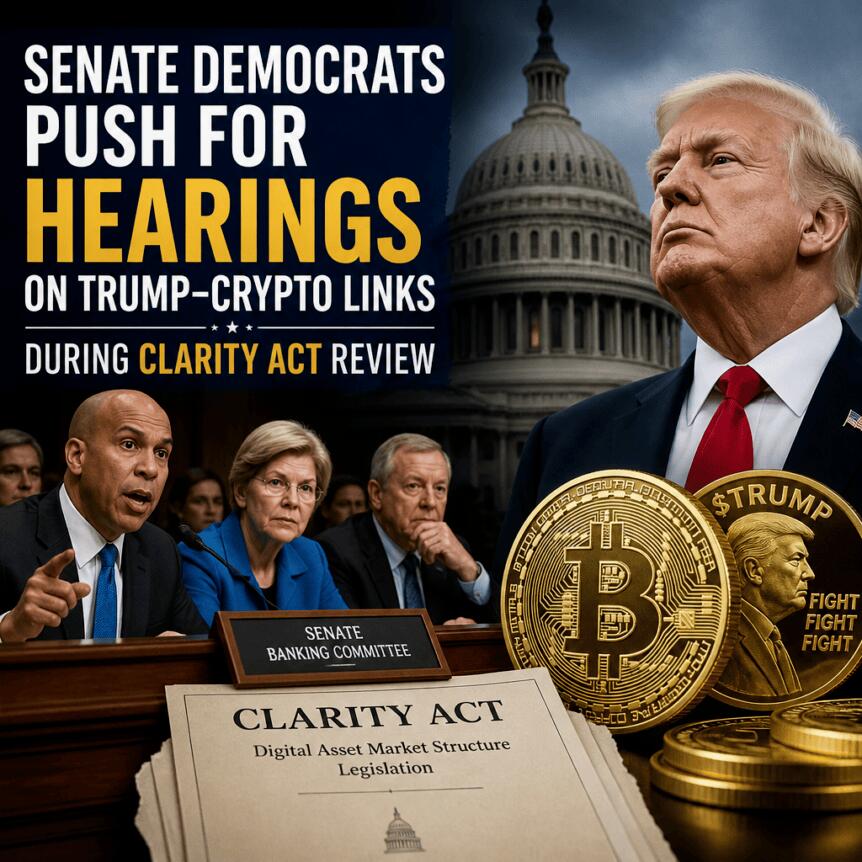
Five Democratic senators have demanded Senate committee hearings to examine the national security implications of President Donald Trump’s cryptocurrency holdings, arguing that disclosure details raise concerns about conflicts of interest as Congress weighs the Digital Asset Market Clarity (CLARITY) Act. The request comes as the bill is set to face a Senate vote this month, with passage requiring significant cross-party support.
In a Friday notice, the Democratic ranking members of five Senate committees and subcommittees said they want lawmakers to scrutinize Trump’s 2025 financial disclosure, in which he reported earning roughly $1.4 billion tied to crypto ventures, including his memecoin and the family’s World Liberty Financial platform. The senators said the reports heighten worries that Trump could be pushing for legislation favorable to an industry he stands to benefit from.
Key takeaways
- Five Democratic Senate ranking members called for committee hearings focused on potential national security risks tied to Trump’s crypto holdings.
- The push cites Trump’s 2025 financial disclosure, which reportedly lists about $1.4 billion in earnings connected to crypto ventures.
- Democrats say the disclosures increase concerns over whether Trump will influence crypto legislation in ways that benefit entities he is linked to.
- Passage of the CLARITY Act in the Senate is expected to require support beyond party lines due to filibuster rules.
- The hearing demand landed shortly before a separate bill containing a ban on Federal Reserve-issued CBDCs is expected to take effect.
Democrats seek hearings over security and disclosure concerns
According to the Friday notice, the senators are asking their respective committees to hold hearings specifically to investigate “the national security implications of President Trump’s cryptocurrency holdings.” The lawmakers also requested scrutiny of “the influence of the United Arab Emirates or unknown third parties on President Trump’s actions,” linking the call to the concerns they described around Trump’s reported crypto exposure.
The notice underscores the political challenge Democrats face in the current legislative environment. As the minority party in both chambers, Democrats generally have less procedural leverage to compel hearings or oversight without Republican buy-in. Still, they used their formal role as ranking members to publicly press the issue and set expectations for committee work.
The senators’ argument is also framed around the timing of the legislative effort. They contend that the disclosure details strengthen the case that Congress should more closely review whether crypto policy is being shaped by personal or business incentives that fall outside standard ethical guardrails.
CLARITY Act vote looms amid ethics demands
The hearing request is closely connected to the trajectory of the CLARITY Act, a bill intended to establish a regulatory framework for digital assets. Democrats have signaled that they could withhold support unless clearer ethics provisions are included, reflecting an emerging standoff over what safeguards should accompany market-structure legislation.
Legislatively, that standoff matters because the Senate’s voting rules create a high bar for moving contested legislation. Under Senate rules, 60 votes are typically needed to overcome a filibuster and advance a bill. While Republicans can set the procedural floor for legislative scheduling, CLARITY’s path is likely to depend on at least some Democratic votes.
Some Senate Republicans have continued to push for CLARITY to advance even as Democrats express reluctance tied to ethics language. Representative French Hill, who chairs the House Financial Services Committee and helped the bill pass in the House in 2025, said in a report earlier this week that Trump’s crypto ties have made the legislation “more complicated,” reflecting how the White House connection may affect bipartisan support.
Separately, earlier coverage from Cointelegraph has highlighted the friction around ethics and market structure, noting that Democrats have been weighing whether the bill includes sufficient conflict-of-interest protections before offering support.
Disclosure scrutiny extends beyond politics into legislative trust
The senators’ push takes aim at a specific question: what oversight is required when the president’s financial disclosures include large-scale involvement with crypto-linked ventures. In the notice, the focus on potential influence—both from named foreign jurisdictions and from “unknown third parties”—moves the debate from ordinary policy disagreements to national security framing.
For investors and builders, the implications are practical rather than purely political. Oversight and hearings can slow legislative timelines, add negotiation points, and influence whether specific ethics provisions become deal-breakers. Even if the market-structure bill ultimately advances, the political conditions around it can shape which sections of CLARITY are adopted and how quickly subsequent rules or enforcement guidance follow.
At the same time, uncertainty remains around what any hearings would concretely determine. The senators’ request is centered on potential risk pathways—such as external influence on presidential decisions—rather than alleging any confirmed wrongdoing. That distinction matters for what Congress may be able to prove during formal testimony.
CBDC ban expected to become law as separate crypto measure advances
While Democrats pressed for hearings on crypto holdings, another crypto-adjacent policy change was set to move forward on a different track. The hearing notice arrived just hours before a bill barring the Federal Reserve from issuing or creating a central bank digital currency (CBDC) until Dec. 31, 2030 is expected to become law on Saturday.
Cointelegraph previously reported on the CBDC ban’s advance and the circumstances surrounding its timing. The current reporting indicates that Trump canceled the signing ceremony for the bipartisan housing legislation containing the CBDC prohibition and did not issue a veto. Because no veto was issued, the measure was expected to automatically become law after 10 days.
That parallel development highlights a split in how Congress is approaching digital-asset policy: while market-structure legislation like CLARITY is facing partisan negotiation over ethics and governance, a CBDC restriction appears to be moving on a more direct legislative track.
Earlier coverage from Cointelegraph has also described CLARITY as facing partisan tension on Senate floor negotiations, particularly around ethics terms—suggesting that lawmakers may be treating different parts of the crypto policy stack with different levels of scrutiny.
For now, the key watchpoints are whether the Senate schedules meaningful committee hearings tied to the disclosure concerns and how ethics provisions are handled as CLARITY approaches its vote. Investors and market participants should also monitor whether bipartisan support solidifies or fractures, since the 60-vote threshold makes the margin for error narrow.
https://www.cryptobreaking.com/senate-democrats-push-for-hearings/?utm_source=blogger%20&utm_medium=social_auto&utm_campaign=Senate%20Democrats%20Push%20for%20Hearings%20on%20Trump–Crypto%20Links%20During%20CLARITY%20Act%20Review%20
Comments
Post a Comment