
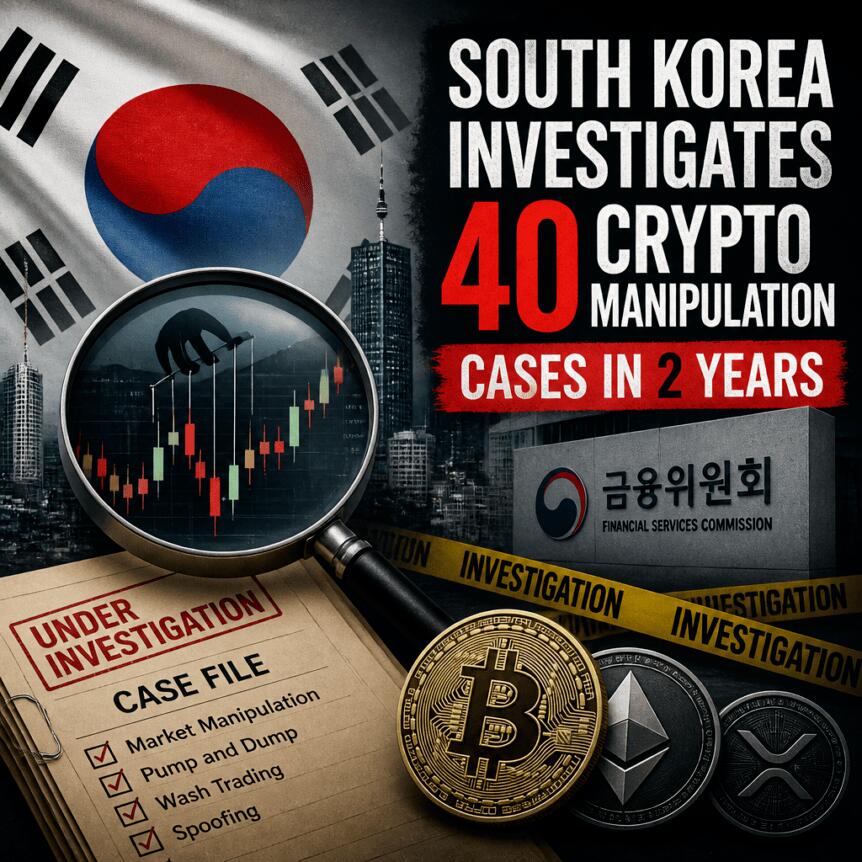
South Korea’s Financial Services Commission (FSC) says it has investigated more than 40 cases of alleged unfair trading involving digital-asset markets over the past two years, ranging from market manipulation to fraudulent crypto trading.
In a post on X, FSC Chair Lee Eog-won reported that 30 of the cases were referred to investigative bodies or reported for further action. He also said the commission identified 25 suspects after the Virtual Asset User Protection Act took effect in July 2024.
Key takeaways
- FSC investigations covered more than 40 unfair trading cases across the past two years, including suspected manipulation and fraud.
- After the Virtual Asset User Protection Act began in July 2024, Lee said the FSC identified 25 suspects and referred or reported 30 cases.
- Lee estimated average unlawful gains at about 1.4 billion won (roughly $940,000) per case.
- The law requires crypto service providers to separate customer deposits and holdings from company assets, with client funds kept in banks.
- South Korea plans to keep expanding AI-assisted surveillance and concentrate on “high-risk areas.”
What the FSC says it has uncovered
Lee Eog-won’s update frames the investigations as a step toward bringing previously less-regulated digital-asset activity under stronger oversight. According to his account, the FSC investigated “more than 40 cases” of alleged unfair trading such as market manipulation and fraudulent trading behavior within the last two years.
Lee added that, within that set of matters, 30 cases were reported or referred to investigative agencies. He linked the period after July 2024—when the Virtual Asset User Protection Act began—to a more structured enforcement pipeline, saying 25 suspects were identified following the law’s implementation.
He also provided an estimate for enforcement economics: average unlawful gains were around 1.4 billion Korean won (about $940,000). While the figure doesn’t break down how gains were calculated in each case, it underlines the FSC’s message that the alleged violations were financially material, not merely technical rule breaches.
How the Virtual Asset User Protection Act changes enforcement
The Virtual Asset User Protection Act is designed to protect users who buy or store crypto assets through regulated virtual asset service providers (VASPs). In practical terms, the FSC highlighted that VASPs must segregate customer deposits and virtual assets from their own corporate holdings.
Under the framework Lee referenced, client deposits are held in banks rather than being commingled with the provider’s own funds. This structure is intended to reduce the risk that customer assets are impaired or diverted if a firm faces operational or financial stress.
The law also targets trading misconduct such as insider trading, wash trading, and market manipulation. Importantly for market participants, the FSC’s role extends beyond licensing and basic compliance: the commission can supervise and inspect VASPs more directly, giving it a clearer enforcement mandate tied to specific categories of prohibited conduct.
Surveillance and AI monitoring—what Lee says will come next
Beyond prosecution and referrals, the FSC chair indicated a continued push to upgrade the monitoring systems used to detect wrongdoing. Lee said the FSC will enhance market surveillance investigation and monitoring systems “based on AI,” and will respond proactively to “high-risk areas.”
That language suggests authorities plan to refine detection for patterns associated with manipulation and other unfair trading tactics, rather than relying solely on post-event investigations. For traders and compliance teams, the key implication is that automated or AI-assisted tools may increasingly shape which activities are flagged, investigated, and escalated for enforcement.
It is also notable that Lee’s update ties enforcement activity to a legal milestone: the second anniversary of the user protection legislation. The emphasis on surveillance capacity—rather than only outcomes—points to an enforcement strategy that seeks earlier identification of misconduct, which can affect how VASPs structure compliance controls and how quickly suspicious behavior is escalated.
Why these enforcement numbers matter to the market
The FSC’s figures—more than 40 investigated cases over two years, with 30 referred or reported and 25 suspects identified after the July 2024 start—serve as a signal to South Korea’s crypto ecosystem that regulatory scrutiny is not limited to paperwork or isolated cases.
For investors, the segregation requirements described by Lee are intended to improve the safety of customer funds. For VASPs, the shift is both operational and reputational: firms must demonstrate that they can comply with asset separation rules while also meeting expectations around market integrity and monitoring.
For traders, the reference to insider trading, wash trading, and market manipulation matters because it underscores that the regulator is actively focused on the mechanics of trading—not just the availability of crypto services. As AI monitoring expands, the compliance burden may increasingly include data-driven controls and more robust reporting processes designed to reduce the risk of violations that authorities can detect and pursue.
Related coverage: South Korea to bring digital assets under new state asset management system.
Going forward, investors and market operators should watch whether the FSC’s AI-assisted surveillance results in a higher rate of referrals and sanctions tied specifically to the law’s protected-user requirements and trading-integrity rules, and whether the average unlawful gains figure is followed by more detailed breakdowns that clarify how investigators assess proceeds and harm.
https://www.cryptobreaking.com/south-korea-investigates-40-crypto/?utm_source=blogger%20&utm_medium=social_auto&utm_campaign=South%20Korea%20Investigates%2040%20Crypto%20Manipulation%20Cases%20in%202%20Years%20
Comments
Post a Comment